Disclaimer: This article provides general information about the potential benefits and risks of computer gaming. It is not intended as medical, psychological, or behavioral advice. If you or someone you know shows signs of gaming addiction, sleep disruption, or related concerns, please consult a qualified healthcare professional.
Modern computer games are far more than entertainment—they're evidence-based tools for developing cognitive and social skills, managing stress, and advancing careers. Below is a structured breakdown with peer-reviewed research, genre examples, real-world applications, and practical tips for maximizing your play sessions while minimizing risks.
Updated: December 2025
At a Glance: Benefits, Risks, and Healthy Play
Top Benefits:
- Faster attention and visual processing (12.7–17.4% speed gains)
- Enhanced problem-solving and strategic thinking
- Improved teamwork and communication
- Stress relief and mood regulation
- Career-ready skills (data analysis, project management, content creation)
Key Risks:
- Overuse (>2h/day for school-age; >3h/day adults)
- Sleep disruption and circadian rhythm changes
- Online toxicity and social isolation if unbalanced
- Microtransaction financial risks
Healthy Gaming Framework:
- Time limits: 1–2 hours/day (ages 6–17); breaks every 60 minutes
- Content ratings: Use PEGI/ESRB filters and parental controls
- Screen hygiene: 20-20-20 rule (every 20 min, look 20 ft away for 20 sec), curfew 1h before sleep
- Balance: Co-play with family 2×/week; log skills and real-world transfer monthly
How General Advantages of the Computer Enabled Modern Gaming
Modern CPU/GPU power, broadband internet, and AI directly empower every computer game. Higher frame rates improve perceived motion and aiming precision; cloud services enable playing at scale; AI enhances NPC behavior and accessibility.
The result? Richer game loops, deeper simulations, and more meaningful experiences that amplify skill acquisition.
Example: NVIDIA GeForce RTX 3070 ensures smooth 144 FPS gameplay with minimal input lag (
According to a 2021 analysis, advanced GPUs reduce cognitive load by maintaining consistent frame times, freeing mental resources for strategic planning rather than fighting technical lag. Cloud gaming platforms (GeForce NOW, Xbox Cloud) further democratize access, allowing players to train skills without costly hardware.
Think about it: when you're running CS2 at 240 FPS, you're not just seeing smoother animations—you're literally giving your brain more data points per second to make split-second decisions. That's a competitive edge, whether you're clutching a 1v3 or timing a skin trade during a market dip.
Top 10 Advantages and Benefits of Playing Computer Games
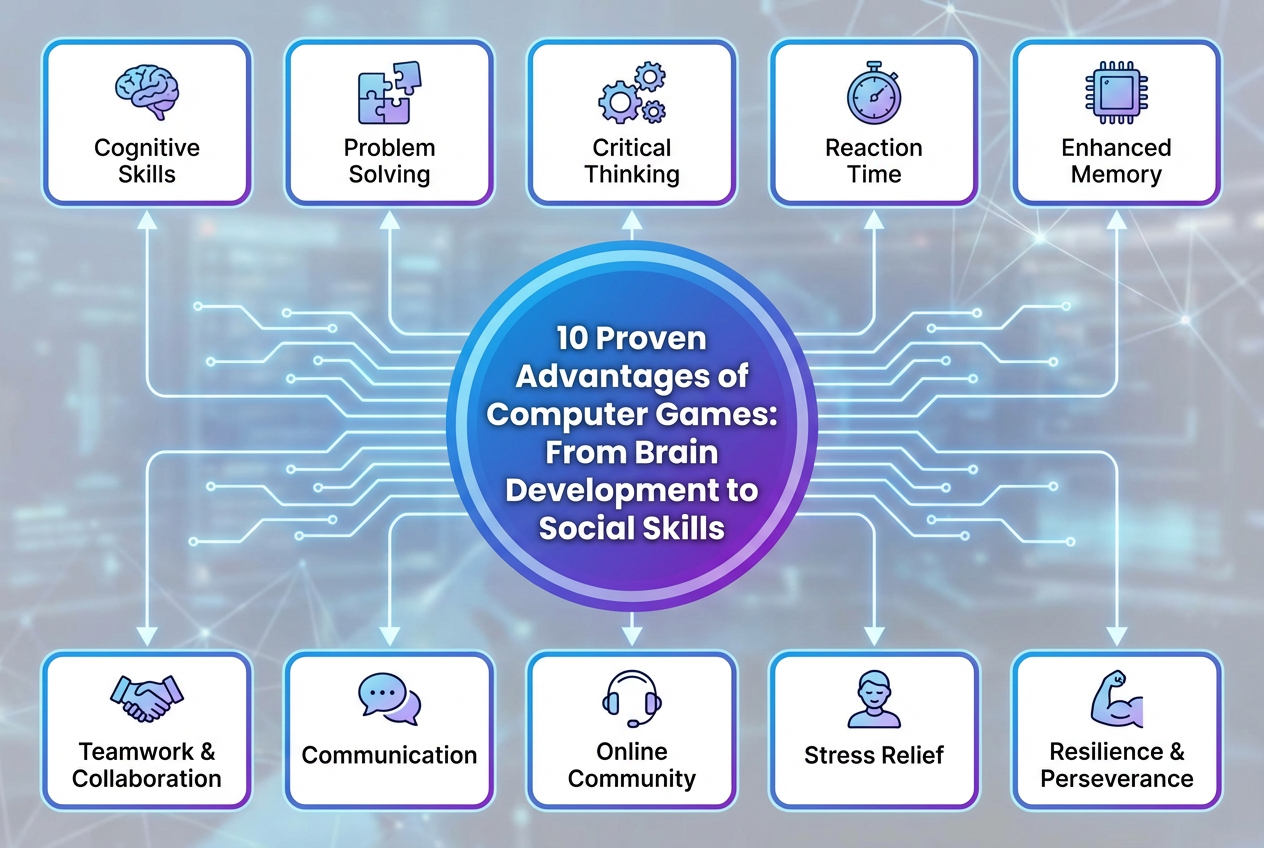
The benefits span cognitive, social, emotional, and career domains. Here are 10 evidence-backed advantages with examples from action, strategy, puzzle, and RPG titles—plus platforms (PC, console, mobile)—to show the practical uses of computer games.
1. Development of Cognitive Skills and Problem-Solving
What it does: Strategy and puzzle games boost analysis, planning, and mental flexibility. Players build hypotheses, test strategies, and adjust based on feedback.
Examples: Civilization VI (4X), Into the Breach (tactics), Portal 2 (physics puzzles).
Why it matters: Skills transfer to schoolwork and jobs (data-driven thinking, resource management).
Research:
- A 2024 meta-analysis in Frontiers in Psychology found moderate-to-strong effects of game-based learning on problem-solving, critical thinking, and decision-making (Frontiers, 2024).
- Adolescents who frequently played strategy games showed improved problem-solving over time, with potential academic benefits (NCBI/PMC, 2025).
How to apply it: Dedicate 30–45 min/day to a strategy game; after each session, write down one problem-solving pattern you noticed (e.g., ""flanking in CS2 = anticipating competitor moves in trading"").
Honestly? The mental gymnastics you do planning a Dota 2 draft or optimizing a Factorio production line are the same skills you'd use mapping out a business plan or debugging code. It's just… more fun with explosions.
2. Improved Reaction Time and Coordination
What it does: Fast-paced action games and shooters train hand-eye coordination, target tracking, and split-second decisions.
Examples: DOOM Eternal (FPS), Apex Legends (battle royale), Geometry Dash (rhythm).
Why it matters: Shorter reaction times, higher accuracy, better situational awareness.
Research:
- British Psychological Society (2024): Regular gamers completed executive-switching and maze tasks 12.7% and 17.4% quicker than non-gamers (BPS, 2024).
- NCBI (2003): Post-session, video game groups showed 52 ms faster reaction time than controls (NCBI/PMC, 2003).
- Dr. Mark Campbell (University of Limerick) notes this research ""may have implications for surgery and air traffic control, where video game play could be encouraged to help develop the elite cognitive performance required"" (BPS, 2024).
3. Strength of Attention and Concentration
What it does: Hardcore roguelikes and competitive shooters demand sustained focus, interference control, and divided attention. Players track objectives, timings, and resources simultaneously.
Examples: Hades, Valorant, League of Legends.
Why it matters: Boosts efficiency in multitasking environments, analytical work, and process monitoring.
Research:
- BPS (2024): Gamers (7+ h/week action games) completed tasks 12.7–17.4% quicker; both groups had similar cognitive fatigue rates, debunking the ""gaming wrecks concentration"" myth (BPS, 2024).
- Nature (2025): Habitual video gaming predicted superior multitasking performance (Nature, 2025).
- When you're juggling inventory in RUST or monitoring cooldowns in Dota 2, you're training your brain to handle complex, real-time information flows—skills that apply to trading markets or customer support queues.
Pro tip: Use the Pomodoro technique (25 min game, 5 min break) to train sustained attention without burnout.
Look, if you can track enemy ult timers, your own item cooldowns, and minimap movements all at once in a teamfight, you can definitely handle a spreadsheet and three Slack channels. It's the same mental muscle.
4. Creativity and Imagination
What it does: Open-world games, sandboxes, and level editors stimulate creativity through content creation, modding, and design.
Examples: Minecraft, Dreams, Kerbal Space Program.
Why it matters: Develops divergent thinking, prototyping, and visual-spatial engineering.
Research:
- NCBI/PMC (2025): Motivation to play predicted creativity, with imagination mediating part of the effect (PMC, 2025).
- Minecraft Education Edition is used for creative contests, historical reconstructions, and modeling—students design objects in pairs to develop imagination.
- Kerbal Space Program teaches real-world physics; students construct rockets accounting for aerodynamics. Educational cases show improved spatial thinking and prototyping (2019–2024).
5. Social Skills and Teamwork
What it does: Co-op and esports settings build communication, role distribution, and leadership.
Examples: Overwatch 2, Dota 2, Among Us.
Why it matters: Coordinates strategies, gives constructive feedback, negotiates goals.
Research:
- University of Melbourne (2024): After a 10-week cooperative gaming program, teachers observed better collaboration, communication, and confidence (""Next Level Collaboration,"" 2024, UniMelb).
Actionable: Join a regular 5-stack team; rotate shot-caller role weekly to practice leadership.
Ever notice how the best in-game leaders are also the smoothest negotiators when trading skins? That's not a coincidence—calling strats in a high-pressure match teaches you to read people, manage egos, and close deals under pressure.
6. Stress Relief and Mood Enhancement
What it does: Immersive games create flow states and safe emotional release.
Examples: Cozy-gaming (Stardew Valley), narrative adventures (Firewatch).
Why it matters: Short-term stress reduction, mood boost, preventing burnout with proper time management.
Research:
- JMIR Games (2025): 55.3% of gamers reported benefits for anxiety and depression, but excessive time related to severe symptoms—indicating a dose-dependent relationship (JMIR, 2025).
- SAGE Journals (2025): Playing an action video game produced measurable reductions in anxiety compared with journaling (SAGE, 2025).
Self-check: If gaming stops being fun and feels compulsive, take a 3-day break and reassess.
Sometimes the best trade you can make is closing Steam and going for a walk. Your brain needs downtime, not just different pixels.
7. Enhanced Visual Perception
What it does: Dynamic genres boost contrast sensitivity, peripheral attention, and visual search speed.
Examples: Shooter games (CS:GO), racing (Forza Horizon).
Why it matters: Sharper detail discrimination in ""visual noise,"" faster detection of signals on-screen and in real environments.
Research:
- Experiments with young adults playing first-person shooters revealed improved eye contrast sensitivity, helping distinguish details on complex backgrounds.
- NCBI/PMC (2024): Video game training improved visual acuity in amblyopia (SMD 0.58; p<0.01)—a systematic review and meta-analysis (PMC, 2024).
- If you're scanning for enemies in CS2 or tracking item drops in RUST, you're literally training your eyes to process information faster and more accurately.
Eye health tip: Follow the 20-20-20 rule; use blue-light filters after 8 PM.
8. Persistence and Resilience to Failure
What it does: Game loops of ""try–fail–improve"" teach players to treat failures as data, not defeat.
Examples: Souls-like (Elden Ring), roguelite (Dead Cells).
Why it matters: Fosters growth mindset, resilience under pressure, incremental improvement.
Research:
- ACM Digital Library (2023): Focusing on growth and accepting difficulty helps players persist after failure in Celeste (ACM, 2023).
- Research comparing growth vs. fixed mindset players found growth mindset players won 87% vs. 78% of cases in serious games, with enhanced attention to mistakes and active seeking of difficult challenges.
- NCBI/PMC (2024): 83% reported life satisfaction and 66.1% could calm down when upset in game-based SEL programs (PMC, 2024).
Mindset shift: After each death, ask ""What did I learn?"" instead of ""Why did I fail?""
You know what separates a hardstuck Silver from a Global Elite? It's not aim—it's the ability to watch a demo, spot the mistake, and fix it. Same goes for trading: one bad deal doesn't make you a bad trader. It makes you smarter for the next one.
9. Learning and Knowledge Transfer
What it does: Simulators, historical, and scientific games make complex concepts tangible.
Examples: Assassin's Creed Discovery Tour (history), Kerbal Space Program (physics), Factorio (systems).
Why it matters: Learning terminology, cause-effect relationships, metrics; applying to STEM and soft skills.
Research:
- Frontiers in Education (2025): A systematic review found serious games effective for STEM learning across multiple domains (Frontiers, 2025).
- Assassin's Creed Discovery Tour offers 75 interactive tours of Ancient Egypt, Greece, Rome, and other eras, created by historians from Yale and Leeds universities, used in schools for visualizing historical locations without game violence, with educational materials from McGill University (2020–2023).
- Kerbal Space Program is applied in universities for hands-on aerodynamics, orbital mechanics, and space flight physics—confirmed by educational cases and STEM research (2019–2024).
- Factorio is used in courses on systems thinking and production management, teaching planning, optimization, and automation through complex production chains (2021–2024).
10. Career and Digital Entrepreneurial Activity
What it does: Games open professions: game dev, UX, QA, data analytics, esports, streaming, content creation.
Example platforms: Steam, itch.io, YouTube, Twitch.
Why it matters: Portfolio projects, monetizing skills, participating in global communities.
Reality check:
The gaming industry is vast, but specific job numbers fluctuate. Instead of citing unverified figures, here's what we know from trusted sources:
- Game dev: A growing field with roles in programming, design, art, QA, and analytics. Check current openings on Gamasutra Jobs or Hitmarker.
- Esports: A multi-billion-dollar industry (Newzoo estimates ~$1.5B+ in 2025), with demand for players, coaches, analysts, and event coordinators.
- Streaming: Platforms like Twitch and YouTube allow creators to monetize via subscriptions, ads, and sponsorships. Success depends on consistency, niche, and community engagement.
- Data analytics: Live-service and mobile games need specialists in monetization, player behavior, and big data—roles often advertised on LinkedIn and industry job boards.
Starter roadmap:
- Pick one skill (e.g., data viz from analyzing Dota 2 patch notes).
- Build a portfolio project (e.g., public spreadsheet tracking CS2 skin price history).
- Share on Reddit/Discord and collect feedback.
- Apply to 5 entry-level QA or community manager roles/month.
And hey, if you're looking to kill time between job applications or just want a quick dopamine hit, check out some online games to keep your reflexes sharp and your mind engaged. Sometimes the best ideas come when you're not actively grinding—just playing.