


As leaders face historic levels of complexity and burnout new data suggests psychological safety may be breaking down at the top
LAGUNA NIGUEL, Calif., Jan. 27, 2026 /PRNewswire/ -- A new Harris Poll/Turas Leadership survey reveals a disconnect between what senior leaders say they want from their teams, and what they feel safe enough to ask for, without compromising their reputation.
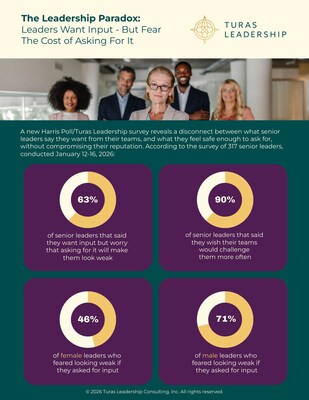
According to the survey, 63% of senior leaders1 say they would seek input more often from their teams to help make big decisions if they didn't think doing so would make them look weak. Male leaders (71%) are significantly more likely than female leaders (46%) to fear the cost of asking for their team's input on big decisions.
In addition, the vast majority (90%) of senior leaders say they wish their teams would share constructive feedback that challenges them and/or the status quo of the organization more often. Yet broader workforce data suggests many employees do not feel confident doing so. According to a 2024 study, 63% of Gen Z employees and 52% of Millennials do not feel confident expressing their opinions at work2, highlighting a significant gap between leadership intent and employee experience. And another survey3 on 21,000 employees found that only 27% say their leader always encourages and recognizes suggestions for improvement.
Together, these findings point to a deeper issue: leaders strongly believe in collaboration and challenge - but many don't feel safe enough to actually initiate them. And adding to the double-bind, many employees still don't feel safe to speak up.
"We've spent years focusing on psychological safety as something leaders create for their teams," said Emily Scherberth, Founder and CEO of Turas Leadership Consulting. "This data suggests that psychological safety may be breaking down at the leadership level first. And when leaders don't feel safe enough to model vulnerability, openness, curiosity, and shared decision-making, those behaviors may not take root anywhere else."
Making Psychological Safety Systemic, Rather Than Directional
These findings emerge amid mounting evidence that leadership is facing unprecedented constraints. Other research shows that 80% of leaders feel that they're under more pressure to ensure the long-term prosperity of the business4, and 71% of C-Suite leaders say they would quit their jobs to protect their well-being5. Leaders are being asked to embody modern leadership behaviors—openness, vulnerability, collaboration, shared problem-solving—while operating in the most volatile and uncertain business environment in our lifetimes.
In addition, a 2025 Harvard Business Review article revealed that middle managers feel less psychologically safe than their own direct reports. This data and the Turas Leadership research both suggest that psychological safety is often directional rather than systemic - created downward for teams, but not upward or inward for leaders themselves. When leaders fear that asking questions, inviting dissent, or admitting uncertainty will undermine their credibility, it has a potentially chilling effect on the entire organization. However, building psychological safety for leaders is not about making those in power more comfortable. It is about developing their capacity to stay present, grounded, and lead through uncertainty without defaulting to control—which is what actually creates safety for everyone in the system.
Rethinking Leadership Development
The Turas survey findings also suggest that organizations need to rethink their approach to leadership development altogether. Leaders want to lead differently and believe in modern leadership principles but they are still constrained by fear and increasing pressure to perform.
"This isn't a failure of skill or will," Scherberth said. "It's about how we develop leaders against the backdrop of volatility, uncertainty, complexity and ambiguity. We can't just teach leaders what to do, we also need to help them build the inner capacity to do it sustainably, under increasingly difficult circumstances, when it matters most."
Turas advocates for leadership development that focuses on capacity-building as a first step. When leaders confront their own mental models of authority, cultivate self-awareness, and deepen their capacity to lead with vulnerability, they create the conditions for the successful transformation of the entire organization.
Leaders who are interested in measuring their own capacity are invited to take the Turas Leadership Capacity Assessment™. And for a deeper analysis of this research, download our white paper: The Leadership Paradox.
About the Survey
This survey was conducted online within the United States by The Harris Poll on behalf of Turas Leadership Consulting, Inc. from January 12 - 16, 2026 among 317 business leaders (i.e. Directors and above). The sampling precision of Harris online polls is measured by using a Bayesian credible interval. For this study, the sample data is accurate to within +/- 5.4 percentage points using a 95% confidence level.
For complete Harris Poll/Turas survey methodology, including weighting variables and subgroup sample sizes, please contact Emily Scherberth at Turas Leadership Consulting (info@turasleadership.com).
About Turas Leadership
Founded in 2025, Turas Leadership Consulting, Inc. provides leadership development, team building, organizational consulting and executive coaching services that result in deeper engagement, increased productivity, and higher profitability. Through its Leader-First Transformation™ model - a leadership-centered approach to organizational transformation that develops the inner capacities leaders need to catalyze lasting change - Turas helps create healthier, more resilient organizational cultures.
1 Defined as those who are Directors and above |
Contact:
Emily Scherberth
213-222-8735
408158@email4pr.com
 View original content to download multimedia:https://www.prnewswire.com/news-releases/new-leadership-research-reveals-a-critical-disconnect-leaders-want-more-input-but-fear-the-cost-of-asking-for-it-302670968.html
SOURCE Turas Leadership Consulting, Inc.









Discover thousands of colleges and courses, enhance skills with online courses and internships, explore career alternatives, and stay updated with the latest educational news..

Gain high-quality, filtered student leads, prominent homepage ads, top search ranking, and a separate website. Let us actively enhance your brand awareness.
Download EasyShiksha Mobile Apps from Android Play Store, Apple App Store, Amazon App Store, and Jio STB.
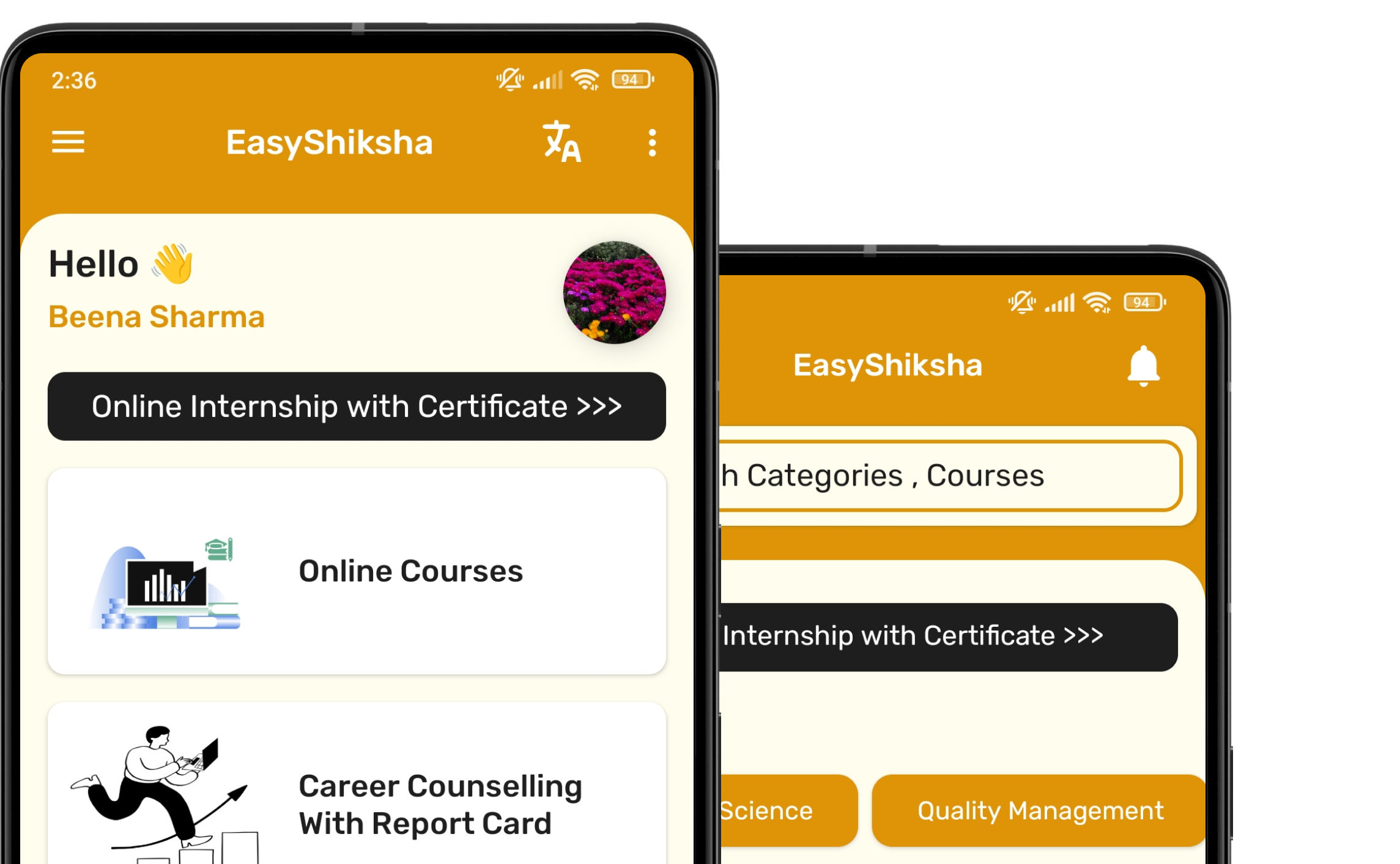


1 million+ learned on the EasyShiksha App