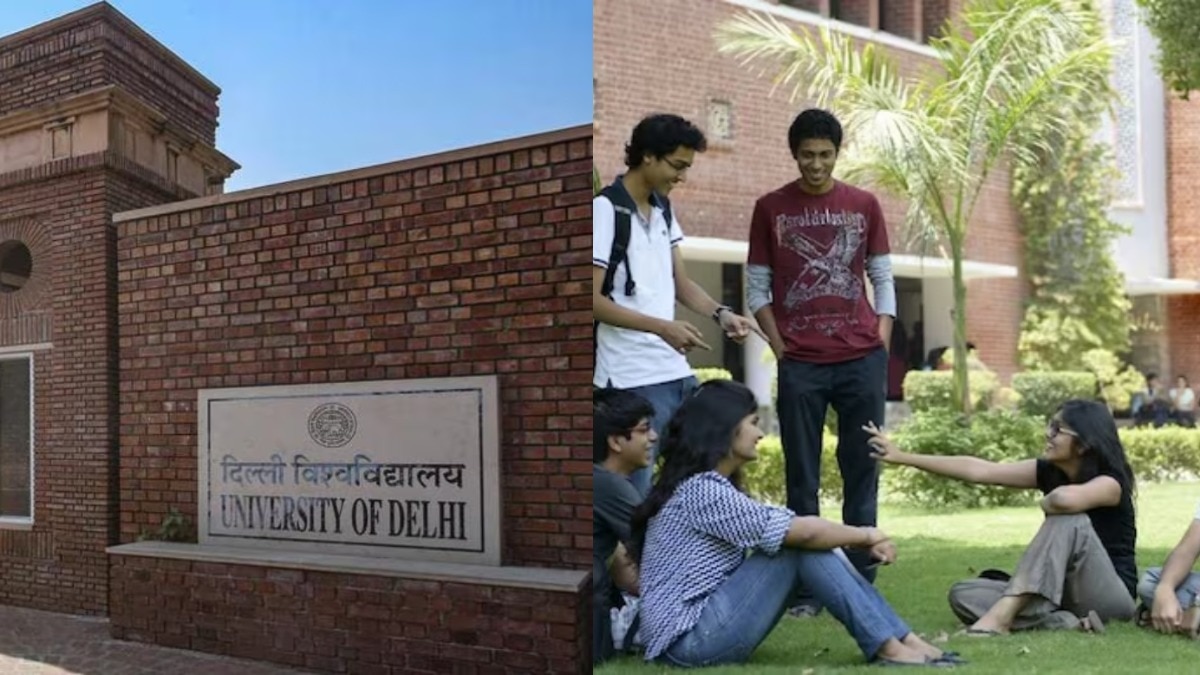
On a September Sunday afternoon, the question of where Delhi University students live acquired a far more frightening meaning.
A paying guest building near the university’s South Campus came crashing down, killing seven students. They had come to Delhi from different parts of the country to study, build careers and, as their families had hoped, secure a better future.
Instead, they never returned home.
In the aftermath, anger spilled onto the streets. Students at Delhi University’s South Campus called the deaths not merely an accident but a consequence of a system that, they allege, leaves students with little choice but to live in overcrowded and poorly regulated paying guest accommodations.
Their demand was immediate: compensation and accountability.
But beneath the protests was a question that Delhi University has faced for years and has still not answered adequately:
WHERE ARE THE HOSTELS?
For thousands of students who arrive in Delhi every year, especially those from outside the capital, finding accommodation is not a peripheral problem. It is part of the cost of getting an education at one of India’s most prestigious public universities.
“I have seen how students are forced to live in cramped lanes and unsafe buildings because there simply aren't enough hostels,” said a student of Rajdhani College. His own PG, he said, is located inside a narrow, congested lane away from the college campus.
The irony is difficult to miss. A university that admits students from across India has an accommodation system that caters to only a small fraction of them.
A university of 2.5 lakh students, and barely 7,000 hostel places
Delhi University’s own 2024-25 annual report records 2.51 lakh enrolled students across undergraduate, postgraduate, PhD, certificate and diploma programmes.
Of these, 2,10,907 are undergraduate students, 34,520 are postgraduate students including PhD scholars, and another 6,047 are enrolled in certificate and diploma programmes.
Against this enormous student population, the university and its constituent colleges together have an estimated 6,500–7,000 hostel places.
That means hostel accommodation is available to fewer than four in every hundred enrolled students.
For a university with 91 constituent colleges, an A++ NAAC accreditation and a sixth-place position in the NIRF university rankings, the accommodation deficit is striking.
And it is not a new problem.
The wheel of hostel construction has been moving slowly for years even as admissions, demand for higher education and the cost of living in Delhi have moved in the opposite direction.
The result is an ecosystem in which thousands of students are effectively pushed into the private rental market.
For students from affluent families, that may mean a relatively comfortable PG or rented apartment.
For others, it can mean sharing a small room with several students, paying a substantial monthly rent and living in buildings whose safety standards they have little ability to independently assess.
THE COST OF STUDYING IN DELHI DOESN'T END WITH SUBMITTING OF COLLEGE FEE
For many students, the irony is particularly sharp.
Delhi University remains attractive partly because its public education is comparatively affordable. But the saving made on college fees can quickly disappear once accommodation, food, transport and other living expenses are added.
“The monthly rental for PGs is much higher than the annual fees of the colleges,” said Saumya, a student of Maitreyi College, who joined a protest at Satya Niketan demanding accountability after the building collapse.
Her question was simple: if Delhi University is a public university serving students from across the country, why should basic accommodation remain inaccessible to the overwhelming majority?
“Delhi University is such a prestigious university. Can’t we seek basic facilities? There are 91 constituent colleges. Can’t we seek hostel accommodation?” she asked.
The question becomes particularly important for students arriving from states hundreds or thousands of kilometres away.
Priya Dutt, a third-year student at Atma Ram Sanatan Dharma College, is from Assam. Her paying guest accommodation stood next to the building that collapsed.
She remembers the moment vividly.
“It felt like an earthquake. We thought we wouldn’t survive,” she recalled.
Her building was later marked unsafe. Supported by iron pillars, it is now slated for phased demolition.
Priya managed to escape with her mobile phone.
For her, the incident transformed the abstract problem of hostel shortages into something much more immediate: the question of whether a student should have to risk her life simply to find a roof near her university.
The hostels exist. The scale doesn't.
Delhi University does have a network of university-run hostels. But their combined capacity is minuscule when measured against the size of the student population.
Among the university’s hostels are facilities such as Rajiv Gandhi Hostel for Girls, with around 520 places, the Undergraduate Hostel for Girls with around 560, Saramati Post-Graduate Men’s Hostel with around 250, and several smaller facilities including Gwyer Hall, Jubilee Hall, Meghdoot Hostel and the International Students’ House for Women.
Taken together, the university’s own hostels provide roughly 2,800 places.
Several constituent colleges have built additional hostels.
St Stephen’s College has around 400 places; Hindu College has around 560 according to recent tender documents; Hans Raj College around 230; Ramjas College around 200; SRCC around 276; Miranda House more than 360; Indraprastha College for Women more than 450 across two hostels; Lady Shri Ram College around 288; and Sri Venkateswara College around 150.
Yet even after adding these facilities, the overall capacity remains somewhere in the vicinity of 6,500–7,000.
Against 2.51 lakh students, the arithmetic is unforgiving.
The problem is not that Delhi University has no hostels. The problem is that it does not have nearly enough of them.
WHO IS RESPONSIBLE
This is where the accommodation crisis enters a familiar bureaucratic maze.
The National Human Rights Commission has now sought answers.
On September 7, the NHRC, through a bench headed by Priyank Kanoongo, issued notices to the UGC Chairman and the Chief Secretary of the Delhi government, asking them to coordinate with Delhi University and provide concrete information on existing hostel capacity, the possibility of expanding it and measures required to strengthen existing infrastructure.
The Commission has sought a time-bound and comprehensive plan to address the shortage.
The move brings an old institutional dispute back into focus: who is supposed to pay for the hostels?
In communication with the NHRC in November 2025, Delhi University pointed towards the funding structure of its colleges.
The university said that of the 65 colleges through which undergraduate admissions take place, 12 are fully funded by the Delhi government, while the remaining colleges receive funding through the UGC. According to the university, infrastructure expansion, including the construction of new hostels, therefore depends on the respective funding agencies.
The university also told the NHRC that it was aware of the difficulties faced by students coming from outside Delhi and that its colleges, with the university’s assistance, had been pursuing the relevant funding agencies for improvements to infrastructure and additional hostel facilities.
But the NHRC appears unwilling to accept a simple transfer of responsibility.
The Commission's intervention effectively raises a more uncomfortable question: if every institution involved has a role to play, who is ultimately accountable when the infrastructure does not exist?
For a student looking for a safe place to sleep, the distinction between UGC funding, Delhi government funding and university administration may be administratively relevant.
It is hardly reassuring.
THE QUESTION THAT REMAINS
The protests at Satya Niketan are therefore about more than one collapsed building.
They are about the invisible infrastructure surrounding higher education.
India has spent years expanding access to universities. Delhi University itself has dramatically expanded the number of students it serves. But access to a university does not end at the admission gate.
A student needs a classroom.
She needs a library.
She needs laboratories and teachers.
And if she has travelled from Assam, Bihar, Rajasthan, Kerala or any other part of the country, she also needs a safe place to live.
That is where Delhi University’s numbers tell a troubling story.
A university with more than 2.5 lakh students has fewer than 7,000 hostel places.
The remaining students must fend for themselves in a private accommodation market where rents are high and, as the recent tragedy has painfully demonstrated, safety cannot always be taken for granted.
The students protesting in Satya Niketan were asking a question that should not require a tragedy to be asked:
“Is this the value of a student’s life?”
The answer cannot come in the form of another committee, another notice or another exchange of letters between institutions.
It has to come in bricks, buildings, inspections, beds and, most importantly, safe rooms for students to return to after their classes end.
Anshika Jain is an Engineer, Developer, and Educational Content Author known for her dedication to technology and knowledge sharing. With a strong analytical mindset and a passion for innovation, she has consistently contributed to creating meaningful digital solutions and insightful educational articles.
Her ability to simplify complex technical concepts into engaging and easy-to-understand content makes her work valuable for students and learners across various platforms. Along with her technical expertise, Anshika is admired for her creativity, professionalism, and commitment to continuous learning.
She represents a perfect blend of technical excellence and impactful communication, inspiring others through both her development work and educational contributions.