

















B.Voc in Plastic and Polymer Science
Program Overview
The B.Voc Plastic and Polymer Science program at Kalinga University is a career-oriented undergraduate program designed to develop practical and technical expertise in polymer materials, plastics processing, product development, and quality testing. Plastics and polymers are essential to modern industries such as automotive, packaging, healthcare, electronics, construction, consumer goods, and manufacturing. The program introduces students to the scientific principles behind polymer materials while emphasizing their practical applications in industrial environments. Students can develop an understanding of polymer chemistry, material properties, processing methods, and the factors that influence the performance and durability of plastic products.
Throughout the program, students can gain exposure to important plastic and polymer processing techniques such as injection molding, extrusion, blow molding, compression molding, compounding, and recycling. The curriculum can also help learners understand material testing, quality control, industrial machinery, product design, and production practices. Practical-oriented learning enables students to connect theoretical concepts with real-world manufacturing processes and develop skills relevant to production and laboratory environments. Students can also explore the characteristics and applications of thermoplastics, thermosetting polymers, elastomers, composites, and other advanced polymer materials.
The three-year, six-semester program is suitable for students interested in materials, manufacturing, industrial production, and sustainable polymer technologies. Along with technical knowledge, learners can develop problem-solving, quality assessment, workplace safety, and professional skills required in the plastics and polymer industry. The program also introduces students to the environmental challenges associated with plastic production and the importance of recycling, waste management, and sustainable alternatives. After completing the B.Voc program, graduates can explore opportunities in polymer processing, quality control, material testing, product development, plastic recycling, production supervision, and technical support, while also pursuing further education or specialized industry certifications.
Eligibility Criteria
Approval Details
Curriculum
- Introduction to polymers, plastics, and their applications in modern industries.
- Basic concepts of polymer chemistry, polymerization, and molecular structure.
- Study of common polymer types, including thermoplastics, thermosets, elastomers, and composites.
- Introduction to raw materials, additives, fillers, plasticizers, and reinforcing materials.
- Basic laboratory practices, industrial safety, material identification, and testing principles.
Download Syllabus
- Study of the physical, chemical, thermal, and mechanical properties of polymer materials.
- Introduction to polymer processing methods and selection of appropriate materials for products.
- Fundamentals of injection molding, extrusion, compression molding, and blow molding.
- Understanding polymer additives, compounding techniques, mixing, and material preparation.
- Practical exposure to basic processing equipment, operating procedures, and workplace safety.
- Detailed study of injection molding machines, molds, components, and operating parameters.
- Understanding extrusion processes for pipes, films, sheets, profiles, and other products.
- Study of blow molding, rotational molding, thermoforming, and other manufacturing techniques.
- Introduction to mold design, product defects, troubleshooting, and process optimization.
- Practical training in machine operation, production monitoring, material handling, and process control.
- Study of mechanical, thermal, physical, and chemical testing methods for polymer materials.
- Understanding quality control procedures for raw materials, intermediate products, and finished goods.
- Identification and analysis of common defects in plastic products and their corrective measures.
- Introduction to laboratory instruments, testing standards, measurement techniques, and documentation.
- Practical training in quality inspection, sample preparation, testing, reporting, and industrial quality assurance.
- Introduction to plastic product design, material selection, prototyping, and development processes.
- Study of polymer composites, specialty plastics, engineering plastics, and advanced applications.
- Understanding plastic recycling, waste management, reuse, and sustainable processing technologies.
- Exploration of biodegradable polymers and environmentally responsible alternatives to conventional plastics.
- Practical project work involving product development, material evaluation, recycling, or process improvement.
- Advanced understanding of polymer processing operations and industrial production management.
- Introduction to production planning, process optimization, workplace safety, and resource efficiency.
- Study of industrial quality systems, documentation, technical reporting, and professional practices.
- Internship or practical industrial training to gain exposure to real-world polymer manufacturing operations.
- Major project involving plastic processing, polymer testing, product development, recycling, or sustainable polymer technology.
Fee Structure
Admission Process
Students can apply for the B.Voc Plastic and Polymer Science programme through EasyShiksha. The complete application process is designed to make admission simple and convenient for eligible students.
Step 1: Click on Apply Now
Click the Apply Now button on the B.Voc Plastic and Polymer Science programme page and begin your application through EasyShiksha.
Step 2: Complete Personal Information
Fill in the required personal, contact and academic details accurately in the application form.
Step 3: Upload Required Documents
Upload the required documents for eligibility and admission verification as specified during the application process.
Step 4: Pay Application Fee
Pay the applicable application fee through the available online payment options to submit your application and initiate the admission process.
Step 5: Application Review
The EasyShiksha team reviews your application and submitted documents to verify your eligibility and ensure that the required information and documents have been provided.
Step 6: University Enrollment
Once the application is successfully reviewed and the student is found eligible, EasyShiksha facilitates the enrollment process with Kalinga University.
Step 7: LMS Access
After successful enrollment, the student is provided access to the Learning Management System (LMS) to begin their academic journey and access the available learning resources.
Start Your Application
Ready to begin your journey in Software Development? Click Apply Now to submit your application through EasyShiksha.
Career & Placements
Kalinga University, Raipur
Kalinga University is a UGC-recognized private university located in Raipur, Chhattisgarh, India. Known for its strong industry connections, cutting-edge curriculum, and commitment to technology-driven education, Kalinga University has established itself as one of central India's premier higher education institutions.
The university's vision is to foster academic excellence, industry readiness, and global competitiveness among its graduates — making it an ideal partner for EasyShiksha's mission of accessible, quality online education.
EasyShiksha has signed an MoU with Kalinga University to facilitate applications for various university programs and jointly offer B.Voc programs. All degrees and certifications under these programs will be awarded by Kalinga University. The EasyShiksha team will provide complete assistance and support throughout the admission and program process.
Kalinga University, Chhattisgarh
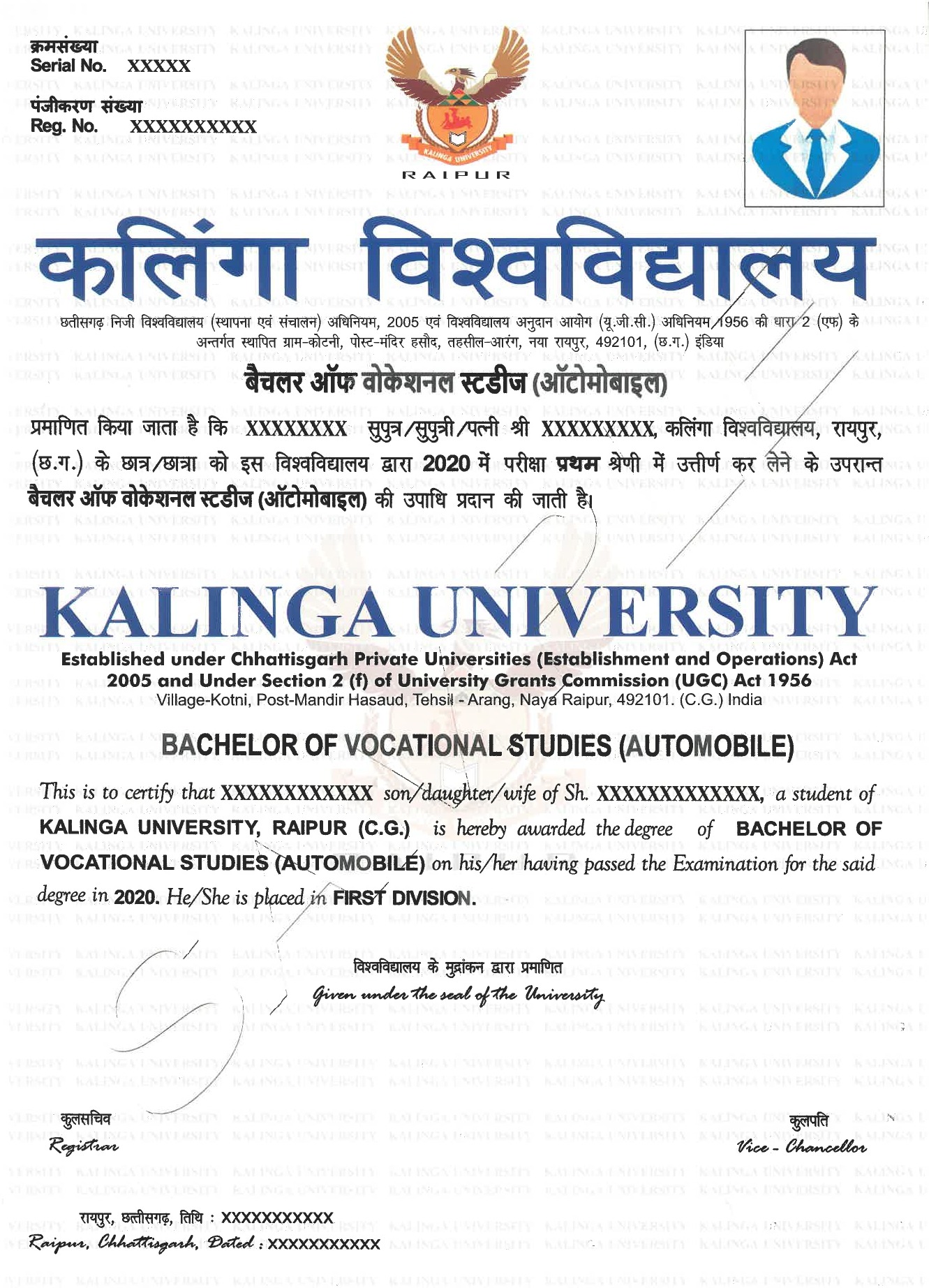
Sample Degree
Documents
Media Gallery
Frequently Asked Questions
Kalinga University offers a student-focused learning environment that combines academic education with practical exposure, industry-oriented programs, internships, research opportunities, and career development. The university offers 130+ programs and has students from more than 33 countries, creating a diverse and engaging academic environment.
Kalinga University stands out for its Centres of Excellence, industry collaborations, modern laboratories, incubation support, value-added courses, academic clubs, and experiential learning opportunities. Students can gain practical exposure in emerging areas such as AI & ML, robotics, coding, drones, IoT, electric vehicles, and automobile technology.
The university focuses on career readiness through internships, industrial visits, skill-development programs, resume building, aptitude preparation, soft-skill training, interview preparation, and campus placement drives. Its Career and Corporate Resource Centre supports students in developing the skills required for professional careers.
Kalinga University is a private university located in Kotni, Near Mantralaya, Naya Raipur, Chhattisgarh. Established in 2013, the University offers a wide range of Diploma, Undergraduate, Postgraduate and Doctoral programs across multiple disciplines.
Yes. Kalinga University has been established under the Chhattisgarh Private Universities (Establishment and Operation) Act, 2005 and is recognized under Section 2(f) of the UGC Act, 1956. The University is empowered to award degrees as specified under Section 22 of the UGC Act.
Kalinga University offers a broad range of academic programs, including Diploma, Undergraduate (UG), Postgraduate (PG), B.Voc and Ph.D. programs. The University currently lists 130+ programs across various academic disciplines.
Students can explore programs across disciplines such as Engineering, Technology, Management, Commerce, Law, Pharmacy, Science, Arts & Humanities, Biotechnology, Information Technology, Education, Journalism & Mass Communication, Fashion Design, Interior Design and Library Science, among others.
Eligibility requirements vary depending on the program. Generally, UG programs require completion of Class 12 or an equivalent qualification, while PG programs require a relevant bachelor's degree. Certain specialized programs may have additional academic, entrance examination or work-experience requirements. Students should check the eligibility criteria of the specific program before applying.
Students can explore the available programs on EasyShiksha and review the eligibility, duration, admission requirements and other program details. Depending on the program, the admission process may involve an application, entrance examination and/or other university-prescribed selection requirements. Kalinga University also provides its official admission portal for applications.
Entrance requirements depend on the program. Kalinga University conducts the Kalinga Scholastic Entrance Examination (KALSEE) for applicable programs, while certain programs or categories may be exempt from the entrance examination. Students should check the admission requirements of their selected program.
Yes. Kalinga University offers certain programs designed with working professionals in mind. For example, its B.Tech Lateral Entry programs provide flexible shift timings, including weekday evenings and weekends, along with access to recorded learning resources through the LMS. Program-specific eligibility and delivery details should be checked before admission.
Students who successfully complete an eligible academic program receive the applicable academic qualification awarded by Kalinga University, such as a Diploma, Degree or other program-specific credential, subject to fulfillment of the University's academic and examination requirements. For example, students completing the B.Voc program can progress through Diploma, Advanced Diploma and Bachelor's Degree exit options based on the duration completed.
Kalinga University lists 69 B.Voc programmes in its programme category.
Kalinga University lists 138 D.Voc programmes in its programme category.
Kalinga University holds a NAAC B+ accreditation grade.
B.Voc Plastic and Polymer Science is a three-year undergraduate vocational program focused on polymer materials, plastic processing, manufacturing, testing, quality control, product development, and sustainable polymer technologies.
According to the provided program information, students who have completed 10+2 or an equivalent qualification in any stream can apply. The eligibility also includes a two-year ITI Diploma after Class 10 or a three-year Polytechnic Diploma after Class 10.
Students can learn about polymer chemistry, plastic materials, polymer processing, molding, extrusion, compounding, material testing, quality control, product development, recycling, and sustainable polymer technologies.
Graduates can explore roles such as Polymer Processing Technician, Quality Control Inspector, Testing Technician, Production Supervisor, Plastic Recycling Technician, Product Development Assistant, Process Technician, and R&D Assistant.
Yes. The program is particularly relevant to students interested in plastics manufacturing, polymer processing, materials, industrial production, quality testing, product development, and recycling technologies.