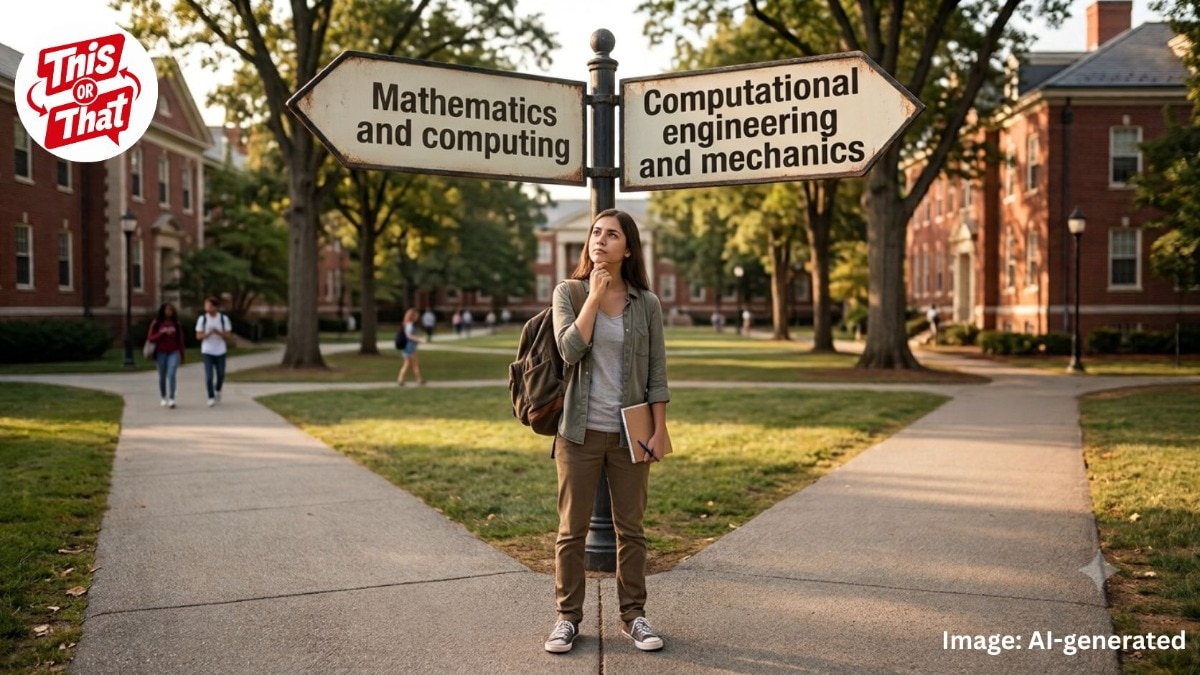
For students who enjoy mathematics but are unsure whether to move towards computing or traditional engineering, two interdisciplinary BTech programmes can offer different routes: Mathematics and Computing and Computational Engineering and Mechanics.
Both programmes combine mathematics with computational tools, but their applications are different. Mathematics and Computing focuses more on algorithms, programming, mathematical modelling and data-driven problem-solving. Computational Engineering and Mechanics applies mathematics and computing to engineering systems, mechanics and simulation.
So, which one should a student choose? The answer depends largely on their interests, strengths and career plans.
MATHEMATICS AND COMPUTING: WHAT DOES THE COURSE OFFER?
A BTech in Mathematics and Computing typically brings together concepts from mathematics, statistics, computer science and computational methods.
Students can expect to study areas such as calculus, linear algebra, probability, statistics, discrete mathematics, algorithms, programming and data structures. Depending on the institute, the curriculum may also include areas such as artificial intelligence, machine learning, optimisation and numerical methods.
The programme can be a good fit for students who enjoy mathematics but also want to build strong programming and computational skills.
Its applications extend beyond conventional software development. Graduates can explore careers in software engineering, data science, artificial intelligence, machine learning, quantitative finance, analytics and research.
The course can also provide a foundation for higher studies in mathematics, computer science, statistics, artificial intelligence and related fields.
COMPUTATIONAL ENGINEERING AND MECHANICS: WHAT IS DIFFERENT?
Computational Engineering and Mechanics combines engineering principles with mathematics and computational techniques.
The programme is more closely connected to physical systems and engineering applications. Students may study mechanics, numerical methods, mathematical modelling, computational methods and engineering fundamentals.
One of the important applications is computer-based simulation. Engineers can use computational models to understand how structures, materials, fluids and other physical systems behave without relying only on physical prototypes.
Educational Games for Kids
This makes the field relevant to sectors such as aerospace, automotive engineering, manufacturing, energy and engineering research.
Students who enjoy physics and engineering along with mathematics may find this programme more suitable than a mathematics-and-computing-focused degree.
MATHEMATICS AND COMPUTING OR COMPUTATIONAL ENGINEERING AND MECHANICS
| Factor | Mathematics and Computing | Computational Engineering and Mechanics |
|---|
| Primary focus | Mathematics, computing and algorithms | Engineering, mechanics and computational modelling |
| Mathematics | Strong | Strong |
| Programming | Strong | Moderate to strong |
| Physics | Relatively limited | Important component |
| Engineering applications | Indirect | Central |
| Key areas | AI, data science, algorithms, computing | Simulation, modelling, mechanics, engineering analysis |
| Career options | Software, AI/ML, data science, analytics, quantitative roles | Aerospace, automotive, manufacturing, simulation, R&D |
| Suitable for | Students interested in maths and computing | Students interested in maths, physics and engineering |
WHICH COURSE HAS BETTER CAREER OPTIONS?
Neither programme is universally better. The career path depends on what a student wants to do after graduation.
Mathematics and Computing may offer greater flexibility for students interested in technology-oriented careers. Its combination of mathematics and computer science can be useful for areas such as AI, data science, software development and quantitative analysis.
Computational Engineering and Mechanics, meanwhile, can be particularly relevant for students who want to work on engineering problems using computational tools. Its applications can include digital simulation, product design, structural analysis and engineering research.
The choice should therefore not be based only on the perceived salary or popularity of a course. Students should look at the curriculum of the specific institute, available electives, laboratory facilities, internships, placement opportunities and higher-study options.
WHO SHOULD CHOOSE MATHEMATICS AND COMPUTING?
This programme may suit students who:
- Enjoy mathematics and problem-solving
- Are comfortable with programming or want to learn coding
- Are interested in AI, data science or computer science
- Want to explore technology and quantitative careers
- Are considering higher studies in mathematics, computing or related fields
WHO SHOULD CHOOSE COMPUTATIONAL ENGINEERING AND MECHANICS?
This programme may be a better fit for students who:
- Enjoy mathematics as well as physics
- Are interested in engineering applications
- Want to understand how physical systems can be modelled computationally
- Are interested in simulation, mechanics or engineering research
- See themselves working in sectors such as aerospace, automotive or advanced manufacturing
Mathematics and Computing and Computational Engineering and Mechanics may share mathematics and computational methods, but they solve different kinds of problems.
Students who see themselves using mathematics and code to solve computational and data-driven problems may find Mathematics and Computing more aligned with their interests.
Those who want to use mathematics and computing to model physical systems and solve engineering problems may prefer Computational Engineering and Mechanics.
Ultimately, students should compare the detailed curriculum and career opportunities offered by the institute they are considering before making a decision.
Disclaimer: This comparison is part of India Today's This or That series, which explores common academic choices students face during admissions. The courses are selected based on frequently asked comparisons and are not ranked or endorsed.