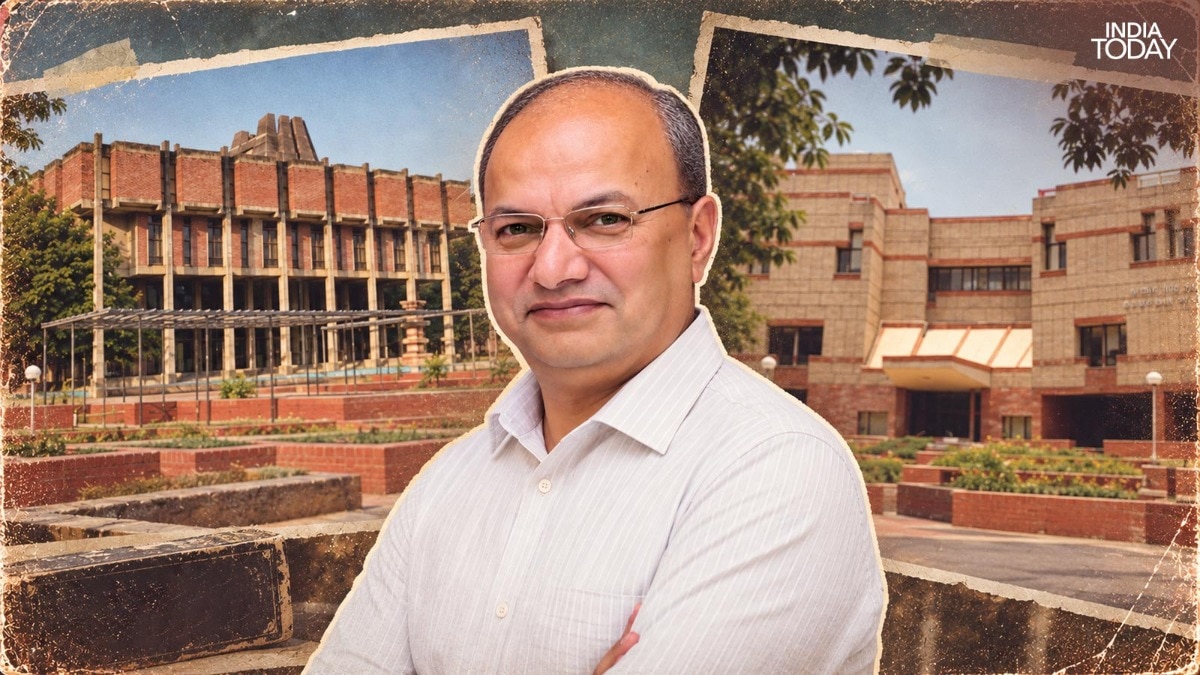
The director you hear about today, active on X and taking science and its ideas to a wider audience, was once a student sitting in the very classrooms. He learnt and debated in the same spaces where students today discuss artificial intelligence, question postulates and pursue ideas that may shape the generations to come. More than four decades ago, in 1982, he first walked these corridors as a student of IIT Kanpur.
Professor Manindra Agrawal, a Fellow of the Royal Society for nearly two decades, a Padma Shri awardee and a recipient of the Gdel Prize, came to IIT Kanpur as a young student, pursued his PhD in computer science, returned to the institute as a faculty member in 1996 and, more than three decades later, took charge as its director in 2024.
A SMALL-TOWN BOY AND A TOP JEE RANK
For Agrawal, however, none of this was mapped out at the beginning. IIT Kanpur entered his life almost by circumstance. He had secured a high rank in the JEE, and that opened the door to an institute he knew little about.
In a freewheeling conversation with India Today Digital, Agrawal recalls what first brought him to one of India’s premier institutes and what, over the next three decades, made him stay.
Professor Agrawal remembers the years for their freedom as much as for their academics, the friendships, arguments, late-night conversations, experiments and long hours in the canteen. In many ways, he says, his student life resembled the world portrayed in 3 Idiots.
Recounting those years, Professor Agrawal says students made full use of the freedom that came with college life. “We had fun, we did all that a student can do, from knocking on seniors’ doors to...” He leaves the sentence unfinished, allowing the memory to speak for itself.
“I was a small-town boy and didn’t really know what IIT was,” he says.
Someone had told the young Agrawal that IIT was a “high-minded” place to study. He appeared for the entrance examination, secured a top rank and was encouraged to choose computer science at IIT Kanpur. He did so. What began as a decision shaped largely by his rank would eventually become a lifelong association with the institute.
His undergraduate years, he recalls, were “huge fun”. Beyond the classroom, the campus introduced him to people from different parts of the country and opened up a world he had not encountered while growing up.
“We had all kinds of students around us. Someone would carry a screwdriver in his pocket, someone would study through the night, while others would simply chill, bunk classes and spend time in the canteen. Those were our carefree days. They passed in a hurry, but I still remember them whenever we sit and talk about those years,” says Agrawal, now the director of IIT Kanpur, as he looks back on his student days.
His interest in mathematics had already begun to shape his academic direction. He was drawn to its precision, the certainty that something could be proved true or shown to be false.
At IIT Kanpur, he found that theoretical computer science offered a natural extension of that way of thinking.
Programming, however, was not his calling.
“By the third year of BTech, I had realised that I’m not going to build a career writing programmes,” he says.
THE US, THE GRE AND A CHANGE OF MIND
By 1986-87, Agrawal was considering going to the US for higher studies, as many of his classmates had done. Some of them would go on to become entrepreneurs and build careers in Silicon Valley.
Then came the GRE, and with it, an unexpected turning point.
Agarwal did not want to spend his time memorising difficult English words merely to clear an examination.
“So once I opened the dictionary, and within five minutes, I closed it,” he recalls.
After five minutes of staring at the Oxford Dictionary, he made his decision: he would stay at IIT Kanpur.
For Professor Agrawal, the years spent pursuing his PhD belonged to a different world. The gaiety of campus life gave way to the quieter demands of research, the patient examination of what was true, what was not, and whether a new result could withstand scrutiny.
“I studied a lot, I learnt a lot,” he says.
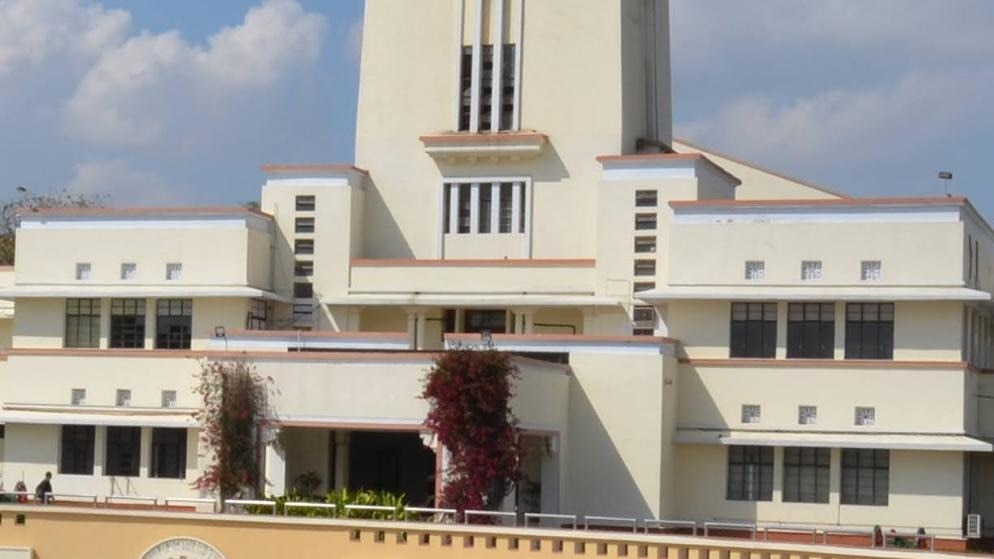
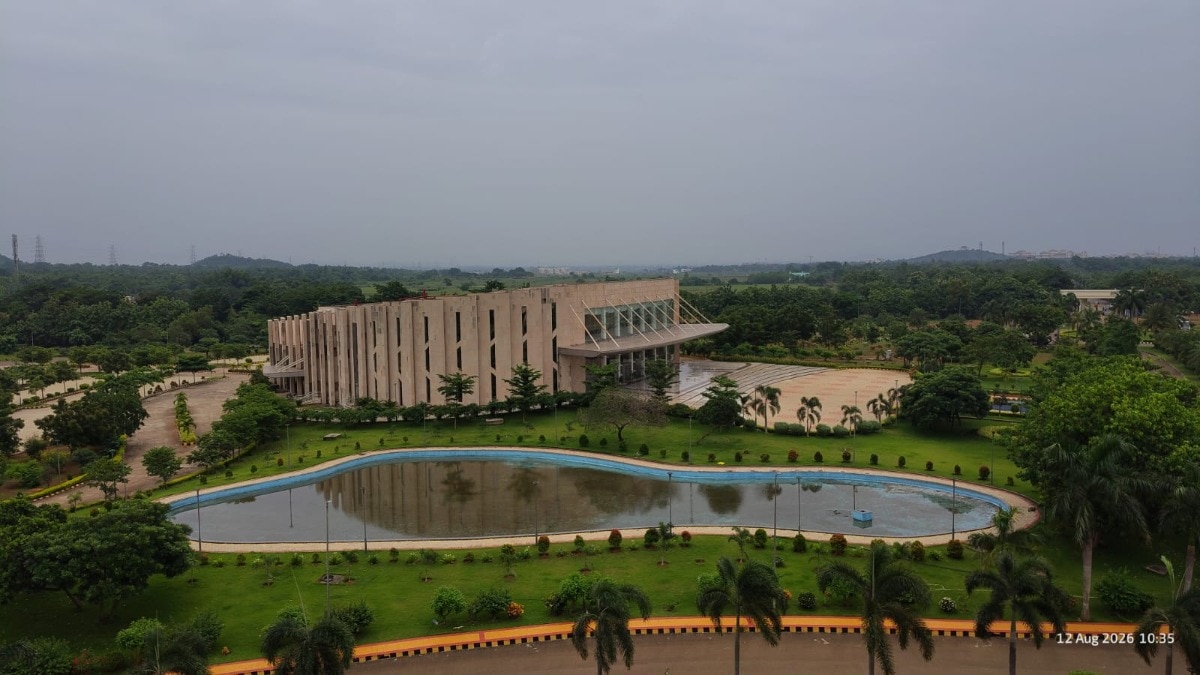
(Image: IIT Kanpur early 2000s)
In 1991, he completed his doctorate at IIT Kanpur, having by then earned recognition as one of the finest mathematicians.
After spending four years away, Agrawal returned to the institute in 1996 as a faculty member.
The transition brought another change. Some of those who had once taught him were now his colleagues. And at IIT Kanpur, colleagues addressed each other by name rather than using formal titles.
“It was also a somewhat unsettling experience at the beginning,” he said. Teaching, though, came naturally to him. He enjoyed interacting with students, particularly those who did not simply follow a lecture but thought ahead and challenged ideas.
Each role, he said, came from a sense of commitment to the institute. “There were things that I wanted or thought could be done better,” he said.
THE FREEDOM TO MAKE MISTAKES
The same idea now defines his role as director. Professor Agrawal believes he has gained significantly from IIT Kanpur and sees his position as an opportunity to give back.
His own student years continue to shape how he views the institute. He remembers getting into trouble with friends, appearing before the Student Senate Advisory Committee and being given an opportunity to explain himself.
(Image: IIT Kanpur)
The committee included both faculty and students, and eventually took what he described as a constructive view of the incident.
For Professor Agarwal, that memory captured something important about IIT Kanpur: freedom came with responsibility, but students were also given room to learn from their mistakes.
The academic standards, however, remained firm. He recalls a course in which he performed well on assignments and even went beyond what was required, although his final examination did not go as well. His instructor still gave him an A grade.
That balance, freedom outside the classroom and rigour inside it, appears to have stayed with him.
Now, as director, Agarwal is watching another major shift take place inside classrooms: the arrival of artificial intelligence.
The Director of IIT Kanpur believes AI has already altered one of the most cordial parts of education: the assignment. With students now able to turn to AI models for solutions to many conventional problems, he feels that simply giving an assignment can no longer serve the purpose it once did.
Yet, he does not see AI only as a challenge. For him, it is also becoming another instrument for learning.
Students can engage with AI systems, explore specialised subjects and build knowledge in ways that are more suited to their individual pace and interests. In design and prototyping, too, the process is changing. An idea can now move more quickly from a concept to a circuit, a set of manufacturing instructions or even a 3D-printed object.
For someone who entered IIT Kanpur in 1982, when computers were still far removed from the way students use them today, the change is part of a much longer story of technology and education.
What has remained constant through Agarwal’s own journey is less about the tools and more about the habit of asking questions, curiosity, mathematics, research and the freedom to explore.
He first entered IIT Kanpur as a student. He returned to the same campus as a professor in 1996. Today, he heads the institution where his own journey began.
The voyage has turned into an inspirational one, a journey that may touch many young minds, give them hope and kindle in them the zeal to think beyond the United States and take a deeper dive into mathematics, a field in which India once held an eminent place.
Aryabhata and Brahmagupta in ancient times, and Harish-Chandra and Ramanujan in the modern era, left a deep impression on generations that followed. In their own ways, they contributed something to humanity, and Professor Agarwal has carried that legacy forward with steadfastness.
For many students, IIT Kanpur is a destination. For Professor Agrawal, it has been the place he has continued to return to, first as a student from a small town, then as a professor, and now as its director.
Anshika Jain is an Engineer, Developer, and Educational Content Author known for her dedication to technology and knowledge sharing. With a strong analytical mindset and a passion for innovation, she has consistently contributed to creating meaningful digital solutions and insightful educational articles.
Her ability to simplify complex technical concepts into engaging and easy-to-understand content makes her work valuable for students and learners across various platforms. Along with her technical expertise, Anshika is admired for her creativity, professionalism, and commitment to continuous learning.
She represents a perfect blend of technical excellence and impactful communication, inspiring others through both her development work and educational contributions.