

















D.Voc in Data Science
Program Overview
The D.Voc (Advanced Diploma) in Data Science is a two-year skill-based vocational program designed to develop advanced technical and practical competencies in data analysis, programming, statistics, databases, data visualization, machine learning fundamentals, and data-driven problem-solving. The program prepares students for professional roles in technology companies, business analytics, finance, retail, healthcare, marketing, e-commerce, and other industries that rely on data for operational and strategic decision-making.
The program provides comprehensive learning across key technical areas such as advanced data science, Python programming, statistics, data structures fundamentals, SQL and database management, data cleaning and preprocessing, exploratory data analysis, data visualization, dashboard development, predictive analytics fundamentals, machine learning, supervised and unsupervised learning fundamentals, model evaluation, data mining, business analytics, data storytelling, and data ethics. Students gain extensive practical exposure through real-world datasets, Python-based analysis, SQL projects, data-cleaning exercises, statistical analysis, visualization and dashboard projects, predictive-modeling activities, machine-learning exercises, data-mining assignments, business analytics projects, and industry-oriented data science projects. The curriculum enables learners to understand the complete data workflow from data collection and preparation to analysis, visualization, modeling, interpretation, and presentation of insights.
Across four semesters, students strengthen their programming, statistical, analytical, visualization, database, machine-learning, communication, and problem-solving abilities. They learn to work with structured datasets, identify patterns and trends, develop analytical solutions, build basic predictive models, evaluate data-driven results, create dashboards, and communicate insights effectively. Graduates can pursue opportunities as Junior Data Analysts, Data Science Assistants, Business Analytics Assistants, Data Visualization Analysts, Reporting Analysts, Data Processing Executives, Machine Learning Assistants, Database Analysts, MIS Executives, and Data Operations Executives. The D.Voc (Advanced Diploma) in Data Science is ideal for students seeking extended, practical, and industry-focused education for careers in data analysis, business intelligence, data science, machine learning, and data-driven technology.
Eligibility Criteria
The minimum requirement for admission to D.Voc is 10+2 or a two-year ITI diploma after class ten or a three-year polytechnic diploma after class ten.
Approval Details
MHRD, Government of India and UGC
Curriculum
Semester 1 builds the foundation in communication, information technology, statistics and database management, along with practical industry exposure.
- Communication Skills: Verbal and non-verbal communication, speaking, reading, writing and professional communication.
- Fundamentals of Information Technology: Computer hardware, software, operating systems, networks, Internet and basic programming concepts.
- Descriptive Statistics: Data representation, measures of central tendency and dispersion, probability, random variables and statistical concepts.
- Database Management System: Database concepts, DBMS architecture, ER models, relational databases, normalization, data mining and data warehousing.
- On Job Training / Internship / Workshop: Practical and industry-oriented learning.
Download Syllabus
Semester 2 develops the mathematical, probability and database skills required for data science, along with environmental studies and practical exposure.
- Mathematics for Data Science-I: Sequences, series, continuity, differentiation, integration, Laplace transforms and related mathematical concepts.
- Environmental Studies: Ecosystems, natural resources, biodiversity, pollution, environmental policies, sustainability and disaster management.
- Introduction to RDBMS and SQL: Database architecture, ER models, SQL commands, constraints, joins, views, stored procedures, functions and triggers.
- Probability and Random Variables: Probability concepts, combinatorics, conditional probability, Bayes' theorem and discrete and continuous random variables.
- On Job Training / Internship / Workshop: Practical and industry-oriented learning.
Semester 3 focuses on optimization, probability distributions and Python programming, supported by hands-on Python laboratory work.
- Optimization Techniques: Linear programming, simplex methods, transportation and assignment problems, network models, decision-making and game theory.
- Probability Distributions: Mathematical expectations, moments, bivariate distributions, correlation and standard probability distributions.
- Python Programming: Python fundamentals, data types, functions, OOP, regular expressions, files, databases, visualization, networking and web programming.
- Python Programming-Lab: Practical programming exercises covering Python, databases, web-server interaction, exception handling and multithreading.
- On Job Training / Internship / Workshop: Practical and industry-oriented learning.
Semester 4 advances students into statistical simulation, Artificial Intelligence and statistical inference, along with practical industry exposure.
- Statistical Simulation Techniques: Random number generation, probability transformations, simulation of discrete and continuous variables, random vectors and multivariate normal distributions.
- Artificial Intelligence: Intelligent agents, search techniques, knowledge representation, probabilistic reasoning, machine learning, neural networks, clustering, expert systems and NLP applications.
- Statistical Inference: Sampling distributions, estimation, confidence intervals, hypothesis testing, t-tests, F-tests, chi-square tests and correlation analysis.
- On Job Training / Internship / Workshop: Practical and industry-oriented learning.
Fee Structure
Admission Process
The D.Voc in Data Science admission process is designed to be simple and student-friendly. Candidates can complete the admission process by following the steps below.
Step 1: Check Eligibility
Review the eligibility requirements for the D.Voc in Data Science programme and ensure that you meet the required academic criteria.
Step 2: Submit Admission Enquiry
Fill out the online admission enquiry/application form with your basic personal, academic and contact details.
Step 3: Counselling & Programme Guidance
After submitting the enquiry, the admission team will connect with you to provide guidance regarding the programme, curriculum, career opportunities, fee structure and other admission-related information.
Step 4: Complete the Application
Proceed with the formal application by providing the required information and uploading the necessary academic and identification documents.
Step 5: Document Verification
The submitted documents and academic details will be reviewed and verified by the admission team/institution.
Step 6: Admission Confirmation
Once the eligibility and documents are verified, the candidate will receive confirmation regarding admission to the programme.
Step 7: Pay Admission / Programme Fee
Complete the applicable fee payment through the available payment options to confirm your seat.
Step 8: Receive Admission Confirmation
After successful fee payment and completion of the admission formalities, the student receives confirmation of admission and further instructions regarding programme commencement, academic schedule and learning resources.
Career & Placements
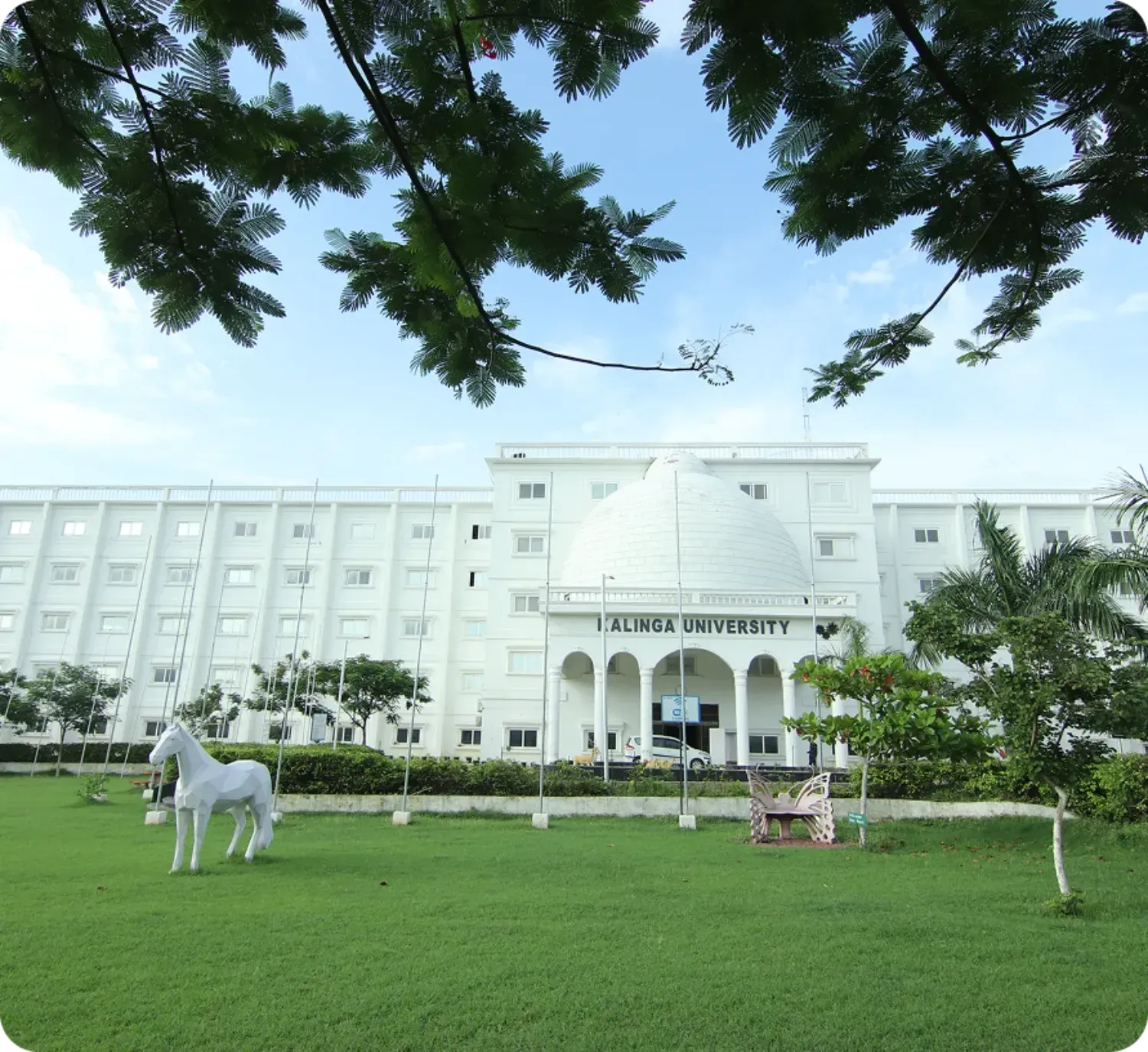
Kalinga University, Raipur
Kalinga University is a UGC-recognized private university located in Raipur, Chhattisgarh, India. Known for its strong industry connections, cutting-edge curriculum, and commitment to technology-driven education, Kalinga University has established itself as one of central India's premier higher education institutions.
The university's vision is to foster academic excellence, industry readiness, and global competitiveness among its graduates — making it an ideal partner for EasyShiksha's mission of accessible, quality online education.
EasyShiksha has signed an MoU with Kalinga University to facilitate applications for various university programs and jointly offer B.Voc programs. All degrees and certifications under these programs will be awarded by Kalinga University. The EasyShiksha team will provide complete assistance and support throughout the admission and program process.
Kalinga University, Chhattisgarh
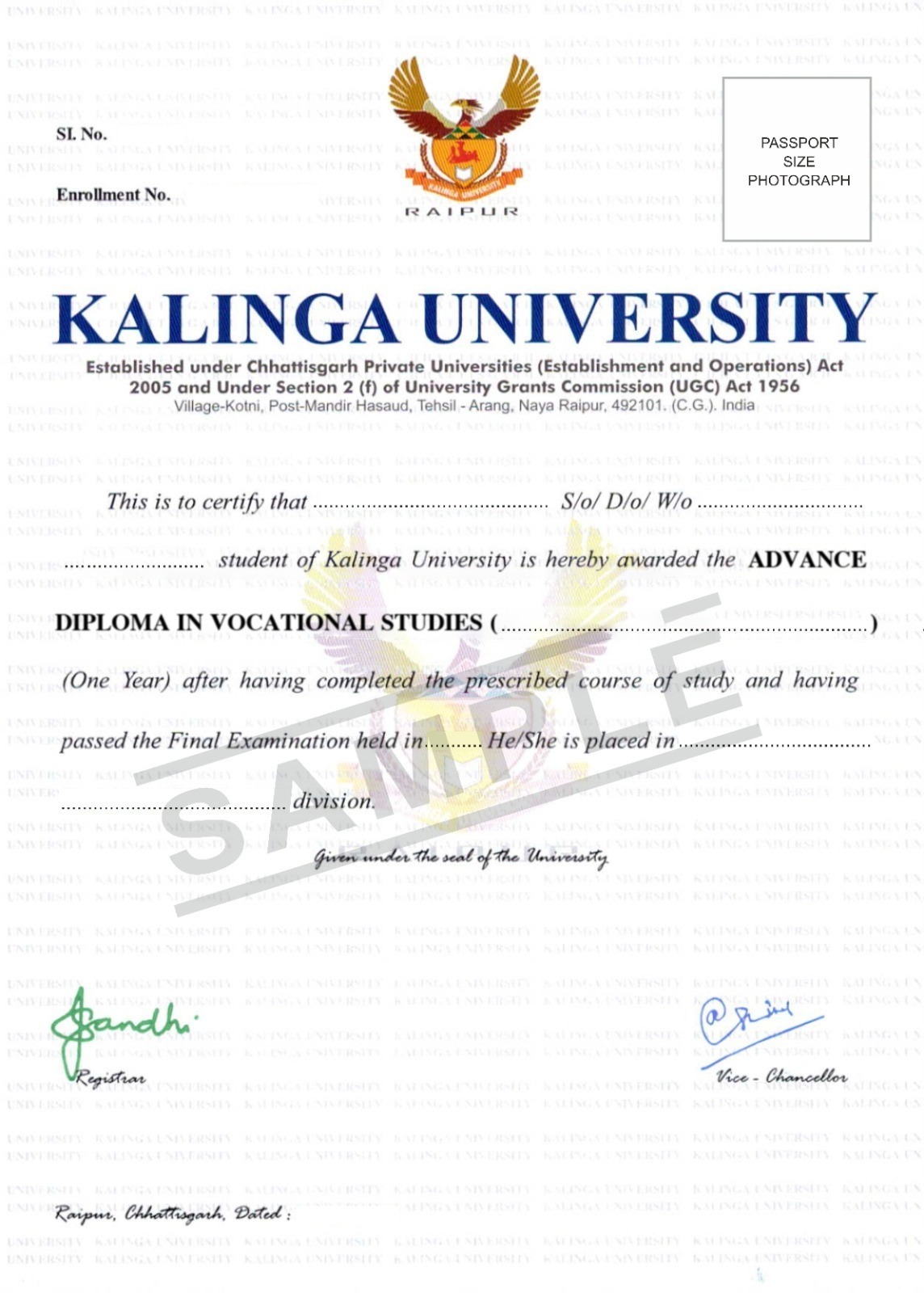
Sample Certificate
Documents
Media Gallery
Frequently Asked Questions
Kalinga University offers a student-focused learning environment that combines academic education with practical exposure, industry-oriented programs, internships, research opportunities, and career development. The university offers 130+ programs and has students from more than 33 countries, creating a diverse and engaging academic environment.
Kalinga University stands out for its Centres of Excellence, industry collaborations, modern laboratories, incubation support, value-added courses, academic clubs, and experiential learning opportunities. Students can gain practical exposure in emerging areas such as AI & ML, robotics, coding, drones, IoT, electric vehicles, and automobile technology.
The university focuses on career readiness through internships, industrial visits, skill-development programs, resume building, aptitude preparation, soft-skill training, interview preparation, and campus placement drives. Its Career and Corporate Resource Centre supports students in developing the skills required for professional careers.
Kalinga University is a private university located in Kotni, Near Mantralaya, Naya Raipur, Chhattisgarh. Established in 2013, the University offers a wide range of Diploma, Undergraduate, Postgraduate and Doctoral programs across multiple disciplines.
Yes. Kalinga University has been established under the Chhattisgarh Private Universities (Establishment and Operation) Act, 2005 and is recognized under Section 2(f) of the UGC Act, 1956. The University is empowered to award degrees as specified under Section 22 of the UGC Act.
Kalinga University offers a broad range of academic programs, including Diploma, Undergraduate (UG), Postgraduate (PG), B.Voc and Ph.D. programs. The University currently lists 130+ programs across various academic disciplines.
Students can explore programs across disciplines such as Engineering, Technology, Management, Commerce, Law, Pharmacy, Science, Arts & Humanities, Biotechnology, Information Technology, Education, Journalism & Mass Communication, Fashion Design, Interior Design and Library Science, among others.
Eligibility requirements vary depending on the program. Generally, UG programs require completion of Class 12 or an equivalent qualification, while PG programs require a relevant bachelor's degree. Certain specialized programs may have additional academic, entrance examination or work-experience requirements. Students should check the eligibility criteria of the specific program before applying.
Students can explore the available programs on EasyShiksha and review the eligibility, duration, admission requirements and other program details. Depending on the program, the admission process may involve an application, entrance examination and/or other university-prescribed selection requirements. Kalinga University also provides its official admission portal for applications.
Entrance requirements depend on the program. Kalinga University conducts the Kalinga Scholastic Entrance Examination (KALSEE) for applicable programs, while certain programs or categories may be exempt from the entrance examination. Students should check the admission requirements of their selected program.
Yes. Kalinga University offers certain programs designed with working professionals in mind. For example, its B.Tech Lateral Entry programs provide flexible shift timings, including weekday evenings and weekends, along with access to recorded learning resources through the LMS. Program-specific eligibility and delivery details should be checked before admission.
Students who successfully complete an eligible academic program receive the applicable academic qualification awarded by Kalinga University, such as a Diploma, Degree or other program-specific credential, subject to fulfillment of the University's academic and examination requirements. For example, students completing the B.Voc program can progress through Diploma, Advanced Diploma and Bachelor's Degree exit options based on the duration completed.
Kalinga University lists 69 B.Voc programmes in its programme category.
Kalinga University lists 138 D.Voc programmes in its programme category.
Kalinga University holds a NAAC B+ accreditation grade.
The D.Voc (Advanced Diploma) in Data Science is a v What is the duration of the D.Voc (Advanced Diploma) in Data Science?ocational program designed to develop advanced skills in data analysis, Python, statistics, databases, data visualization, machine learning, predictive analytics, and data-driven problem-solving.
The D.Voc (Advanced Diploma) in Data Science is a 2-year program divided into 4 semesters, providing extended practical and industry-oriented data science training.
The program covers advanced data science, Python programming, statistics, data structures fundamentals, SQL, database management, data cleaning, exploratory data analysis, data visualization, dashboard development, predictive analytics, machine learning, supervised and unsupervised learning fundamentals, model evaluation, data mining, business analytics, data storytelling, and data ethics.
Graduates can pursue opportunities as Junior Data Analysts, Data Science Assistants, Business Analytics Assistants, Data Visualization Analysts, Reporting Analysts, Data Processing Executives, Machine Learning Assistants, Database Analysts, MIS Executives, and Data Operations Executives.
The program combines Python programming, real-world datasets, SQL projects, data cleaning, statistical analysis, dashboard development, data visualization, predictive analytics, machine-learning exercises, data mining, and business analytics projects, helping students develop practical data science skills.