B.Voc in Software Development
Program Overview
B.Voc in Software Development at Mangalayatan University, Aligarh is a three-year undergraduate vocational degree programme designed to develop practical skills in software programming, web technologies, databases, software engineering, application development, information security and software testing.
The programme combines core theoretical concepts with practical laboratory work, internships and project-based learning. Across six semesters, students progress from C programming, web technology and IT fundamentals to Java, databases, operating systems, information security, open-source software, software project management, software testing, mobile application development and Python programming.
Eligibility Criteria
The minimum eligibility for admission in B.Voc is 10+2 (in any stream) or equivalent or a two-year ITI Diploma after Class 10th or a three-year Polytechnic Diploma after Class 10th.
Approval Details
MHRD, Government of India and UGC
Curriculum
Semester 1 builds the foundation in computer fundamentals, web development, programming and professional communication.
- Functional English: Grammar, reading comprehension, writing, speaking, listening and professional communication skills.
- Fundamentals of Information Technology: Computer fundamentals, hardware and software, operating systems, productivity tools, networking, Internet, databases and emerging technologies.
- Web Technology: Internet and web fundamentals, HTML, CSS, JavaScript, responsive design, server-side scripting, databases, web frameworks and web security.
- Programming using C Language: C programming fundamentals, data types, operators, control structures, functions, arrays, strings, pointers, structures, file handling and debugging.
- Business Communication: Business communication principles, written and oral communication, business correspondence, presentations, interviews, email, reports and workplace communication.
- Programming in C Language – Lab: Practical implementation of C programming concepts.
- Office Automation and Web Technology – Lab: Practical work involving office productivity tools and web technologies.
Download Syllabus
Semester 2 introduces object-oriented programming, data structures, Internet applications and practical programming.
- Internet Applications: Internet fundamentals, web technologies, email, cloud storage, collaboration tools, CMS, cloud applications, e-commerce and Internet security.
- Object-Oriented Programming: Classes, objects, constructors, encapsulation, abstraction, inheritance, polymorphism, interfaces, exception handling, templates/generics and OOP-based applications.
- Environmental Studies: Environment, ecosystems, natural resources, biodiversity, pollution, environmental laws, sustainability and environmental management.
- Data Structure: Arrays, linked lists, stacks, queues, trees, graphs, searching, sorting and hashing, with focus on their applications in software development.
- Professional Communication: Professional writing, reports, resumes, presentations, interviews, listening, negotiation, teamwork and digital communication.
- Programming in C++ – Lab: Practical programming using C++ and object-oriented concepts.
- Data Structure – Lab: Practical implementation of data structures and algorithms.
- Internship/Project-I: Practical exposure through an internship or introductory software project.
Semester 3 focuses on Java programming, software development methodologies, database systems and application development.
- Principles of Management: Management fundamentals, planning, decision-making, organisation, staffing, leadership, motivation, controlling and modern management practices.
- Java Programming: Java fundamentals, JVM/JDK/JRE, variables, control structures, arrays, strings, OOP, inheritance, polymorphism, interfaces, exception handling, file I/O, GUI and collections.
- Software Engineering Methodology: Software engineering concepts, SDLC, Waterfall, V-Model, Incremental, Spiral and Agile methodologies, requirements analysis, SRS, software design, UML, implementation, testing and quality assurance.
- Database System: Database concepts, DBMS, relational models, keys, ER modelling, normalization, SQL, joins, subqueries, stored procedures, triggers, transactions, database security, backup and NoSQL databases.
- Lab Based on SQL & PL/SQL: Practical database programming and SQL/PL-SQL implementation.
- Project Work: Development of a software module based on web technology, database or programming language.
- Java Programming – Lab: Practical implementation of Java programming concepts and applications.
Semester 4 develops knowledge in operating systems, cybersecurity, entrepreneurship, open-source technologies and application development.
- Operating System: OS fundamentals, process management, CPU scheduling, synchronization, memory management, virtual memory, file systems, I/O management, security and Linux/Unix concepts.
- Information Security: Information security principles, CIA triad, cyber threats, cryptography, encryption, network security, firewalls, IDS/IPS, VPN, authentication, authorization, access control, incident response and disaster recovery.
- Entrepreneurship Development: Entrepreneurship concepts, business ideas, feasibility analysis, business planning, funding, marketing, sales, startup management, innovation and business growth.
- Open-Source Software: Open-source philosophy, licensing, Linux, open-source tools, Git/GitHub/GitLab, IDEs, collaborative development, deployment and open-source applications in cloud, web and mobile development.
- ASP.NET using C# – Lab: Practical development using ASP.NET and C#.
- Android Development – Lab: Practical mobile application development for Android.
- Open-Source Software Tool – Lab: Practical use of open-source development tools and platforms.
Semester 5 focuses on professional software development practices, project management, software maintenance and quality assurance.
- Software Project Management and Business Solution: Software project life cycle, project planning, estimation, scheduling, resource allocation, risk management, quality assurance, business requirements and project monitoring.
- Software Re-Engineering: Legacy software maintenance, reverse engineering, forward engineering, redesign, refactoring, re-architecture, testing, quality assurance and re-engineering tools.
- Organizational Behavior: Individual behaviour, motivation, teamwork, leadership, organizational culture, conflict management, change management and contemporary workplace practices in IT organisations.
- Software Testing & Quality Assurance: Testing fundamentals, SDLC and testing, black-box and white-box techniques, test cases, regression testing, SQA, quality standards, automation and modern testing practices.
- Major Project – II: Major practical software development project.
- Soft Skills in IT – Lab: Practical development of professional and workplace skills.
- System and Network Administration – Lab: Practical system and network administration activities.
- Software Testing (CASE Tools): CASE tools, test planning, test management, automated testing, functional/non-functional testing, CI/CD integration and cloud-based testing.
Semester 6 brings together mobile application development, Python programming, microprocessors and an advanced final project.
- Windows Mobile Application Development: Mobile platforms, Windows Mobile, development environments, Visual Studio, C#, XAML, UI design, application programming, data storage, APIs, networking, security, testing and deployment.
- Introduction to Python Programming: Python fundamentals, syntax, variables, operators, control structures, functions, data structures, modules, file handling, libraries and object-oriented programming.
- Introduction to Microprocessors: Microprocessor fundamentals, architecture, registers, buses, instruction sets, assembly programming, interrupts, interfacing, communication and embedded-system applications.
- Windows Mobile Application Development – Lab: Practical development, testing and deployment of mobile applications.
- Python Programming – Lab: Practical implementation of Python programming concepts and applications.
- Major Project Based on AI or Computer Network Security: Final major project focused on Artificial Intelligence or Computer Network Security, integrating the technical knowledge and practical skills developed throughout the programme.
Fee Structure
Admission Process
Students can apply for the B.Voc Software Development programme through EasyShiksha. The complete application process is designed to make admission simple and convenient for eligible students.
Step 1: Click on Apply Now
Click the Apply Now button on the B.Voc Software Development programme page and begin your application through EasyShiksha.
Step 2: Complete Personal Information
Fill in the required personal, contact and academic details accurately in the application form.
Step 3: Upload Required Documents
Upload the required documents for eligibility and admission verification as specified during the application process.
Step 4: Pay Application Fee
Pay the applicable application fee through the available online payment options to submit your application and initiate the admission process.
Step 5: Application Review
The EasyShiksha team reviews your application and submitted documents to verify your eligibility and ensure that the required information and documents have been provided.
Step 6: University Enrollment
Once the application is successfully reviewed and the student is found eligible, EasyShiksha facilitates the enrollment process with Mangalyatan University.
Step 7: LMS Access
After successful enrollment, the student is provided access to the Learning Management System (LMS) to begin their academic journey and access the available learning resources.
Start Your Application
Ready to begin your journey in Software Development? Click Apply Now to submit your application through EasyShiksha.
Career & Placements
After completing the programme, graduates can explore roles such as:
- Software Developer
- Web Developer
- Junior Software Engineer
- Application Developer
- Database Developer
- Software Testing / QA Associate
- Mobile Application Developer
- Python Developer
- Technical Support / IT Professional
- System and Network Support Professional
The programme also provides a foundation for further specialisation in software development, web development, mobile applications, databases, cybersecurity, AI and related IT domains.
Mangalayatan University, Aligarh
Mangalayatan University is a UGC-recognized private university located in Aligarh, Uttar Pradesh, India. Known for its strong industry connections, cutting-edge curriculum, and commitment to technology-driven education, Mangalayatan University has established itself as one of central India's premier higher education institutions.
The university's vision is to foster academic excellence, industry readiness, and global competitiveness among its graduates — making it an ideal partner for EasyShiksha's mission of accessible, quality online education.
EasyShiksha has signed an MoU with Mangalayatan University to facilitate applications for various university programs and jointly offer B.Voc programs. All degrees and certifications under these programs will be awarded by Mangalayatan University. The EasyShiksha team will provide complete assistance and support throughout the admission and program process.
Mangalayatan University, Uttar Pradesh
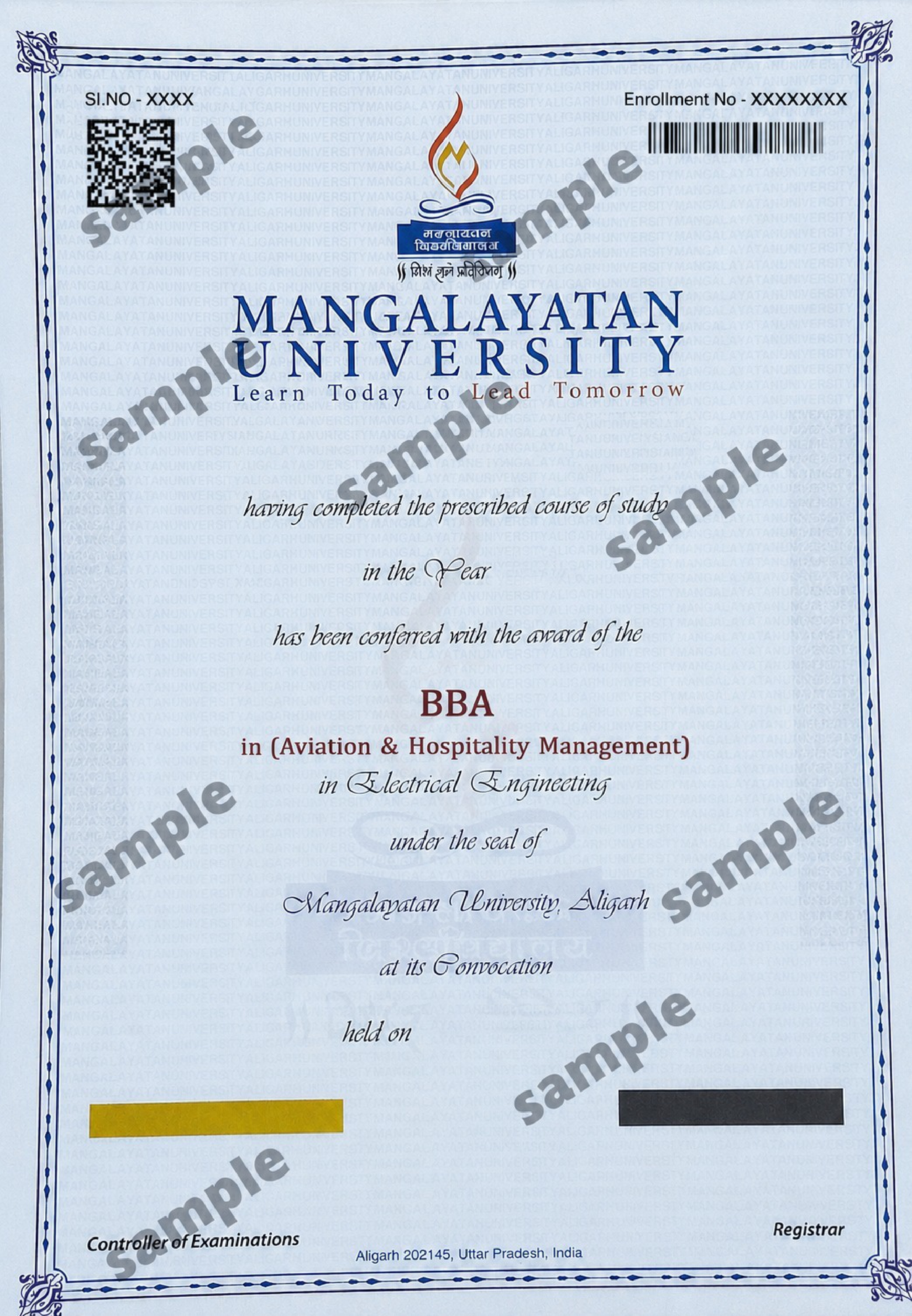
Sample Degree
Documents
Media Gallery
Frequently Asked Questions
Mangalayatan University is located at 33rd Milestone, Aligarh-Mathura Highway, Beswan, Aligarh, Uttar Pradesh, India. The campus is situated in close proximity to the Yamuna Expressway and the cities of Aligarh and Mathura.
Mangalayatan University was established in 2006 under the Mangalayatan University, Uttar Pradesh Act, 2006. The University states that it has the right to confer degrees under Sections 2(f) and 22(1) of the UGC Act.
Yes. Mangalayatan University states that it is recognized by the University Grants Commission (UGC) and was established through an Act of the Uttar Pradesh State Legislature. The University also lists NAAC A+ accreditation among its recognitions.
Yes. The University states that it is recognized by UGC-DEB for Open and Distance Learning (ODL) and is entitled by the UGC to offer online degree programmes. It also states that its online programmes are approved by AICTE.
Mangalayatan University offers programmes across multiple academic levels, including UG, PG, Diploma, PG Diploma and PhD. Its programme portfolio covers areas such as Engineering & Technology, Computer Applications, Management, Agriculture, Biotechnology, Pharmacy, Physiotherapy, Nursing, Journalism & Mass Communication and other disciplines.
Depending on the programme, applicants may be required to provide Class 10 and Class 12 certificates and marksheets, graduation/post-graduation marksheets where applicable, competitive examination rank card where applicable, migration/transfer certificate and recent passport-size photographs. Original documents may be required for verification.
Yes. The University states that students can apply for an education loan through banks, subject to the bank's eligibility criteria.
Mangalayatan University has a 70+ acre campus in Aligarh, Uttar Pradesh.
Mangalayatan University holds an A+ accreditation grade from the National Assessment and Accreditation Council (NAAC).
Yes. Mangalayatan University carries AICTE approval for its technical programmes.
The degree certificate is issued and signed directly by Mangalayatan University, rather than by EasyShiksha or another third-party platform.
The degree certificate is personalised with the student's name, programme, and completion date and carries the university's official signature and seal.
Yes. The university's campus hosts optional immersion sessions associated with select Executive and Hybrid-mode programmes.
Students can select a Mangalayatan University programme, submit their personal details and required documents, pay the application fee, and proceed through the university's application review process.
Yes. Applications submitted through EasyShiksha can be monitored through the dashboard, where applicants can view status updates such as Under Review and Accepted along with their reference ID.
The B.Voc Software Development programme at Mangalayatan University is a 3-year undergraduate degree programme divided into 6 semesters, with a total of 136 credits.
The programme covers C/C++ programming, web technologies, data structures, Java, software engineering, database systems, operating systems, information security, open-source software, software testing, mobile application development and Python programming.
Yes. The curriculum includes multiple practical laboratories covering C/C++, data structures, SQL/PL-SQL, Java, ASP.NET, Android, open-source tools, system and network administration, software testing, Python and Windows Mobile Application Development. It also includes internship/project work and major projects.
Graduates can pursue opportunities in areas such as software development, web development, application development, database development, mobile application development, software testing and IT support. The programme also provides a foundation for further specialisation in areas such as AI and computer network security through the final major project.
Students work with several programming languages and technologies, including C, C++, Java, C#, ASP.NET, Python, HTML, CSS, JavaScript, SQL/PL-SQL and Android development technologies. The curriculum also covers software engineering, databases, operating systems, information security and open-source tools.