A molecule is not created by placing unrelated atoms together randomly. Its structure emerges through specific interactions, compatible bonds, molecular arrangements and relationships between smaller components. Individual atoms contribute their properties, but their combination produces structures with characteristics that cannot be understood by examining each atom independently. This principle offers an intriguing way to rethink how knowledge is organised, taught and developed in modern education.
Traditional education generally presents knowledge through subjects, chapters, courses and academic programmes. Students study individual topics, complete assessments and gradually move towards more advanced material. Although this structure provides an organised curriculum, it does not always make the relationships between concepts visible. A learner may understand individual ideas in mathematics, physics or computer science but struggle to combine them when facing a complex problem. The difficulty may not come from a lack of information. It may arise because the learner has not developed the conceptual connections required to assemble separate pieces of knowledge into a larger understanding.
This creates an opportunity to explore Molecular Knowledge Assembly, a proposed educational framework inspired by the principles of molecular organisation. Under this approach, knowledge would be represented as smaller conceptual units that can connect through meaningful relationships to form increasingly complex structures of understanding. Instead of treating every lesson as an independent destination, an educational platform could identify the foundational concepts required for a subject, explain how those concepts interact and guide learners through the process of combining them.
For an education ecosystem such as EasyShiksha, this idea could provide a new way to connect online courses, quizzes, projects, internships, certificates, university programmes and career guidance. The platform could potentially organise learning around conceptual compatibility and dependency rather than relying exclusively on course completion. A learner would not simply finish one topic and begin another. They would progressively assemble a network of understanding in which each new concept strengthens, extends or modifies what they already know.
The central question is therefore not simply how students can learn more information. It is how educational systems can help them assemble information into coherent, transferable and increasingly sophisticated knowledge.
Understanding Molecular Assembly as an Educational Analogy
Molecular assembly describes the organisation of smaller molecular components into larger structures through interactions that depend on their properties and surrounding conditions. The resulting structure is influenced by compatibility, bonding, orientation, stability and the environment in which assembly occurs. These principles can offer a useful analogy for understanding the construction of knowledge, provided that the comparison is treated as a design inspiration rather than a claim that human learning follows identical chemical processes.
In education, a foundational concept can be compared to an individual building unit. A learner studying programming, for example, may first understand variables, data types, conditions, loops and functions. Each concept has a distinct meaning, but its practical value becomes greater when it is connected with other concepts. A student who understands all five ideas independently may still struggle to develop a working application. The ability to combine them into a logical structure represents a higher level of understanding.
The same pattern appears in mathematics, business, science, finance, design and professional education. Understanding a financial ratio is useful, but interpreting it requires additional knowledge about accounting, business performance and the context in which the ratio is being applied. Learning the principles of user interface design becomes more meaningful when combined with user research, accessibility, interaction patterns and technical implementation.
Molecular Knowledge Assembly would treat these connections as an essential part of the educational experience. Concepts would not be organised only according to their position in a syllabus. They would also be organised according to the relationships that allow learners to combine them into more complex forms of understanding.
From Isolated Concepts to Conceptual Building Units
A major challenge in digital education is that learning content is frequently divided into small lessons without providing a sufficiently clear picture of how those lessons relate to one another. Short lessons can make information easier to access, but fragmentation can also create gaps between concepts.
A conceptual building unit should therefore be more than a short paragraph, video or definition. It should represent a clearly identifiable piece of knowledge with a specific meaning, relevant assumptions, examples and relationships to other concepts. It should also make clear what a learner needs to understand before using it successfully.
Consider a beginner learning data analytics. The subject may involve data collection, data cleaning, statistical reasoning, visualisation, programming and interpretation. Each of these areas can be divided into smaller conceptual units. A lesson on averages, for example, could be represented as a foundational unit connected to data distribution, outliers, statistical summaries and business interpretation.
Once the learner understands the individual units, the platform could introduce activities that require their combination. The student might analyse a dataset, identify unusual values, calculate appropriate summaries and create a visual explanation. The result would be more than a collection of completed lessons. It would be an assembled capability that depends on several connected concepts.
For EasyShiksha, this approach could encourage a transition from content delivery towards structured conceptual development. Online courses could introduce the building units, quizzes could examine individual and combined understanding, and practical projects could test whether students can assemble those units independently.
Insights from Internship Students: Testimonials
×
Conceptual Compatibility: Why Some Ideas Must Be Learned Together
In molecular assembly, not every component can combine with every other component in the same way. The properties of the components influence which interactions are possible and how stable the resulting structure becomes. A comparable principle exists in education: some concepts are naturally connected, while others require additional foundational knowledge before they can be understood meaningfully.
A student cannot reliably apply advanced machine learning methods without understanding relevant mathematical and computational foundations. Similarly, a learner studying financial forecasting needs some understanding of historical data, assumptions, uncertainty and statistical interpretation. Introducing advanced concepts without the necessary foundations can create superficial familiarity rather than genuine understanding.
A knowledge assembly system could represent these relationships through conceptual compatibility rules. Each learning unit could identify the knowledge it requires, the ideas it supports and the concepts with which it can be combined. The platform could then recommend a learning sequence that respects these relationships.
This would make recommendations more meaningful than simply suggesting another course in the same subject category. A learner who completes an introductory Python course might benefit from a unit on data structures before moving towards data analysis. Another learner with strong programming foundations might be ready for a project involving data processing.
The objective would be to identify the next concept that can meaningfully connect with the learner's existing knowledge, rather than recommending content solely because it is popular or frequently selected by other students.
The Role of Conceptual Bonds in Learning
A molecule is held together through interactions between its components. In an educational system, the equivalent of a bond is the relationship that connects one concept with another. These relationships may involve prerequisite knowledge, cause and effect, comparison, application, shared principles or logical dependency.
For example, a student learning web development may connect HTML with document structure, CSS with visual presentation and JavaScript with behaviour. These concepts are distinct, but their combination produces an interactive website. The relationship between them is not merely that they appear in the same course. Each contributes a different function to the final structure.
A conceptual bond becomes meaningful when the learner can explain why two ideas belong together and how one affects the use of the other. This distinction is important because students can memorise several definitions without understanding the relationships between them.
An intelligent learning platform could make these bonds visible through concept maps, linked explanations, integrated exercises and projects. Instead of showing a list of completed lessons, it could display how the learner's understanding is developing across connected areas.
Such a representation could help students identify whether they have learned concepts independently or can combine them to solve a broader problem.
Knowledge Structures and the Importance of Assembly Order
Molecular structures depend on the way their components interact and arrange themselves. Similarly, the order in which concepts are introduced can influence how effectively learners understand a subject. Some ideas provide essential foundations, while others become meaningful only after those foundations are established.
A traditional course may follow a predetermined sequence because the curriculum has been organised into chapters. However, the most useful learning sequence can differ depending on a student's prior knowledge and learning objectives. Two students entering the same course may have very different conceptual foundations.
One learner beginning a data science programme may already understand programming but need additional statistics. Another may have a mathematical background but little experience with coding. A fixed sequence may require one student to repeat familiar material while leaving the other without sufficient support.
Molecular Knowledge Assembly could support more flexible sequencing by identifying the dependencies between conceptual units. The platform could examine what the learner already understands and introduce new material in an order that creates stable connections.
This does not mean that every student should receive a completely different curriculum. Shared academic standards and essential learning outcomes would remain important. The difference would be in how learners reach those outcomes and how foundational concepts are connected along the way.
AI as a Conceptual Assembly Engine
Artificial intelligence could become an important component of Molecular Knowledge Assembly because it can potentially analyse relationships across large collections of educational content. A conventional learning platform may organise courses according to categories, levels and subject areas. An AI-supported assembly system could examine the underlying concepts and identify connections that are not immediately visible from course titles.
For example, a student completing a course in digital marketing may have studied audience segmentation, content strategy, analytics and campaign measurement. AI could identify that these concepts can be combined into a practical campaign-planning activity. It could also recognise that the learner may need additional understanding of conversion measurement before attempting more advanced performance analysis.
The system could potentially analyse lesson content, assessment responses, project outcomes and previously demonstrated knowledge to estimate which conceptual units are understood and which relationships remain weak.
However, AI should not assume that the appearance of a concept in a student's activity proves genuine understanding. Reading a lesson or watching a video is not the same as being able to apply its content. The system would need evidence from explanations, problem-solving, assessments and practical tasks.
Its role would be to support the assembly process by identifying possible connections, recommending appropriate activities and helping learners test whether their conceptual structures are sufficiently developed.
Quizzes as Tests of Individual Components and Combined Structures
Quizzes can play two different roles within a Molecular Knowledge Assembly framework. The first is to test whether students understand individual conceptual units. The second is to determine whether they can combine those units in unfamiliar situations.
A conventional quiz may ask a student to define a term, identify a formula or select the correct explanation. Such questions can be useful for checking foundational knowledge, but they do not always demonstrate whether the learner can apply several concepts together.
A more advanced assessment could begin with an individual question about a concept and gradually introduce problems that require multiple concepts to be used together. In a programming course, a student might first answer questions about loops and conditions separately. A later task could require both to process a collection of data and produce a result.
This progression would allow the platform to distinguish between component-level understanding and integrated understanding. A learner might perform well on individual questions but need further practice when concepts are combined.
EasyShiksha could potentially use this distinction to make quizzes more diagnostic. Instead of reporting only an overall score, an assessment could provide insight into which conceptual units appear secure and which combinations require further development.
From Conceptual Assembly to Practical Projects
The real value of assembled knowledge becomes visible when learners use it to complete practical tasks. Projects provide an environment in which multiple concepts must work together to produce an outcome. They therefore offer a natural testing ground for Molecular Knowledge Assembly.
Consider a student learning user experience design. Understanding typography, colour theory, layout, accessibility and user research separately is important, but these concepts become professionally meaningful when the learner uses them to design an actual interface. The project requires the student to make decisions about how the concepts interact and sometimes resolve conflicts between them.
A project may reveal that the learner understands each topic but cannot yet combine them effectively. For instance, an attractive design may not be accessible, or a technically functional interface may be difficult to navigate. These challenges demonstrate why conceptual integration matters.
Within EasyShiksha, projects could potentially become assembly laboratories. Students could apply concepts from different course modules to create websites, business plans, analytical reports, design prototypes, research presentations or other practical outputs.
The project would serve as evidence that the learner can use knowledge as an organised system rather than simply recall separate pieces of information.
Cross-Disciplinary Knowledge Assembly
Some of the most interesting problems cannot be solved through one academic discipline alone. Climate analysis, public health, business strategy, artificial intelligence and sustainable engineering often require knowledge from several fields.
Molecular Knowledge Assembly could provide a useful framework for connecting concepts across disciplinary boundaries. A student working on a sustainability project, for example, may need to combine environmental science, economics, data analysis, public policy and communication. These subjects have different methods and assumptions, but their integration can produce a more complete understanding of the problem.
The difficulty is that cross-disciplinary learning can become confusing when students encounter unfamiliar terminology and different ways of reasoning. A structured assembly system could identify the concepts that connect disciplines and explain how their assumptions differ.
For example, a business student studying sustainable operations might connect carbon measurement with supply-chain management and financial planning. The system could introduce the relevant concepts separately before asking the learner to use them in a single decision-making exercise.
This approach could help students understand that interdisciplinary knowledge is not simply the accumulation of information from several subjects. It requires deliberate integration.
Molecular Stability and the Durability of Understanding
A molecular structure must maintain sufficient stability under its surrounding conditions. In education, a comparable question concerns whether a learner's understanding remains reliable over time and across different contexts.
Students may understand a concept immediately after studying it but struggle to recall or apply it several weeks later. They may also succeed in a familiar exercise but fail when the same principle appears in a different situation.
This suggests that conceptual assembly should not be judged only at the moment when a lesson is completed. The platform should also consider whether the relationships between concepts remain accessible and useful over time.
A proposed Knowledge Stability Assessment could revisit important conceptual connections through spaced practice, cumulative quizzes and practical applications. Instead of repeating exactly the same question, the system could test whether the learner can recognise and use the same underlying idea in a new context.
For example, a student who learns statistical averages in a mathematics lesson might later encounter them in a business analytics project. Applying the concept in a different setting could provide evidence that the understanding has become more transferable.
The goal would be to build knowledge structures that remain useful beyond the original lesson.
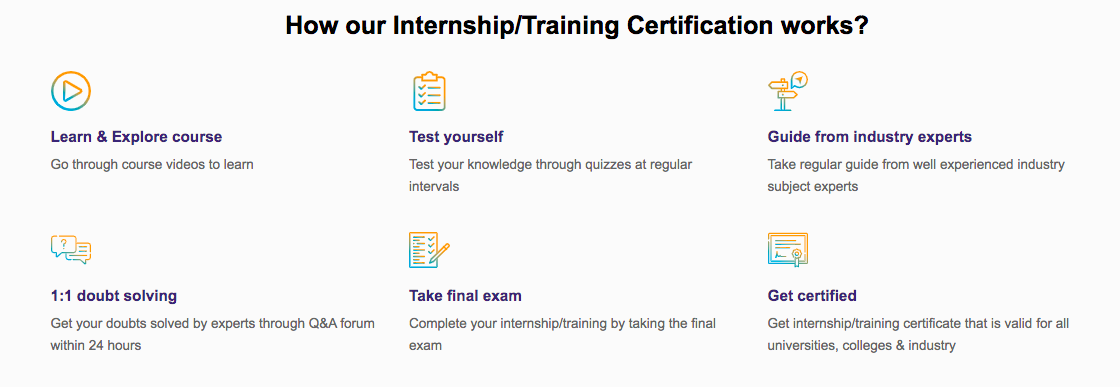
How EasyShiksha Internship/Training Program Works
Detecting Weak Conceptual Bonds
Not every conceptual connection formed during learning will be reliable. Students can misunderstand relationships, apply rules outside their valid conditions or connect ideas that appear similar but have different meanings.
A learner might assume that correlation always indicates causation, confuse a financial metric with a measure of overall business performance or apply a programming technique in a situation where it is unsuitable. These errors can become more difficult to detect when they are embedded in a larger explanation or project.
An intelligent assembly system could attempt to identify weak conceptual bonds by analysing assessment patterns and student explanations. If a learner repeatedly makes the same type of reasoning error across different subjects, the system might identify a relationship that needs clarification.
However, AI-generated diagnoses would need to be treated as suggestions rather than unquestionable judgments. A student's incorrect answer may result from unclear wording, incomplete information or an unusual interpretation of the task. Human review and transparent feedback would remain important.
For EasyShiksha, this could create an opportunity to make assessments more informative. Students would not only discover which answers were incorrect but also receive guidance about the conceptual relationships that may need further attention.
Learning Pathways as Evolving Knowledge Structures
Traditional educational pathways are often represented as a linear progression from beginner to intermediate and advanced levels. Molecular Knowledge Assembly suggests that a learner's knowledge may be better represented as an evolving structure with several possible directions.
A student who understands basic programming might move towards web development, data science, automation or artificial intelligence. Each pathway uses some shared foundations while introducing new conceptual units. The learner's previous knowledge remains relevant, even when the direction changes.
A dynamic learning pathway could therefore preserve existing conceptual structures while allowing new connections to develop. This would be particularly useful for students who change career interests or move between academic and professional learning.
EasyShiksha could potentially use this model to connect courses with related skills, projects and internships. A learner completing a foundational course could explore several next pathways based on demonstrated understanding and career interests. The platform would not need to assume that every learner follows the same sequence.
Such flexibility could make learning more responsive to changing professional goals without requiring students to abandon everything they have previously studied.
Connecting Courses, Certificates and Professional Capabilities
Certificates often represent the completion of a course or programme. However, course completion alone does not necessarily show whether a learner can combine the concepts covered in that programme.
Molecular Knowledge Assembly could encourage a more capability-oriented interpretation of credentials. A certificate could be connected with the conceptual areas covered, the assessments completed and the practical tasks used to demonstrate understanding.
For example, a learner completing a data analytics programme might have studied spreadsheet operations, statistical foundations, data cleaning and visualisation. A project could demonstrate how these concepts were combined to analyse a dataset and communicate findings.
The resulting record would provide more context than a certificate title alone. It could help learners explain what they studied and how they applied it.
For EasyShiksha, this represents a possible opportunity to connect courses, quizzes, certificates and projects into a more meaningful learning record. The purpose would not be to replace formal qualifications but to provide additional evidence of what a learner can understand and accomplish.
Internships as Real-World Assembly Environments
Internships introduce students to situations in which knowledge must be combined under practical conditions. A learner may need to apply technical skills, communication, teamwork, research and problem-solving within a single assignment.
This makes internships particularly valuable for testing whether conceptual assembly can operate outside the controlled environment of a course. A student who understands marketing analytics theoretically may discover that interpreting actual campaign data requires additional knowledge about business objectives, customer behaviour and reporting expectations.
An internship can expose these gaps while providing opportunities to develop stronger connections between concepts.
Within an EasyShiksha learning journey, internship experiences could potentially be connected to the courses and projects that prepare students for them. After completing an internship, students could reflect on which concepts they used, which skills they found difficult to apply and what additional learning might be valuable.
This would create a continuous relationship between academic learning and professional experience. Knowledge would not remain confined to the classroom or online course. It would be tested, extended and reorganised through real tasks.
The Role of Games in Conceptual Assembly
Educational games can provide another environment for exploring how concepts interact. A well-designed game may require students to combine knowledge, evaluate consequences and make decisions within changing conditions.
For example, a business simulation could require a learner to consider pricing, customer demand, inventory and financial constraints at the same time. A science-based game might ask students to use several scientific principles to predict the outcome of a scenario. A programming challenge could require the integration of logic, data structures and debugging.
The value of such experiences lies in their ability to make relationships between concepts visible through decisions and outcomes.
EasyShiksha's games and interactive learning experiences could potentially be connected with course content and assessments to provide more integrated practice. Instead of functioning as separate entertainment activities, they could become environments where learners experiment with combinations of knowledge.
The design would need to ensure that game mechanics support the educational objective. Rewards and scores alone cannot demonstrate that meaningful conceptual integration has occurred.
Personalised Knowledge Assembly Without Permanent Labels
Students differ in their previous knowledge, learning pace and experience. A conceptual assembly system should account for these differences without permanently categorising learners according to their past performance.
One student may already understand the mathematical foundations required for data science, while another may need additional support. A third may have practical experience but limited theoretical understanding. Their learning pathways should reflect these differences.
AI could potentially use assessment evidence to recommend which conceptual units should be introduced, reviewed or connected next. However, these recommendations should remain flexible. A learner who struggles with a concept today may understand it after receiving a clearer explanation or encountering a more relevant example.
The system should therefore treat a learner's knowledge structure as something that develops continuously rather than as a fixed profile.
Personalisation should also preserve student choice. AI can suggest useful learning pathways, but students should be able to explore interests, challenge recommendations and receive explanations about why particular concepts are being suggested.
The Technical Architecture Behind Molecular Knowledge Assembly
Turning this concept into a functioning educational system would require more than organising lessons into smaller sections. It would require a structured representation of concepts and their relationships.
Each conceptual unit could contain information about its meaning, subject area, prerequisite knowledge, learning outcomes, examples, assessment methods and possible applications. Relationships between units could identify whether one concept depends on another, extends it, provides an alternative explanation or applies it in a different context.
An educational knowledge graph could represent these relationships. AI systems could analyse the graph to identify possible learning sequences, discover missing connections and recommend relevant practice activities. Assessment results could provide evidence about how successfully learners understand individual units and their relationships.
The architecture would also need mechanisms for updating content. Academic knowledge changes, professional tools evolve and new research can alter established explanations. A conceptual unit should therefore be maintainable without requiring an entire course to be redesigned whenever one component changes.
This technical approach could help an education platform become more modular and adaptable. Nevertheless, the quality of the system would depend on accurate educational content, careful instructional design and meaningful assessment rather than on the knowledge graph alone.
Challenges and Limitations of the Molecular Assembly Model
Molecular assembly provides a useful analogy, but human understanding is more complex than the organisation of physical components. Concepts can have multiple interpretations, depend on cultural and disciplinary contexts, and change meaning when applied to different situations. A strict assembly model could oversimplify these relationships if every concept were treated as a fixed unit with predictable connections.
There is also a risk of excessive fragmentation. If educational content is divided into too many small units, students may lose sight of the broader meaning of a subject. The purpose of modular learning should be to improve understanding of relationships, not to turn education into an endless collection of disconnected micro-lessons.
Another challenge concerns the reliability of AI-generated conceptual relationships. An AI system may identify a connection that appears plausible but is academically inaccurate. It may also overlook important assumptions or treat two related concepts as interchangeable. Subject experts and educators would need to validate the conceptual structures and ensure that recommendations remain academically sound.
Privacy and learner control would also matter. A system that continuously analyses assessments, projects and learning activity would need transparent data practices. Students should understand how their information is used and have meaningful control over their learning records.
The most responsible implementation would therefore combine modular content, expert validation, AI-supported recommendations, student choice and opportunities for human guidance.
Empower your team. Lead the industry
Get a subscription to a library of online courses and digital learning tools for your organization with
EasyShiksha
EasyShiksha's educational ecosystem provides a useful context for exploring Molecular Knowledge Assembly because its learning experiences can support different stages of conceptual development. Online courses can introduce foundational units, quizzes can examine individual and integrated understanding, games can provide interactive challenges, projects can test the combination of concepts, and internships can expose learners to professional applications.
University programmes can provide deeper academic structures, while certificates can document completed learning experiences. Career guidance can help students understand how their assembled knowledge relates to possible professional directions.
The opportunity lies in connecting these experiences through a common understanding of the learner's developing capabilities. A student should not have to begin every new course without any recognition of previously acquired knowledge. Relevant concepts, completed projects and demonstrated skills could potentially inform the next learning recommendation.
For example, a learner who has completed courses in programming and database fundamentals might be guided towards a project involving application development and data management. Another learner with an interest in business could combine financial literacy, spreadsheet analysis and communication skills through a practical case study.
These pathways would be proposals for a more integrated learning architecture rather than claims about existing platform functionality. Their value would depend on how effectively the platform connects learning content with evidence of understanding and application.
Conclusion: Education as the Architecture of Connected Understanding
The molecular assembly analogy introduces a different way to think about educational development. Knowledge does not become powerful simply because learners accumulate more information. Its value increases when individual concepts are connected, tested and combined into structures that support deeper reasoning and practical application.
A student may memorise definitions, complete lessons and receive certificates while still struggling to solve unfamiliar problems. The missing element may be the ability to assemble separate ideas into a coherent understanding. Molecular Knowledge Assembly addresses this challenge by treating conceptual relationships as a central part of learning design.
For EasyShiksha, this framework could provide a way to connect courses, quizzes, games, projects, internships, certificates, university programmes and career guidance through a more continuous model of capability development. AI could help identify conceptual dependencies, recommend suitable learning sequences and detect weak relationships, while assessments and practical experiences could provide evidence of successful integration.
The long-term objective would not be to reduce every subject to small fragments. It would be to make complex knowledge easier to approach without losing the relationships that give it meaning. Foundational concepts would remain important, but their value would become clearer when students could see how they contribute to larger intellectual and practical structures.
The future of intelligent education may therefore depend not only on how effectively platforms deliver information, but also on how intelligently they help learners connect it. When smaller conceptual units are assembled into stable and meaningful structures, education can move beyond the accumulation of lessons towards the development of genuine understanding, adaptable skills and professional capability.
Anshika Jain is an Engineer, Developer, and Educational Content Author known for her dedication to technology and knowledge sharing. With a strong analytical mindset and a passion for innovation, she has consistently contributed to creating meaningful digital solutions and insightful educational articles.
Her ability to simplify complex technical concepts into engaging and easy-to-understand content makes her work valuable for students and learners across various platforms. Along with her technical expertise, Anshika is admired for her creativity, professionalism, and commitment to continuous learning.
She represents a perfect blend of technical excellence and impactful communication, inspiring others through both her development work and educational contributions.