







M.A in Economics

Program Overview
The M.A. Economics programme at Madurai Kamaraj University (MKU) is a postgraduate programme designed to develop advanced understanding of economic theories, quantitative methods, economic policies and their applications. MKU offers M.A. Economics through its School of Economics, while the Directorate of Distance Education (DDE) also has an official M.A. Economics syllabus. The university's programme listing confirms M.A. Economics as a programme under Economics.
The official DDE syllabus describes the programme as covering areas such as Microeconomics, Macroeconomics, Monetary Economics, Agricultural Economics and Econometrics, with emphasis on analytical thinking, economic data analysis and understanding national and global economic activities and policies.
The DDE M.A. Economics structure is organised into four semesters over two years, with core and elective papers. Major subjects include Micro Economics, Macro Economics, Mathematical Economics, Statistics and Research Methodology, Econometrics, International Economics, Public Economics, Monetary Economics and Environmental Economics.
The programme can be relevant for students interested in economics research, banking and finance, economic analysis, policy-related work, consulting, business analysis and higher education.
Eligibility Criteria
- Bachelor’s degree from a recognized university
Approval Details
- MHRD, Government of India and UGC
Fee Structure
Admission Process
Students can apply for the M.A. in Economics Program from MK University through EasyShiksha. The complete application process is designed to make enrollment simple, convenient, and accessible for eligible learners.
Step 1: Click on Apply Now
Click the Apply Now button on the M.A. in Economics Program page and begin your application through EasyShiksha.
Step 2: Complete Personal Information
Fill in the required personal, contact, and academic details accurately in the application form. Ensure that all information provided is correct and matches your official academic and identification documents.
Step 3: Upload Required Documents
Upload the required documents for eligibility and admission verification as specified during the application process. These may include academic certificates, identity proof, photographs, and other documents required for enrollment.
Step 4: Pay Application Fee
Pay the applicable program or admission fee through the available online payment options to submit your application and initiate the enrollment process.
Step 5: Application Review
The EasyShiksha team reviews your application and submitted documents to verify your eligibility and ensure that all required information and documents have been provided.
Step 6: University Enrollment
Once the application is successfully reviewed and the learner is found eligible, EasyShiksha facilitates the enrollment process with MK University.
Step 7: LMS Access
After successful enrollment, the learner is provided access to the applicable learning platform and academic resources to begin the M.A. in Economics program and access study materials, learning content, and other available academic resources.
Start Your Application
Ready to strengthen your expertise in economics, financial systems, economic policy, markets, development, public finance, and economic research? Click Apply Now to submit your application through EasyShiksha and take the next step toward pursuing an M.A. in Economics from MK University.
Career & Placements
- Banking & finance — banks, financial institutions, insurance, investment-related roles.
- Government sector — economic planning, public administration, policy-related work.
- NGOs/INGOs — development projects, research, monitoring and evaluation.
- Research & data analysis — economic research, market research, statistics and policy analysis.
- Business & corporate sector — business analyst, market analyst, finance-related roles.
- Teaching/academics — with further qualifications such as a Master’s degree.
- Higher studies — Economics, Development Studies, Finance, Business, Public Policy, and related fields.

MK University Patan, Patan
MK University Patan is a UGC-recognized private university located in Patan, Gujarat, India. Known for its strong industry connections, cutting-edge curriculum, and commitment to technology-driven education, MK University Patan has established itself as one of central India's premier higher education institutions.
The university's vision is to foster academic excellence, industry readiness, and global competitiveness among its graduates — making it an ideal partner for EasyShiksha's mission of accessible, quality online education.
EasyShiksha has signed an MoU with MK University Patan to facilitate applications for various university programs and jointly offer B.Voc programs. All degrees and certifications under these programs will be awarded by MK University Patan. The EasyShiksha team will provide complete assistance and support throughout the admission and program process.
MK University Patan, Gujarat
Sample Degree

Documents
Media Gallery
Frequently Asked Questions
MK University Patan was established in 2022 and is located in Patan, Gujarat. It is described as a UGC-recognised private university.
The available programme categories include Degree, Certification, Diploma, PG Diploma, B.Voc, M.Voc, D.Voc, B.Tech, M.Tech, MBA, BBA, B.Sc, B.A, B.Com, M.Sc, M.Com, M.A, PGDCA, BCA, MCA, library science, journalism and mass communication, hospitality, social work, education, physical education and sports, law, design, valuation and Executive programmes.
B.Voc, or Bachelor of Vocation, is an undergraduate degree format that combines academic education with practical and industry-aligned skill development. The source describes areas such as Software Development, Data Science, Computer Applications and Information Technology, Cloud & DevOps, Cybersecurity, UI/UX Design, Graphic & Digital Design, Digital Marketing, Retail Management and Financial Services.
A Diploma is a focused academic or vocational qualification that can be offered at different educational levels, while a PG Diploma is a specialised postgraduate-level programme generally pursued after an undergraduate degree. Eligibility and programme structure depend on the individual course.
M.Voc, or Master of Vocation, is a postgraduate vocational programme focused on advanced knowledge, practical skills and specialised training in a professional or vocational field. The source notes that eligibility and other requirements vary according to the university and specialisation.
D.Voc, or Diploma in Vocation, is designed around practical knowledge, occupational skills and industry-oriented learning in a specific vocational field. Depending on the programme, learning may include practical training, projects and workshops.
B.Tech programmes may cover engineering and technology disciplines such as Computer Science and Engineering, Information Technology, Mechanical Engineering, Civil Engineering, Electrical Engineering, Electronics and Communication Engineering, Artificial Intelligence and Data Science.
MBA programmes provide advanced knowledge of business and management and may cover areas including finance, marketing, human resources, operations, strategy, entrepreneurship and business analytics. Specific specialisations depend on the university and programme.
B.Sc programmes focus on scientific knowledge and subject-specific study. Depending on the programme, areas may include Physics, Chemistry, Mathematics, Biology, Biotechnology, Computer Science, Information Technology, Environmental Science, Microbiology, Zoology, Botany and Statistics.
B.A programmes may cover humanities, social sciences, languages, communication and related disciplines. Examples mentioned in the source include English, Hindi, History, Political Science, Sociology, Psychology, Economics, Geography, Philosophy, Journalism and Public Administration.
M.Com is a postgraduate commerce programme that may include advanced study of Accounting, Finance, Banking, Taxation, Economics, Financial Management, International Business, Business Analytics and Corporate Finance.
PGDCA, or Post Graduate Diploma in Computer Applications, is a postgraduate-level programme covering computer applications, information technology and related digital systems. Depending on the curriculum, students may study programming, databases, computer networks, web technologies, software engineering, operating systems and data structures.
B.Des, or Bachelor of Design, focuses on design thinking, creative problem-solving, visual communication, product development and user-centred design. Depending on the programme, it may include fashion design, communication design, product design, interior design, interaction design, industrial design, textile design and other design areas.
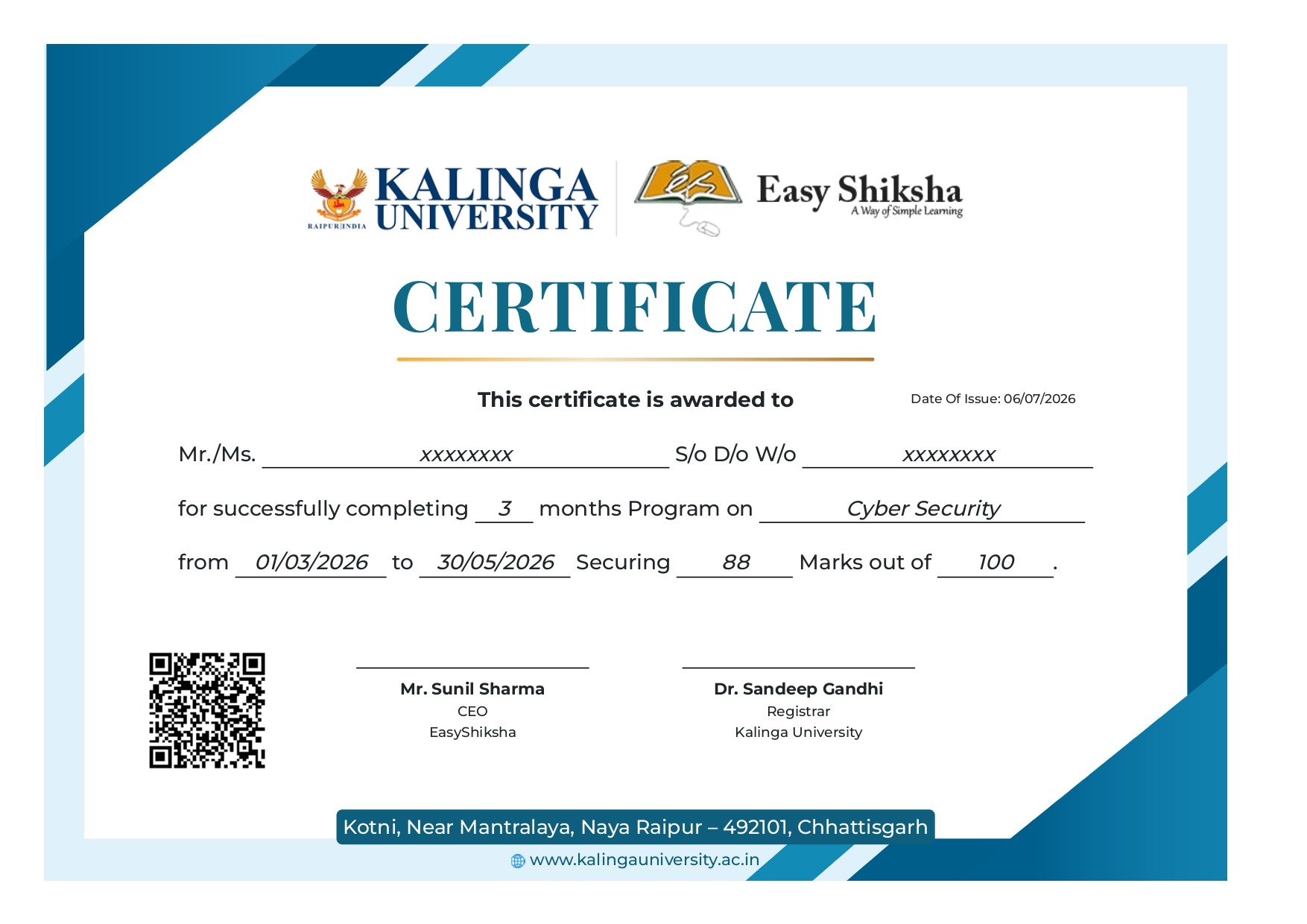
The source states that the degree certificate is issued directly by MK University Patan rather than by a third-party course platform. It is personalised with the student's name, programme and completion date and carries the university's official signature and seal.
The stated process has five stages: choose a programme, apply online by submitting personal details and required documents, pay the applicable fee, have the application reviewed, and then begin the programme after acceptance. The application status can be tracked through the EasyShiksha dashboard.
M.A. Economics is a postgraduate programme focused on advanced economic theory, quantitative analysis and applied economics. At MKU, the curriculum includes areas such as Microeconomics, Macroeconomics, Mathematical Economics, Econometrics, International Economics, Public Economics, Monetary Economics and Environmental Economics. The programme is designed to develop analytical and research-oriented understanding of economic issues.
The official MKU Directorate of Distance Education syllabus states that the M.A. Economics programme is designed to be completed within two years and is organised into four semesters. Each semester includes core and elective coursework. Students should refer to the latest official admission notification for the currently applicable programme regulations.
The programme includes subjects such as Micro Economics, Macro Economics, Mathematical Economics, Statistics and Research Methodology, Economics of Growth and Development, Econometric Methods, International Economics, Public Economics, Monetary Economics and Environmental Economics. Elective areas include Agricultural Economics, Rural and Development Economics, Demography and Labour Economics.
For the MKU DDE programme, the official syllabus states eligibility for specified B.A., B.B.A., B.Com., B.Sc. and B.E. graduates with Economics, Mathematics or Statistics as major or ancillary subjects, along with specified Mathematics or Business Mathematics requirements. The document also specifies category-wise qualifying marks. Applicants should verify the latest admission notification before applying.
Yes. Mathematics and statistics form an important part of the programme. Mathematical Economics covers concepts such as differentiation, consumer and firm theory, market equilibrium and game theory. The curriculum also includes Statistics and Research Methodology and Econometric Methods, helping students develop quantitative and analytical capabilities.