


















B.Voc in Data Science and AI
Program Overview
The B.Voc in Data Science with AI at Mangalayatan University, Beswan, Aligarh is a three-year, six-semester vocational undergraduate programme designed to develop practical skills in data analysis, programming, databases, statistics, business intelligence, data science, machine learning, artificial intelligence, deep learning, NLP, computer vision, Generative AI, data products and MLOps.
The curriculum follows a progressive learning structure. Students begin with foundational subjects such as Excel for Data Analysis, C programming, C++, statistics and digital literacy, and then advance into databases, SQL, web technologies, mathematics, Power BI, data structures and algorithms.
In the later semesters, the programme moves into core Data Science and AI areas including Python for Data Science, Machine Learning, Artificial Intelligence, Data Wrangling, Deep Learning, Natural Language Processing, Big Data and AI Ethics. The final semester introduces advanced industry-oriented areas such as Computer Vision, Generative AI & Prompt Engineering, Data Product Development, Model Deployment & MLOps, Capstone Project / Industry Internship and Entrepreneurship in AI & Data Startups.
The complete programme carries 134 credits, distributed across six semesters: 22 credits each in Semesters I–V and 24 credits in Semester VI. The curriculum also includes an induction programme as per applicable UGC/regulatory-body guidelines.
Eligibility Criteria
The minimum eligibility for admission in B.Voc is 10+2 (in any stream) or equivalent or a two-year ITI Diploma after Class 10th or a three-year Polytechnic Diploma after Class 10th.
Approval Details
MHRD, Government of India and UGC
Curriculum
Semester I – Foundations of Programming, Data Analysis & Statistics
Semester I establishes the foundation required for a career in Data Science and AI. Students develop communication skills, spreadsheet-based data analysis capabilities, programming fundamentals, statistical understanding and digital literacy. The semester carries 22 credits.
1. English Communication – I
This subject develops foundational professional communication skills.
Key areas include:
- Basics of communication
- Verbal and non-verbal communication
- Communication barriers
- Grammar and sentence structure
- Tenses, articles, prepositions and modals
- Reading and comprehension
- Vocabulary development
- Paragraph and essay writing
- Formal and informal letters
- Professional email writing
- Resume and cover-letter preparation
- Report and notice writing
- Listening and speaking skills
- Group discussions and presentations
- Professional and workplace communication
2. Basic MS Excel for Data Analysis
Introduces Excel as a foundational data-analysis tool.
Students learn:
- Excel interface, worksheets and workbooks
- Cell referencing
- Data entry and formatting
- Mathematical and logical formulas
- Functions such as SUM, AVERAGE, IF, AND and OR
- Text functions
- Date and time functions
- VLOOKUP, HLOOKUP, MATCH and INDEX
- Sorting and filtering
- Conditional formatting
- Data validation
- Charts and Sparklines
- Pivot Tables and Pivot Charts
- Slicers
- Descriptive statistics
- What-If Analysis
- Basic data cleaning
- Macros and automation concepts
- CSV and text-file data import/export
- Introduction to Power Query and Power Pivot
- Basic dashboard development
3. Introduction to Programming using C
Provides the fundamentals of programming and algorithmic thinking.
Topics include:
- Computer systems and programming languages
- Algorithms and flowcharts
- Structure of C programs
- Compilation and execution
- Variables and data types
- Operators
- Input and output
- Conditional statements
- Loops
- Arrays
- Strings
- Functions
- Recursion
- Pointers
- Structures and unions
- File handling
4. Object-Oriented Programming Concepts using C++
Introduces object-oriented programming concepts using C++.
Students learn:
- Structured vs. object-oriented programming
- Abstraction
- Encapsulation
- Inheritance
- Polymorphism
- C++ syntax and programming
- Classes and objects
- Constructors and destructors
- Access specifiers
- Function and operator overloading
- Virtual functions
- Abstract classes
- Arrays and strings
- Pointers and references
- Dynamic memory allocation
- File handling
- Exception handling
5. Basics of Statistics
Builds the statistical foundation necessary for data analysis and Data Science.
Topics include:
- Introduction to statistics
- Qualitative and quantitative data
- Primary and secondary data
- Population and sample
- Measurement scales
- Data classification and tabulation
- Frequency distributions
- Graphical representation
- Mean, median and mode
- Measures of dispersion
- Standard deviation
- Correlation
- Regression
- Probability
- Conditional probability
- Index numbers
- CPI and WPI
6. Digital Literacy & Internet Fundamentals
Develops essential digital skills required for modern technology careers.
Topics include:
- Computer hardware and software
- Operating systems
- File management
- Windows and Linux basics
- Office productivity tools
- Internet and web browsers
- Email and online communication
- Cloud storage
- Cybersecurity fundamentals
- Phishing, malware and online threats
- Data privacy
- Digital footprint
- Cyber laws and ethics in India
- Introduction to AI, Cloud Computing and IoT
- Digital services and e-governance
- Digital payments
- Remote-work technologies
Download Syllabus
Semester II – Databases, SQL, Advanced Excel & Web Fundamentals
Semester II strengthens the student's technical foundation with databases, SQL, advanced Excel analytics, web technologies and mathematics for computer science. The semester carries 22 credits.
1. English Communication – II
Builds advanced professional communication skills through:
- Advanced grammar
- Vocabulary
- Business correspondence
- Professional email writing
- Report writing
- Resume and cover-letter preparation
- Public speaking
- Group discussions
- Interview preparation
- Reading and comprehension
- Listening skills
- Corporate and academic communication
- Cross-cultural communication
2. Introduction to Databases
Introduces database concepts and Database Management Systems.
Students study:
- Database fundamentals
- DBMS components
- File-based vs. database systems
- Database users and administrators
- Data models
- ER modelling
- Database architecture
- Relational database concepts
- Keys and relationships
- Relational algebra
- SQL fundamentals
- Database normalization
- 1NF, 2NF, 3NF and BCNF
- Transactions
- ACID properties
- Concurrency
- Backup and recovery
- Database security
3. SQL Fundamentals
Develops practical SQL skills for working with relational databases.
Topics include:
- Relational databases
- SQL statement categories
- DDL, DML, DCL and TCL
- Database and table creation
- Constraints
- ALTER, DROP and TRUNCATE
- Indexes and views
- INSERT, UPDATE and DELETE
- SELECT queries
- Filtering and sorting
- Aggregate functions
- GROUP BY and HAVING
- UNION and INTERSECT
- Joins
- Subqueries
- Stored procedures and functions
- Transactions
- COMMIT, ROLLBACK and SAVEPOINT
- Query optimization
4. Advanced Excel for Data Analytics
Moves beyond basic spreadsheet usage into professional data-analysis workflows.
Students learn:
- Data import and export
- Data cleaning
- Advanced filtering
- Advanced Excel functions
- XLOOKUP, INDEX and MATCH
- Statistical functions
- Conditional analysis
- What-If Analysis
- Solver
- PivotTables
- PivotCharts
- Slicers
- Interactive dashboards
- Dynamic charts
- Macros and VBA basics
- Workbook protection
- Excel integration with Power BI
5. Web Design Fundamentals – HTML, CSS, JavaScript Basics
Introduces the fundamentals of web technologies.
Topics include:
- Internet and web technologies
- Front-end and back-end concepts
- Client-server architecture
- Domains, hosting and URLs
- HTML
- Semantic HTML
- Forms and multimedia
- CSS
- CSS selectors and box model
- Flexbox and Grid
- Responsive design
- Media queries
- Bootstrap overview
- JavaScript fundamentals
- Variables and data types
- Functions
- DOM manipulation
- Events
- Form validation
- Dynamic effects
- HTML, CSS and JavaScript integration
6. Mathematics for Computer Science
Provides mathematical foundations used in computing, algorithms and Data Science.
Topics include:
- Logic and proof techniques
- Propositional and predicate logic
- Sets and relations
- Functions
- Matrices and determinants
- Linear equations
- Combinatorics
- Probability
- Graph theory
- Trees and graph traversal
- Number theory
- Recurrence relations
- Applications in algorithms and cryptography
Semester III – Data Management, Statistics, BI & Algorithms
Semester III moves students further into core computing and analytics. It carries 22 credits and includes Power BI, Database Management Systems, Statistics & Probability, Computer Architecture and Data Structures & Algorithms.
1. Presentation Skills – I
Develops the ability to communicate technical and analytical information effectively.
Topics include:
- Presentation fundamentals
- Audience analysis
- Presentation planning
- Content structuring
- Verbal and non-verbal communication
- Visual aids
- PowerPoint, Google Slides and Canva
- Presentation delivery
- Q&A handling
- Feedback and self-assessment
- Personal presentation portfolio
2. Computer Architecture and Networks
Introduces computer hardware architecture and networking fundamentals.
Topics include:
- Computer organization
- CPU, ALU, control unit and registers
- Von Neumann architecture
- Number systems
- Memory hierarchy
- RAM, ROM and virtual memory
- Instruction execution
- Pipelining
- RISC and CISC
- I/O organization
- LAN, MAN, WAN and PAN
- Network topologies
- Network devices
- OSI and TCP/IP models
- IP addressing and subnetting
- DNS
- Routing and switching
- Wireless networks
- Network security
3. Database Management Systems
Provides deeper knowledge of database design and management.
Students study:
- DBMS architecture
- Data independence
- Data models
- ER diagrams
- Entities and relationships
- Relational models
- Normalization
- Functional dependencies
- SQL
- Aggregate functions
- Joins and subqueries
- Transactions
- ACID properties
- Concurrency control
- Deadlock handling
- Recovery
- Database security
- Distributed databases
- NoSQL databases
- Cloud databases
4. Statistics & Probability Theory
Develops a stronger statistical foundation for Data Science.
Topics include:
- Statistical concepts
- Data collection and presentation
- Central tendency
- Dispersion
- Probability theory
- Conditional probability
- Bayes' theorem
- Random variables
- Probability distributions
- Binomial, Poisson and Normal distributions
- Correlation and regression
- Statistical inference
- Hypothesis testing
- Type I and Type II errors
- t-test, chi-square test and F-test
- Confidence intervals
5. Power BI for Business Intelligence
Introduces Microsoft Power BI for business intelligence and data visualization.
Students learn:
- Business Intelligence fundamentals
- Power BI Desktop and Service
- Data import
- Power Query
- Data cleaning
- Data transformation
- Data modelling
- Relationships
- Calculated columns
- Measures
- DAX
- Time intelligence
- Data visualization
- Interactive reports
- Slicers and filters
- Dashboards
- Publishing and sharing reports
- Data refresh
- Power BI security and governance
6. Data Structures and Algorithms
Develops algorithmic thinking and efficient data-processing skills.
Topics include:
- Data structures
- Abstract Data Types
- Algorithm analysis
- Time and space complexity
- Big O notation
- Arrays
- Linked lists
- Stacks and queues
- Trees
- Graphs
- BFS and DFS
- Searching
- Sorting
- Hashing
- Divide and conquer
- Greedy algorithms
- Dynamic programming
Semester III – Data Management, Statistics, BI & Algorithms
Semester III moves students further into core computing and analytics. It carries 22 credits and includes Power BI, Database Management Systems, Statistics & Probability, Computer Architecture and Data Structures & Algorithms.
1. Presentation Skills – I
Develops the ability to communicate technical and analytical information effectively.
Topics include:
- Presentation fundamentals
- Audience analysis
- Presentation planning
- Content structuring
- Verbal and non-verbal communication
- Visual aids
- PowerPoint, Google Slides and Canva
- Presentation delivery
- Q&A handling
- Feedback and self-assessment
- Personal presentation portfolio
2. Computer Architecture and Networks
Introduces computer hardware architecture and networking fundamentals.
Topics include:
- Computer organization
- CPU, ALU, control unit and registers
- Von Neumann architecture
- Number systems
- Memory hierarchy
- RAM, ROM and virtual memory
- Instruction execution
- Pipelining
- RISC and CISC
- I/O organization
- LAN, MAN, WAN and PAN
- Network topologies
- Network devices
- OSI and TCP/IP models
- IP addressing and subnetting
- DNS
- Routing and switching
- Wireless networks
- Network security
3. Database Management Systems
Provides deeper knowledge of database design and management.
Students study:
- DBMS architecture
- Data independence
- Data models
- ER diagrams
- Entities and relationships
- Relational models
- Normalization
- Functional dependencies
- SQL
- Aggregate functions
- Joins and subqueries
- Transactions
- ACID properties
- Concurrency control
- Deadlock handling
- Recovery
- Database security
- Distributed databases
- NoSQL databases
- Cloud databases
4. Statistics & Probability Theory
Develops a stronger statistical foundation for Data Science.
Topics include:
- Statistical concepts
- Data collection and presentation
- Central tendency
- Dispersion
- Probability theory
- Conditional probability
- Bayes' theorem
- Random variables
- Probability distributions
- Binomial, Poisson and Normal distributions
- Correlation and regression
- Statistical inference
- Hypothesis testing
- Type I and Type II errors
- t-test, chi-square test and F-test
- Confidence intervals
5. Power BI for Business Intelligence
Introduces Microsoft Power BI for business intelligence and data visualization.
Students learn:
- Business Intelligence fundamentals
- Power BI Desktop and Service
- Data import
- Power Query
- Data cleaning
- Data transformation
- Data modelling
- Relationships
- Calculated columns
- Measures
- DAX
- Time intelligence
- Data visualization
- Interactive reports
- Slicers and filters
- Dashboards
- Publishing and sharing reports
- Data refresh
- Power BI security and governance
6. Data Structures and Algorithms
Develops algorithmic thinking and efficient data-processing skills.
Topics include:
- Data structures
- Abstract Data Types
- Algorithm analysis
- Time and space complexity
- Big O notation
- Arrays
- Linked lists
- Stacks and queues
- Trees
- Graphs
- BFS and DFS
- Searching
- Sorting
- Hashing
- Divide and conquer
- Greedy algorithms
- Dynamic programming
Semester V – Advanced AI, Big Data, NLP & Industry Project
Semester V builds advanced AI and Data Science capabilities while introducing industry-oriented project work. The semester carries 22 credits.
1. Interview & Career Skills
Prepares students for professional employment and career development.
Topics include:
- Career planning
- Goal setting
- SWOT analysis
- Time management
- Resume writing
- Cover letters
- Interview preparation
- HR and technical interviews
- Mock interviews
- Group discussions
- Aptitude skills
- Workplace readiness
- Professionalism
- Collaboration
- Conflict resolution
- Continuous learning
2. Deep Learning
Introduces neural-network-based AI and deep-learning architectures.
Topics include:
- AI, ML and Deep Learning
- Neural networks
- Perceptrons
- Activation functions
- Loss functions
- Gradient descent
- Backpropagation
- Feedforward Neural Networks
- Multilayer Perceptrons
- Dropout
- Batch normalization
- Hyperparameter tuning
- Convolutional Neural Networks
- Image classification
- RNNs
- LSTM
- GRU
- Autoencoders
- GANs
- Transfer learning
- TensorFlow and Keras
- AI applications in Computer Vision and NLP
3. Natural Language Processing (NLP)
Introduces techniques for processing and understanding human language using AI.
Students learn:
- NLP fundamentals
- NLP pipelines
- Text encoding
- Tokenization
- Stemming
- Lemmatization
- Stop-word removal
- POS tagging
- Bag of Words
- TF-IDF
- Word embeddings
- Word2Vec
- GloVe
- FastText
- Parsing
- Named Entity Recognition
- Semantic analysis
- Text classification
- Sentiment analysis
- Topic modelling
- RNN and LSTM
- Transformer architecture
- Attention mechanisms
- BERT and GPT overview
- Chatbots
- Text summarization
- Question-answering systems
- NLP ethics and privacy
4. Big Data Fundamentals
Introduces technologies and architectures for processing large-scale datasets.
Topics include:
- Big Data characteristics: Volume, Velocity, Variety, Veracity and Value
- Big Data architecture
- Distributed computing
- Data-processing frameworks
- Cloud-based Big Data
- Hadoop
- HDFS
- MapReduce
- YARN
- Hive
- Pig
- Apache Spark
- RDDs and DataFrames
- MongoDB
- Cassandra
- Data ingestion tools
- Kafka overview
- Real-time analytics
- Big Data applications
- Security and privacy
5. Ethics in Data Science & AI
Focuses on responsible development and use of data-driven technologies.
Students study:
- Technology ethics
- Ethical decision-making
- Professional codes of conduct
- Data privacy
- Data ownership
- Consent
- GDPR
- Indian data-protection context
- Anonymization
- De-identification
- Algorithmic bias
- Fairness
- Accountability
- Transparency
- Explainable AI
- Responsible AI frameworks
- AI governance
- Human oversight
- Employment and social impact
- Surveillance
- Deepfakes
- Misinformation
- Digital manipulation
6. Project / Internship – I
Provides practical exposure through an industry-oriented project or internship, allowing students to apply the technical concepts developed during the programme in a practical environment.
Semester VI – Generative AI, Computer Vision, Data Products & MLOps
Semester VI is the most advanced stage of the programme and carries 24 credits. It focuses strongly on emerging AI technologies, production deployment and entrepreneurship.
1. Computer Vision and Image Processing in AI
Introduces AI-based image processing and computer vision.
Topics include:
- Digital image fundamentals
- Pixels and colour models
- RGB, HSV and grayscale
- Image acquisition
- Image enhancement
- Noise removal
- Histogram equalization
- Spatial and frequency filtering
- Edge detection
- Image segmentation
- Contour detection
- Feature extraction
- SIFT, SURF and ORB
- Object tracking
- CNNs for image classification
- Transfer learning
- VGG, ResNet and Inception
- YOLO and R-CNN overview
- Autoencoders and GANs
- OpenCV
- Keras and TensorFlow
- Image annotation
- Computer vision applications
- Privacy and ethical considerations
2. Generative AI & Prompt Engineering
Introduces modern Generative AI technologies and prompt-engineering techniques.
Topics include:
- Generative AI fundamentals
- Generative vs. discriminative models
- Large Language Models
- Generative AI tools
- ChatGPT
- DALL·E
- Midjourney
- Variational Autoencoders
- GANs
- Diffusion models
- Prompt engineering
- Instruction-based prompts
- Zero-shot and few-shot prompting
- Prompt formulation
- Output evaluation and refinement
- OpenAI API
- Hugging Face
- Generative text and image models
- Prompt tuning
- Fine-tuning
- Python-based AI automation
- Generative AI applications
- Responsible AI
- Bias, misinformation and plagiarism
- Multimodal and autonomous generative systems
3. Data Product Development
Introduces the process of converting data and AI capabilities into usable products.
Students learn:
- Data-product concepts
- Dashboards
- APIs
- Predictive models
- AI-powered tools
- Data-product lifecycle
- Ideation and prototyping
- Product architecture
- Data ingestion
- Data processing
- Visualization
- Cloud-based architecture
- Data pipelines
- Airflow and Prefect
- APIs and automation
- Data quality
- Scalability
- Model integration
- Version control
- Testing
- CI/CD
- Docker
- Cloud deployment
- Performance monitoring
- KPIs
- User feedback
- Data privacy and security
- Responsible AI product development
4. Model Deployment & MLOps
Introduces the practices required to move machine-learning models from development into production.
Topics include:
- MLOps fundamentals
- MLOps vs. traditional DevOps
- Data, model and code management
- Model packaging
- Pickle
- ONNX
- TensorFlow SavedModel
- Flask and FastAPI
- Cloud deployment
- Docker
- Version control
- CI/CD
- Jenkins
- GitHub Actions
- MLflow
- Model testing
- Model monitoring
- Drift detection
- Prometheus
- Grafana
- Model retraining
- Scalability
- Latency
- Kubeflow
- TFX
- Airflow
- Secure and ethical model deployment
5. Capstone Project / Industry Internship – II
The final practical component allows students to undertake an advanced capstone project or industry internship, applying the knowledge gained throughout the six-semester programme to a substantial Data Science or AI-oriented project.
6. Entrepreneurship in AI & Data Startups
Introduces entrepreneurship and startup development specifically in AI and data-driven industries.
Topics include:
- Entrepreneurship fundamentals
- AI startup ecosystem
- Innovation opportunities
- Design thinking
- Ideation
- Market feasibility
- Intellectual property
- Patents, copyrights and trademarks
- Business Model Canvas
- AI product and service strategy
- Customer discovery
- Value proposition
- Pricing
- Lean startup methodology
- Product-market fit
- Startup finance
- Bootstrapping
- Angel investment
- Venture capital
- Financial projections
- AI startup operations
- Business plans
- Investor pitches
- Branding and marketing
- Customer acquisition
- AI startup case studies
- Scaling and sustainability
Fee Structure
Admission Process
Students can apply for the B.Voc Data Science and AI programme through EasyShiksha. The complete application process is designed to make admission simple and convenient for eligible students.
Step 1: Click on Apply Now
Click the Apply Now button on the B.Voc Data Science and AI programme page and begin your application through EasyShiksha.
Step 2: Complete Personal Information
Fill in the required personal, contact and academic details accurately in the application form.
Step 3: Upload Required Documents
Upload the required documents for eligibility and admission verification as specified during the application process.
Step 4: Pay Application Fee
Pay the applicable application fee through the available online payment options to submit your application and initiate the admission process.
Step 5: Application Review
The EasyShiksha team reviews your application and submitted documents to verify your eligibility and ensure that the required information and documents have been provided.
Step 6: University Enrollment
Once the application is successfully reviewed and the student is found eligible, EasyShiksha facilitates the enrollment process with Mangalyatan University.
Step 7: LMS Access
After successful enrollment, the student is provided access to the Learning Management System (LMS) to begin their academic journey and access the available learning resources.
Start Your Application
Ready to begin your journey in Software Development? Click Apply Now to submit your application through EasyShiksha.
Career & Placements
The B.Voc in Data Science with AI provides a broad technical foundation across data analytics, programming, databases, business intelligence, machine learning, artificial intelligence, deep learning, NLP, computer vision, Generative AI, data engineering concepts, data products and MLOps.
Graduates can explore opportunities in the following areas:
Data & Analytics Roles
- Data Analyst
- Junior Data Analyst
- Business Data Analyst
- Data Analytics Executive
- Reporting Analyst
- BI Analyst
- Business Intelligence Executive
- Data Visualization Analyst
The programme specifically develops skills in Excel, statistics, Power BI, SQL and data visualization, which form the foundation for analytics and BI-oriented roles.
Data Science & Machine Learning Roles
- Junior Data Scientist
- Associate Data Scientist
- Machine Learning Associate
- Machine Learning Engineer – Junior
- AI/ML Analyst
- Data Science Intern
- Machine Learning Intern
The curriculum provides dedicated training in Python, data preprocessing, supervised and unsupervised learning, model evaluation, deep learning and machine-learning implementation using relevant frameworks.
Artificial Intelligence Roles
- AI Developer
- AI/ML Engineer – Junior
- AI Solutions Associate
- AI Application Developer
- Generative AI Associate
- AI Automation Developer
- Prompt Engineering Associate
The programme covers AI fundamentals, deep learning, Generative AI, prompt engineering, AI APIs and AI-based automation workflows.
NLP & Conversational AI
Students can pursue entry-level opportunities in:
- NLP Engineer – Junior
- NLP Analyst
- Conversational AI Developer
- Chatbot Developer
- AI Content Processing Associate
- Language AI Intern
The NLP curriculum includes text processing, embeddings, classification, sentiment analysis, transformers, BERT/GPT overview, chatbots, summarization and question-answering systems.
Computer Vision & AI Imaging
Possible career directions include:
- Computer Vision Engineer – Junior
- Computer Vision Developer
- Image Processing Engineer – Junior
- AI Vision Developer
- Computer Vision Intern
The programme covers image processing, segmentation, feature extraction, CNNs, transfer learning, object detection and OpenCV-based implementation.
Data Engineering & Big Data
Students can explore entry-level opportunities such as:
- Junior Data Engineer
- Big Data Associate
- Data Pipeline Developer
- Data Processing Associate
- Big Data Intern
The curriculum introduces distributed computing, Hadoop, HDFS, MapReduce, Spark, NoSQL databases and real-time data technologies.
MLOps & AI Deployment
The final semester provides exposure to production-oriented AI workflows, including:
- MLOps Associate
- ML Deployment Engineer – Junior
- AI Deployment Associate
- ML Platform Intern
- AI DevOps / MLOps Intern
Students are introduced to model packaging, APIs, Docker, cloud deployment, CI/CD, MLflow, monitoring, drift detection and model lifecycle management.
Data Product & AI Product Roles
The Data Product Development subject creates a pathway toward roles such as:
- Data Product Associate
- AI Product Associate
- Data Product Analyst
- Junior AI Product Manager
- Data Product Development Intern
Students learn about data-product lifecycles, product architecture, pipelines, APIs, model integration, deployment, KPIs and continuous product improvement.
Entrepreneurship & Freelancing
The programme also prepares students to pursue independent opportunities by developing knowledge of:
- AI-based product development
- Data-driven business models
- AI startup ideation
- Business Model Canvas
- Customer discovery
- Pricing strategies
- Startup finance
- Investor pitching
- AI product marketing
- Product-market fit
The final subject specifically focuses on Entrepreneurship in AI & Data Startups, including startup finance, venture capital, business planning, investor pitches and scaling.
Mangalayatan University, Aligarh
Mangalayatan University is a UGC-recognized private university located in Aligarh, Uttar Pradesh, India. Known for its strong industry connections, cutting-edge curriculum, and commitment to technology-driven education, Mangalayatan University has established itself as one of central India's premier higher education institutions.
The university's vision is to foster academic excellence, industry readiness, and global competitiveness among its graduates — making it an ideal partner for EasyShiksha's mission of accessible, quality online education.
EasyShiksha has signed an MoU with Mangalayatan University to facilitate applications for various university programs and jointly offer B.Voc programs. All degrees and certifications under these programs will be awarded by Mangalayatan University. The EasyShiksha team will provide complete assistance and support throughout the admission and program process.
Mangalayatan University, Uttar Pradesh
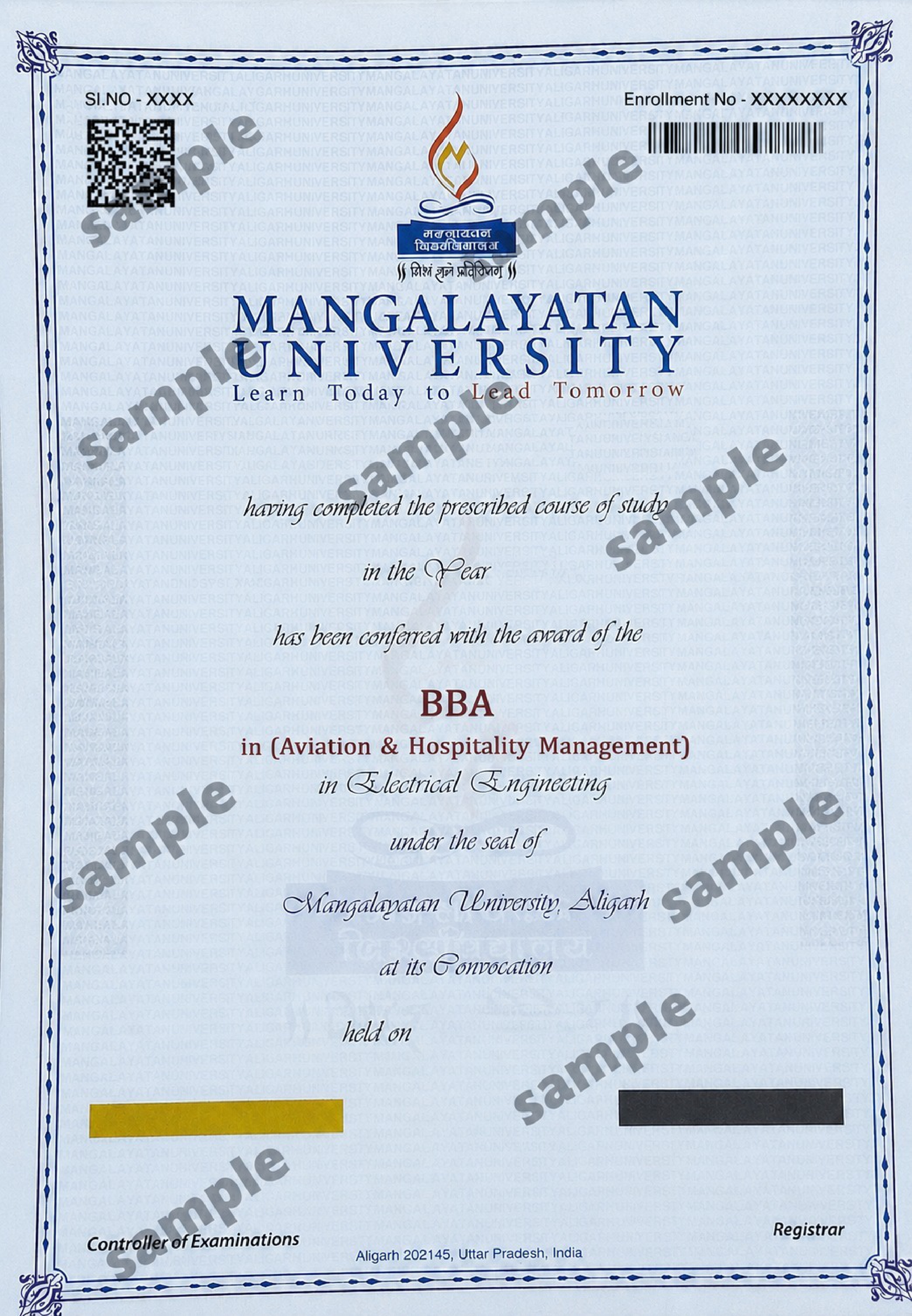
Sample Degree
Documents
Media Gallery
Frequently Asked Questions
Mangalayatan University is located at 33rd Milestone, Aligarh-Mathura Highway, Beswan, Aligarh, Uttar Pradesh, India. The campus is situated in close proximity to the Yamuna Expressway and the cities of Aligarh and Mathura.
Mangalayatan University was established in 2006 under the Mangalayatan University, Uttar Pradesh Act, 2006. The University states that it has the right to confer degrees under Sections 2(f) and 22(1) of the UGC Act.
Yes. Mangalayatan University states that it is recognized by the University Grants Commission (UGC) and was established through an Act of the Uttar Pradesh State Legislature. The University also lists NAAC A+ accreditation among its recognitions.
Yes. The University states that it is recognized by UGC-DEB for Open and Distance Learning (ODL) and is entitled by the UGC to offer online degree programmes. It also states that its online programmes are approved by AICTE.
Mangalayatan University offers programmes across multiple academic levels, including UG, PG, Diploma, PG Diploma and PhD. Its programme portfolio covers areas such as Engineering & Technology, Computer Applications, Management, Agriculture, Biotechnology, Pharmacy, Physiotherapy, Nursing, Journalism & Mass Communication and other disciplines.
Depending on the programme, applicants may be required to provide Class 10 and Class 12 certificates and marksheets, graduation/post-graduation marksheets where applicable, competitive examination rank card where applicable, migration/transfer certificate and recent passport-size photographs. Original documents may be required for verification.
Yes. The University states that students can apply for an education loan through banks, subject to the bank's eligibility criteria.
Mangalayatan University has a 70+ acre campus in Aligarh, Uttar Pradesh.
Mangalayatan University holds an A+ accreditation grade from the National Assessment and Accreditation Council (NAAC).
Yes. Mangalayatan University carries AICTE approval for its technical programmes.
The degree certificate is issued and signed directly by Mangalayatan University, rather than by EasyShiksha or another third-party platform.
The degree certificate is personalised with the student's name, programme, and completion date and carries the university's official signature and seal.
Yes. The university's campus hosts optional immersion sessions associated with select Executive and Hybrid-mode programmes.
Students can select a Mangalayatan University programme, submit their personal details and required documents, pay the application fee, and proceed through the university's application review process.
Yes. Applications submitted through EasyShiksha can be monitored through the dashboard, where applicants can view status updates such as Under Review and Accepted along with their reference ID.
B.Voc in Data Science with AI is a vocational undergraduate programme focused on developing practical skills in data analysis, programming, databases, statistics, machine learning, artificial intelligence and advanced AI technologies. The curriculum progresses from foundational programming and analytics to advanced areas such as Generative AI, Computer Vision and MLOps.
The programme covers a wide range of subjects including C, C++, Excel, Statistics, SQL, Databases, Mathematics, Power BI, Data Structures, Cloud Computing, Python, Machine Learning, Artificial Intelligence, Data Wrangling, Deep Learning, NLP, Big Data, Computer Vision, Generative AI, Prompt Engineering, Data Product Development and MLOps.
Yes. Artificial Intelligence is introduced in Semester IV, while advanced AI topics are covered in later semesters. The final semester includes Computer Vision and Image Processing in AI and Generative AI & Prompt Engineering, including LLMs, generative models, prompt engineering, OpenAI API, Hugging Face and AI automation workflows.
Yes. The curriculum includes Project / Internship – I in Semester V and Capstone Project / Industry Internship – II in Semester VI. These components provide students with opportunities to apply the knowledge acquired throughout the programme in practical or industry-oriented work.
Graduates can explore opportunities across Data Analytics, Business Intelligence, Data Science, Machine Learning, Artificial Intelligence, NLP, Computer Vision, Big Data, Generative AI, Data Products and MLOps. Depending on their skills and experience, they can work toward roles such as Data Analyst, BI Analyst, Junior Data Scientist, ML Associate, AI Developer, NLP Associate, Computer Vision Associate, Big Data Associate, Generative AI Associate and MLOps Associate. The programme also includes entrepreneurship training for students interested in building AI and data-driven startups.