

















B.Voc in Patient Care Management
Program Overview
The B.Voc in Patient Care Management at Mangalayatan University is a three-year vocational undergraduate program focused on developing knowledge and practical skills relevant to patient care, healthcare support services and hospital operations. The curriculum combines human anatomy and physiology, patient care, first aid, hospital stores and inventory, Hospital Information System (HIS), healthcare ethics, infection control, health and wellness, quality management, medical terminology and organizational behavior.
The first year establishes the foundation of patient care and healthcare operations. Students study Fundamentals of Human Anatomy and Physiology, Patient Care I, First Aid I, Stores & Inventory I, Hospital Information System, Ethics for Healthcare Professionals - I, Communication in Business Settings, Managerial Accounting, Principles of Managerial Economics, Infection Control Procedures & Protocols I, Introduction to Computers and Environmental Studies. Vocational practical courses provide hands-on exposure to patient-care skills, first aid, hospital stores, HIS, communication, ethics and environmental practices.
The second year advances students into areas such as Health & Wellness I, Advance Patient Care I, Introduction to Quality Management, Organizational Behavior, Biomedical Waste Management, Medical Terminology, Human Anatomy & Physiology II, Patient Care II, First Aid II, Stores & Inventory II, Hospital Information System II and Ethics for Healthcare Professionals - II. Practical training progressively integrates patient care, infection control, emergency response, nutrition and feeding support, medical terminology, quality management and hospital information systems.
The final year emphasizes advanced infection-control practices, patient-care project work and vocational training. Students complete Infection Control Procedures & Protocols II, Patient Care Project & Viva Voce, Vocational Practical - V, Health & Wellness II, Advance Patient Care II, Training & Project Work and Vocational Practical - VI. The training and project component includes supervised exposure to patient care, infection control and hospital operations, along with project implementation, data collection, documentation, presentation and viva voce.
Eligibility Criteria
The minimum eligibility for admission in B.Voc is 10+2 (in any stream) or equivalent or a two-year ITI Diploma after Class 10th or a three-year Polytechnic Diploma after Class 10th.
Approval Details
MHRD, Government of India and UGC
Curriculum
Semester I introduces students to the fundamentals of the human body, patient care, emergency support, hospital stores, healthcare information systems and professional ethics. The semester carries 24 credits and includes a dedicated vocational practical component.
1. Fundamentals of Human Anatomy and Physiology
This subject introduces the structure and functioning of the human body and establishes an anatomical foundation for patient-care studies.
Key Topics:
- Anatomical terminology and body organization
- Cells, tissues and organ systems
- Skeletal and muscular systems
- Circulatory and lymphatic systems
- Respiratory and digestive systems
- Nervous, endocrine, excretory and reproductive systems
- Skin and vital signs in applied physiology
Credits: 4
2. Patient Care I
This course introduces the principles, responsibilities and practical foundations of patient care in healthcare settings.
Key Topics:
- Introduction to patient care
- Hospital environment and patient admission/discharge
- Basic nursing care and vital signs
- Patient hygiene, feeding and daily activities
- Infection control and first aid
- Patient communication and comfort
- Mobility and rehabilitation
- Care of special patients
- Patient safety and documentation
Credits: 4
3. First Aid I
This subject develops foundational knowledge of first aid and emergency response.
Key Topics:
- Principles and objectives of first aid
- Basic Life Support and CPR
- Management of bleeding and shock
- First aid for wounds, burns and fractures
- Medical emergencies
- Environmental emergencies
- Casualty transportation
- Bandaging and dressing
- Disaster and mass-casualty first aid
- First aid for special situations
Credits: 3
4. Stores & Inventory I
This course introduces hospital stores and inventory-management practices.
Key Topics:
- Healthcare stores management
- Classification of medical and non-medical materials
- Purchasing and procurement
- Receiving and inspection
- Storage and preservation
- Inventory-control techniques
- Issue and distribution systems
- Stock records and documentation
- Legal and ethical aspects
- Technology in inventory management
Credits: 3
5. Hospital Information System
This subject introduces the use of information systems in healthcare and hospital administration.
Key Topics:
- Hospital Information System fundamentals
- Healthcare information management
- HIS modules and components
- Electronic Health Records
- Communication and networking in HIS
- Decision-support systems
- HIS applications in patient care
- Healthcare data security
- HIS implementation
- AI, cloud computing and IoT in healthcare
Credits: 4
6. Ethics for Healthcare Professionals - I
This course introduces ethical principles and professional responsibilities in healthcare.
Key Topics:
- Healthcare ethics and moral principles
- Professionalism and accountability
- Patient rights and responsibilities
- Informed consent and confidentiality
- Ethical issues in patient care
- Professional–patient relationships
- Legal aspects of healthcare
- Ethics in research and clinical practice
- Workplace ethics
- Contemporary healthcare ethics
Credits: 2
7. Vocational Practical - I
This practical component develops foundational vocational skills in patient care, first aid, hospital stores, HIS and professional conduct.
Key Topics:
- Hand hygiene, PPE and patient-bed preparation
- Patient positioning and vital signs
- Personal hygiene and patient assistance
- Feeding and elimination assistance
- First aid, bandaging and BLS
- Hospital stores and inventory basics
- HIS and electronic patient records
- Patient communication and documentation
- Ethical and legal applications
- Community and preventive care practices
Download Syllabus
Semester II expands the curriculum into business communication, accounting, managerial economics, infection control, computer applications and environmental studies. It carries 22 credits and includes a vocational practical component.
1. Communication in Business Settings
This subject develops professional communication skills for healthcare and hospital-administration environments.
Key Topics:
- Fundamentals of business communication
- Oral communication and presentations
- Business writing and correspondence
- Non-verbal and interpersonal communication
- Healthcare and patient communication
- Meetings and negotiations
- Presentation and public-relations skills
- Digital communication
- Professional documentation
- Contemporary communication practices
Credits: 2
2. Managerial Accounting
This course introduces accounting and financial concepts relevant to management and healthcare institutions.
Key Topics:
- Managerial accounting concepts
- Accounting principles and bookkeeping
- Cost concepts and classification
- Budgeting and budgetary control
- Break-even and marginal costing
- Standard costing and variance analysis
- Responsibility accounting
- Capital budgeting
- Financial statement analysis
- Healthcare financial-management practices
Credits: 3
3. Principles of Managerial Economics
This subject introduces economic concepts and their application to healthcare and hospital management.
Key Topics:
- Managerial economics fundamentals
- Demand analysis and forecasting
- Supply and production analysis
- Cost analysis
- Market structures
- Pricing decisions
- National income and business cycles
- Monetary and fiscal policy
- International trade and globalization
- Contemporary healthcare economics
Credits: 3
4. Infection Control Procedures & Protocols I
This course introduces infection prevention and control practices in healthcare environments.
Key Topics:
- Infection-control fundamentals
- Microorganisms and pathogens
- Standard precautions and hand hygiene
- PPE
- Cleaning, disinfection and sterilization
- Hospital infection-control committees
- Isolation and barrier nursing
- Occupational safety
- Environmental infection control
- Infection surveillance and emerging issues
Credits: 4
5. Introduction to Computers
This subject develops foundational computer skills applicable to healthcare and hospital management.
Key Topics:
- Computer hardware and software
- Operating systems
- Word processing
- Spreadsheets and presentations
- Computer networks and internet
- Database-management basics
- Healthcare documentation
- Cybersecurity fundamentals
- Cloud and mobile applications
- EHR, telemedicine and healthcare IT
Credits: 2
6. Environmental Studies
This course introduces environmental systems, conservation, pollution, sustainability and environmental issues relevant to healthcare.
Key Topics:
- Environmental studies and ecosystems
- Natural resources
- Biodiversity and conservation
- Environmental pollution
- Climate change
- Population and environment
- Environmental legislation
- Environmental education
- Sustainable development
- Contemporary environmental challenges
Credits: 2
7. Vocational Practical - II
This practical course reinforces patient care and integrates infection control, emergency response, HIS, computer applications and managerial skills.
Key Topics:
- Advanced patient-care skills
- Infection-control and safety practices
- First aid and emergency response
- Hospital stores and inventory
- HIS practical activities
- Communication and professional conduct
- Computer applications
- Environmental and sustainability practices
- Managerial and accounting exercises
- Ethical and legal applications
Semester III develops advanced knowledge in health and wellness, patient care, quality management, organizational behavior, biomedical waste and medical terminology. The semester carries 24 credits.
1. Health & Wellness I
This course introduces health, wellness, nutrition, fitness, preventive care and community health.
Key Topics:
- Health and wellness concepts
- Nutrition and balanced diet
- Personal hygiene and grooming
- Physical fitness and exercise
- Mental and emotional well-being
- Health screening and preventive care
- Lifestyle-disease management
- Workplace wellness
- Community health and wellness
- Contemporary wellness trends
Credits: 4
2. Advance Patient Care I
This subject builds upon basic patient-care knowledge and introduces more advanced patient-support practices.
Key Topics:
- Advanced patient-care skills
- Vital-signs monitoring
- Care of pediatric and geriatric patients
- Care of patients with chronic conditions
- Advanced hygiene and infection control
- Nutrition and feeding
- Emergency and first-aid care
- Medication assistance
- Patient documentation
- Patient comfort and psychological support
Credits: 4
3. Introduction to Quality Management
This course introduces quality management and patient-safety concepts in healthcare.
Key Topics:
- Quality management fundamentals
- Healthcare quality standards
- Quality assurance and quality control
- Total Quality Management
- Quality-management tools
- Patient safety and risk management
- Documentation and record keeping
- Continuous Quality Improvement
- Leadership in quality
- Patient feedback and emerging quality practices
Credits: 3
4. Organizational Behavior
This subject examines individual, group and organizational behavior within healthcare environments.
Key Topics:
- Organizational behavior fundamentals
- Individual behavior and motivation
- Group dynamics and teamwork
- Leadership
- Organizational communication
- Organizational culture and climate
- Conflict management
- Organizational change
- Employee engagement
- Diversity and contemporary workplace practices
Credits: 3
5. Biomedical Waste Management
This course develops knowledge of biomedical-waste handling, segregation, treatment and regulatory requirements.
Key Topics:
- Biomedical-waste fundamentals
- Waste classification and segregation
- Collection and transportation
- Storage procedures
- Treatment and disposal
- Occupational health and safety
- Legal and regulatory framework
- Monitoring and auditing
- Environmental sustainability
- Contemporary biomedical-waste issues
Credits: 3
6. Medical Terminology
This subject develops the ability to understand and use medical terminology in healthcare documentation and communication.
Key Topics:
- Medical word roots, prefixes and suffixes
- Anatomical terminology
- Body-system terminology
- Medical procedures and diagnostics
- Pharmacology and drug terminology
- Pathology and disease terminology
- Laboratory and clinical terminology
- Medical abbreviations and symbols
- Healthcare documentation
- Digital health and coding terminology
Credits: 3
7. Vocational Practical - III
This practical component integrates advanced patient care with infection control, first aid, nutrition, HIS, quality management and medical terminology.
Key Topics:
- Advanced vital-signs monitoring
- Infection control and safety
- Emergency and first-aid response
- Nutrition and feeding support
- Patient communication and documentation
- HIS practical work
- Biomedical-waste practices
- Quality management and patient safety
- Medical terminology practice
- Integrated clinical scenarios
Semester IV further develops anatomy, patient care, emergency response, hospital inventory, HIS and healthcare ethics. It carries 26 credits and includes an extensive vocational practical component.
1. Human Anatomy & Physiology II
This course continues the study of human body systems and their clinical relevance to patient care.
Key Topics:
- Muscular and skeletal systems
- Nervous system
- Cardiovascular system
- Respiratory system
- Digestive system
- Urinary system
- Endocrine system
- Reproductive system
- Homeostasis
- Applied anatomy and physiology in patient care
Credits: 4
2. Patient Care II
This subject advances patient-care skills and introduces more comprehensive support for special and complex patient populations.
Key Topics:
- Advanced patient assessment
- Care of special populations
- Infection control and aseptic practices
- Nutrition and hydration management
- Medication assistance and monitoring
- Mobility and rehabilitation
- Emergency and critical care
- Communication and documentation
- Patient comfort and psychological support
- Contemporary patient-care practices
Credits: 4
3. First Aid II
This course builds advanced first-aid and emergency-response knowledge.
Key Topics:
- Advanced first aid
- Trauma and injury management
- Burns and scalds
- Shock and circulatory emergencies
- Respiratory emergencies
- Cardiac emergencies and CPR
- Poisoning and chemical emergencies
- Environmental emergencies
- First aid for special populations
- Emergency drills and practical application
Credits: 3
4. Stores & Inventory II
This course advances hospital stores and inventory-management knowledge.
Key Topics:
- Hospital stores management
- Inventory-control methods
- Procurement and purchasing
- Storage and handling of supplies
- Stock issuance and distribution
- Inventory software and digital systems
- Costing and budgeting
- Auditing and quality assurance
- Safety and risk management
- Contemporary hospital supply-chain practices
Credits: 3
5. Hospital Information System II
This subject develops advanced knowledge of HIS, patient data, hospital workflows and healthcare information security.
Key Topics:
- Advanced HIS
- Patient data management
- Appointment and scheduling systems
- Clinical information management
- Pharmacy and inventory integration
- Billing and financial management
- Data analytics and reporting
- Security and risk management
- HIS implementation and maintenance
- Telemedicine, cloud HIS and AI applications
Credits: 4
6. Ethics for Healthcare Professionals - II
This course extends healthcare ethics into patient rights, confidentiality, decision-making and contemporary healthcare challenges.
Key Topics:
- Healthcare ethics and decision-making
- Patient rights and professional responsibilities
- Confidentiality and privacy
- Informed consent
- Ethical issues in patient care
- Professionalism
- Legal and regulatory frameworks
- Ethics in special healthcare settings
- Conflict resolution and ethical decision-making
- AI, robotics, genomics and emerging healthcare ethics
Credits: 2
7. Vocational Practical - IV
This practical component integrates advanced patient care, infection control, emergency response, nutrition, medication support, HIS, biomedical waste, quality and ethics.
Key Topics:
- Advanced patient-care practices
- Infection control and safety protocols
- Emergency response and first aid
- Nutrition and medication support
- HIS and healthcare documentation
- Biomedical waste and environmental practices
- Quality and ethics in patient care
- Medical terminology exercises
- Integrated clinical scenarios
- Evaluation and reporting
Semester V focuses on advanced infection control and project-based patient-care learning. It carries 20 credits and includes Patient Care Project & Viva Voce along with vocational practical work.
1. Infection Control Procedures & Protocols II
This course develops advanced knowledge of infection prevention, hospital-acquired infections and infection-control systems.
Key Topics:
- Advanced infection-control principles
- Hospital-acquired infections
- Hand hygiene and PPE
- Sterilization and disinfection
- Isolation and barrier nursing
- Waste management and environmental hygiene
- Occupational health and safety
- Infection control in special hospital areas
- Surveillance and quality improvement
- Emerging infections and pandemic preparedness
Credits: 4
2. Patient Care Project & Viva Voce
This project course provides structured experience in planning, implementing, analyzing and presenting a patient-care-related project.
Key Topics:
- Project planning and proposal development
- Data collection and observation
- Patient-care project implementation
- Data analysis and interpretation
- Project report writing
- Presentation and viva voce
- Evaluation of project work
- Patient confidentiality and ethical considerations
Credits: 8
3. Vocational Practical - V
This practical course consolidates advanced vocational skills in patient care and healthcare operations.
Key Topics:
- Advanced patient-care skills
- Infection-control and safety practices
- Emergency response and first aid
- Medication and nutrition support
- HIS practical activities
- Quality and ethics
- Biomedical-waste practices
- Medical terminology integration
- Integrated clinical scenarios
- Evaluation and reporting
Semester VI is the final semester and focuses on advanced health and wellness, patient care, supervised training and practical integration. It carries 24 credits.
1. Health & Wellness II
This course develops advanced knowledge of wellness, nutrition, fitness, preventive healthcare and holistic approaches.
Key Topics:
- Advanced health and wellness concepts
- Nutrition and dietary management
- Physical fitness and exercise therapy
- Mental health and stress management
- Preventive healthcare
- Occupational health and safety
- Environmental and social wellness
- Health education and counseling
- Holistic and integrative approaches
- Contemporary health and wellness trends
Credits: 4
2. Advance Patient Care II
This subject develops advanced patient-care knowledge for complex and special populations.
Key Topics:
- Comprehensive patient assessment
- Complex and special patient populations
- Advanced infection prevention
- Medication and therapeutic support
- Nutrition and hydration management
- Mobility and rehabilitation
- Emergency and critical care
- Communication and documentation
- Quality assurance and patient safety
- Technology-assisted advanced patient care
Credits: 4
3. Training & Project Work
This component provides supervised vocational training and project-based experience in healthcare settings.
Key Topics:
- Training orientation and planning
- Hospital policies and workflows
- Supervised practical training
- Patient monitoring, feeding, mobility and hygiene
- Infection-control and hospital-safety protocols
- Data collection and project implementation
- Data analysis and interpretation
- Training and project report writing
- Presentation and viva voce
- Evaluation and feedback
Credits: 8
4. Vocational Practical - VI
This final practical component integrates the major vocational skills developed throughout the program.
Key Topics:
- Advanced patient-care practices
- Infection-control and safety protocols
- Medication and therapeutic support
- Emergency and critical-care skills
- Nutrition and hydration management
- Hospital Information System practical work
- Quality assurance and ethics
- Integrated clinical scenarios
- Documentation and reporting
- Professional development and career readiness
Fee Structure
Admission Process
Students can apply for the B.Voc Patient Care Management programme through EasyShiksha. The complete application process is designed to make admission simple and convenient for eligible students.
Step 1: Click on Apply Now
Click the Apply Now button on the B.Voc Patient Care Management programme page and begin your application through EasyShiksha.
Step 2: Complete Personal Information
Fill in the required personal, contact and academic details accurately in the application form.
Step 3: Upload Required Documents
Upload the required documents for eligibility and admission verification as specified during the application process.
Step 4: Pay Application Fee
Pay the applicable application fee through the available online payment options to submit your application and initiate the admission process.
Step 5: Application Review
The EasyShiksha team reviews your application and submitted documents to verify your eligibility and ensure that the required information and documents have been provided.
Step 6: University Enrollment
Once the application is successfully reviewed and the student is found eligible, EasyShiksha facilitates the enrollment process with Mangalyatan University.
Step 7: LMS Access
After successful enrollment, the student is provided access to the Learning Management System (LMS) to begin their academic journey and access the available learning resources.
Start Your Application
Ready to begin your journey in Software Development? Click Apply Now to submit your application through EasyShiksha.
Career & Placements
The B.Voc in Patient Care Management covers patient-care assistance, first aid, infection control, healthcare information systems, hospital stores, health and wellness, quality management, medical terminology, healthcare ethics and practical training. Based on these curriculum areas, graduates can explore opportunities in healthcare-support and hospital-operation environments, subject to the requirements of individual employers and roles.
Patient Care and Healthcare Support
- Patient Care Assistant – Support day-to-day patient-care activities such as hygiene, mobility, comfort, feeding and observation.
- Patient Care Support Professional – Apply training in patient monitoring, documentation, communication and basic care procedures.
- Healthcare Support Assistant – Assist healthcare teams with appropriate patient-support and routine healthcare activities.
- Geriatric Care Support Assistant – Apply relevant learning to support elderly patients with mobility, nutrition, hygiene and comfort.
The curriculum specifically covers basic and advanced patient care, special populations, mobility, nutrition, hygiene and patient documentation.
Hospital Operations and Administration
- Hospital Operations Assistant – Support routine hospital operational activities using knowledge of healthcare workflows.
- Hospital Information System Assistant – Work with patient records, HIS workflows, reports and healthcare information processes.
- Healthcare Documentation Assistant – Support documentation and record-keeping activities.
- Hospital Stores & Inventory Assistant – Apply knowledge of procurement, inventory control, stock records and supply distribution.
The syllabus covers HIS, hospital records, inventory, procurement, stock control, data security and healthcare administration.
Infection Control and Safety
- Infection Control Support Assistant – Assist with infection-prevention procedures, hygiene practices, PPE and related documentation.
- Hospital Safety Support Professional – Apply training in occupational safety, emergency response and healthcare safety practices.
- Biomedical Waste Management Support Assistant – Support appropriate segregation, handling, documentation and monitoring of biomedical waste.
The curriculum includes infection control, sterilization, isolation, PPE, occupational safety, biomedical waste and infection surveillance.
Emergency and First-Aid Support
- First-Aid Support Professional – Apply foundational and advanced first-aid knowledge in appropriate support settings.
- Emergency Care Support Assistant – Assist with emergency-response procedures within the scope of training and supervision.
- Patient Transport Support Assistant – Apply training related to safe movement and transportation of patients.
First Aid I and First Aid II cover BLS, CPR, trauma, burns, shock, respiratory and cardiac emergencies, disaster response and patient transportation.
Health and Wellness Services
- Health & Wellness Support Professional – Apply knowledge of wellness, nutrition, fitness and preventive health.
- Health Education Support Assistant – Support health-awareness and patient-education activities.
- Wellness Program Support Assistant – Explore roles involving wellness promotion and healthy-lifestyle activities.
The curriculum includes nutrition, physical fitness, mental well-being, preventive healthcare, counseling and community wellness.
Quality and Patient Safety
- Quality Management Support Assistant – Assist with quality documentation, audits, feedback systems and continuous-improvement activities.
- Patient Safety Support Professional – Support patient-safety monitoring and reporting activities.
- Healthcare Quality Documentation Assistant – Work with quality records, incident reports and audit documentation.
The syllabus specifically includes quality management, patient safety, risk management, CQI, audits, feedback and quality-monitoring tools.
Medical Documentation and Communication
- Medical Documentation Assistant – Apply medical terminology and documentation skills in suitable healthcare settings.
- Healthcare Communication Assistant – Use professional communication skills with patients, families and healthcare teams.
- Medical Records Support Assistant – Apply knowledge of patient records, medical terminology and electronic healthcare information.
The curriculum includes Medical Terminology, healthcare communication, HIS and patient documentation.
Mangalayatan University, Aligarh
Mangalayatan University is a UGC-recognized private university located in Aligarh, Uttar Pradesh, India. Known for its strong industry connections, cutting-edge curriculum, and commitment to technology-driven education, Mangalayatan University has established itself as one of central India's premier higher education institutions.
The university's vision is to foster academic excellence, industry readiness, and global competitiveness among its graduates — making it an ideal partner for EasyShiksha's mission of accessible, quality online education.
EasyShiksha has signed an MoU with Mangalayatan University to facilitate applications for various university programs and jointly offer B.Voc programs. All degrees and certifications under these programs will be awarded by Mangalayatan University. The EasyShiksha team will provide complete assistance and support throughout the admission and program process.
Mangalayatan University, Uttar Pradesh
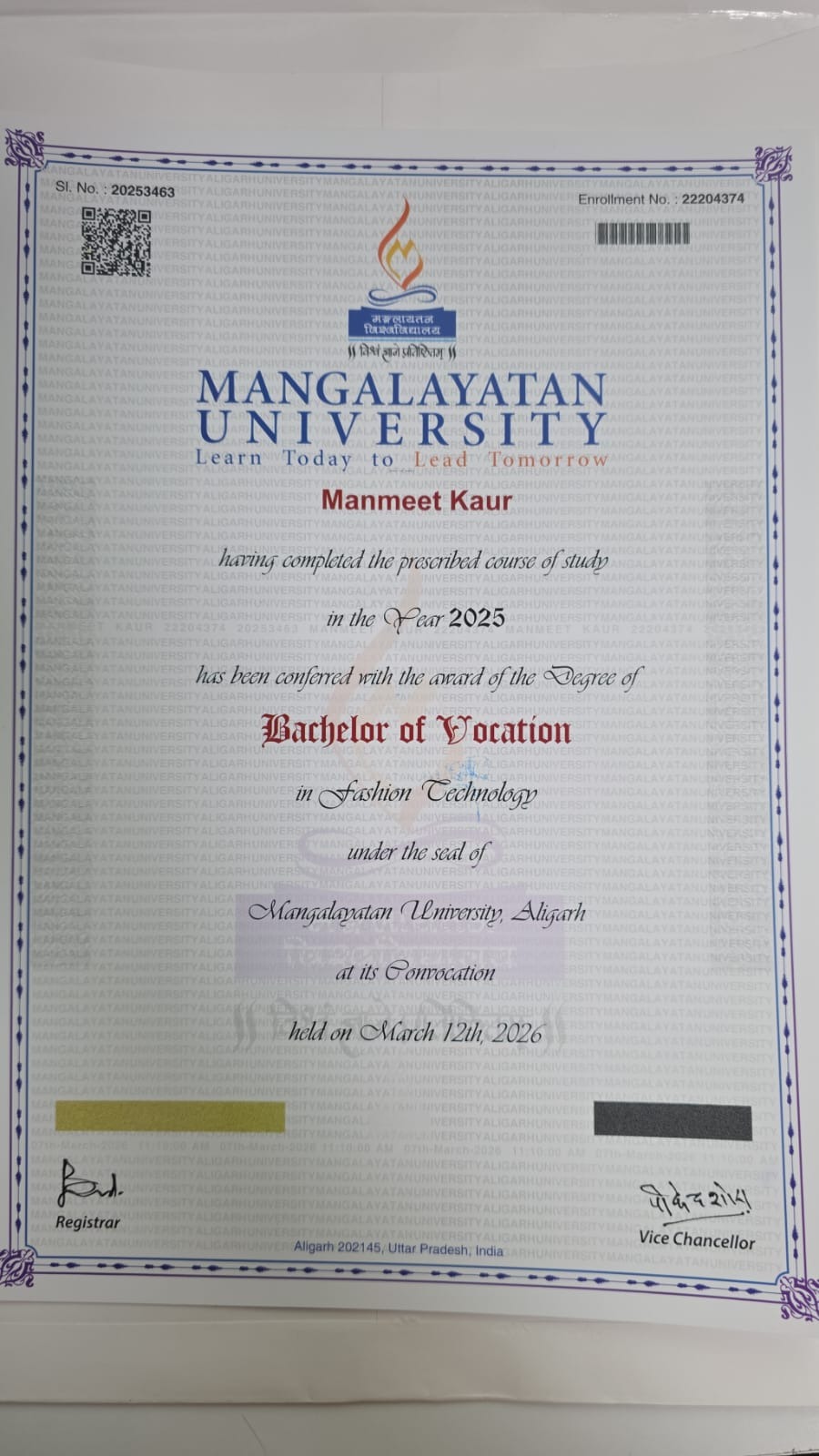
Sample Degree
Documents
Media Gallery
Frequently Asked Questions
Mangalayatan University is located at 33rd Milestone, Aligarh-Mathura Highway, Beswan, Aligarh, Uttar Pradesh, India. The campus is situated in close proximity to the Yamuna Expressway and the cities of Aligarh and Mathura.
Mangalayatan University was established in 2006 under the Mangalayatan University, Uttar Pradesh Act, 2006. The University states that it has the right to confer degrees under Sections 2(f) and 22(1) of the UGC Act.
Yes. Mangalayatan University states that it is recognized by the University Grants Commission (UGC) and was established through an Act of the Uttar Pradesh State Legislature. The University also lists NAAC A+ accreditation among its recognitions.
Yes. The University states that it is recognized by UGC-DEB for Open and Distance Learning (ODL) and is entitled by the UGC to offer online degree programmes. It also states that its online programmes are approved by AICTE.
Mangalayatan University offers programmes across multiple academic levels, including UG, PG, Diploma, PG Diploma and PhD. Its programme portfolio covers areas such as Engineering & Technology, Computer Applications, Management, Agriculture, Biotechnology, Pharmacy, Physiotherapy, Nursing, Journalism & Mass Communication and other disciplines.
Depending on the programme, applicants may be required to provide Class 10 and Class 12 certificates and marksheets, graduation/post-graduation marksheets where applicable, competitive examination rank card where applicable, migration/transfer certificate and recent passport-size photographs. Original documents may be required for verification.
Yes. The University states that students can apply for an education loan through banks, subject to the bank's eligibility criteria.
Mangalayatan University has a 70+ acre campus in Aligarh, Uttar Pradesh.
Mangalayatan University holds an A+ accreditation grade from the National Assessment and Accreditation Council (NAAC).
Yes. Mangalayatan University carries AICTE approval for its technical programmes.
The degree certificate is issued and signed directly by Mangalayatan University, rather than by EasyShiksha or another third-party platform.
The degree certificate is personalised with the student's name, programme, and completion date and carries the university's official signature and seal.
Yes. The university's campus hosts optional immersion sessions associated with select Executive and Hybrid-mode programmes.
Students can select a Mangalayatan University programme, submit their personal details and required documents, pay the application fee, and proceed through the university's application review process.
Yes. Applications submitted through EasyShiksha can be monitored through the dashboard, where applicants can view status updates such as Under Review and Accepted along with their reference ID.
The B.Voc in Patient Care Management is a three-year vocational undergraduate program at Mangalayatan University. It consists of six semesters and 140 total credits, combining patient-care theory, healthcare operations, vocational practical training, project work and training.
The program covers Fundamentals of Human Anatomy and Physiology, Patient Care I and II, First Aid I and II, Stores & Inventory I and II, Hospital Information System, Hospital Information System II, Infection Control Procedures & Protocols I and II, Health & Wellness I and II, Advance Patient Care I and II, Medical Terminology, Biomedical Waste Management, Quality Management, healthcare ethics and vocational practical courses.
Yes. The curriculum includes Vocational Practical - I through Vocational Practical - VI, along with Patient Care Project & Viva Voce and Training & Project Work. The training component includes supervised practical exposure to patient care, infection control and hospital operations, as well as project implementation, documentation and viva voce.
Students can develop skills related to patient care, vital-sign monitoring, first aid, infection control, patient communication, healthcare documentation, hospital information systems, stores and inventory management, biomedical-waste handling, medical terminology, quality and patient safety, health and wellness, and practical healthcare operations.
Graduates can explore opportunities in areas such as patient-care support, hospital operations, healthcare information systems, hospital stores and inventory, infection-control support, first-aid and emergency support, health and wellness services, medical documentation and healthcare quality support. Actual job responsibilities depend on the specific organization and role.