

















B.Voc in Fashion Design & Styling
Program Overview
The Bachelor of Vocation (B.Voc) in Fashion Design & Styling at Mangalayatan University is a vocationally oriented undergraduate program focused on fashion design, illustration, pattern making, garment construction, textiles, apparel production, styling, marketing and related professional practices. The official curriculum is offered through the Institute of Vocational Studies and is structured across six semesters with a total of 148 credits.
The program begins with foundational areas such as Foundation Art and Sketching, Fashion Art and Drawing, Concept of Fashion Design, History of Costumes, Draping and Pattern Making, Basics of Garment Stitching and Computer Application – Photoshop. Students progressively develop their understanding of fashion illustration, textiles, garment manufacturing, design communication, pattern development and digital design applications.
As students progress, the curriculum introduces Design Project, Fashion Illustration (Kids), Indian Embroideries and Textiles, Apparel Production and Management, Research Methods – Craft Documentation, commercial pattern development, fashion marketing and retailing, sustainable fashion ethics, quality control, global marketing and fashion styling. The curriculum also includes portfolio-based work and practical industry-oriented components such as Live Project – Industrial and Craft Documentation – Field Work.
Overall, the curriculum supports the development of skills in fashion illustration, garment design and construction, pattern making, textile understanding, apparel production, digital design, fashion communication, research, marketing, styling and entrepreneurship. It also provides exposure to traditional Indian textiles and crafts, sustainable fashion practices and global fashion markets.
Eligibility Criteria
The minimum eligibility for admission in B.Voc is 10+2 (in any stream) or equivalent or a two-year ITI Diploma after Class 10th or a three-year Polytechnic Diploma after Class 10th.
Approval Details
MHRD, Government of India and UGC
Curriculum
Semester I – Foundations of Fashion Design
The first semester establishes the fundamental artistic, design, garment construction and digital skills required for fashion studies. Students are introduced to drawing, fashion concepts, costume history, draping, pattern making, stitching and Photoshop.
1. FOUNDATION ART AND SKETCHING
This subject introduces the fundamentals of art and design required for fashion sketching and visual expression. Students learn drawing techniques, colour theory, human proportions, fashion figures and basic rendering.
Key Topics:
- Fundamentals of art and design
- Elements and principles of design
- Basic drawing and shading techniques
- Colour theory and colour application
- Human anatomy and proportion
- Fashion sketching and illustration
- Fabric textures and patterns
- Accessories and portfolio presentation
2. FASHION ART AND DRAWING I- FEMALE
This subject develops foundational skills for female fashion illustration. Students study female proportions, facial features, poses, garments, fabrics, colour application and fashion presentation.
Key Topics:
- Female fashion croquis
- Female body proportions
- Facial features and hairstyling
- Garment drawing and draping
- Fabric rendering
- Colour application
- Fashion poses and stylization
- Portfolio presentation
3. CONCEPT OF FASH cycles, forecasting, design development, fabric selection and collection presentatiION DESIGN
Students learn the fundamentals of fashion design, including fashion concepts, design elements, fashionon.
Key Topics:
- Introduction to fashion design
- Elements and principles of fashion design
- Fashion cycle and forecasting
- Design development process
- Fabric and material selection
- Mood boards and concept boards
- Fashion collections
- Portfolio and presentation
4. HISTORY OF COSTUMES - WESTERN I
This subject introduces the historical development of Western costumes and examines how culture, society, politics, technology and other factors influenced clothing.
Key Topics:
- Introduction to costume history
- Ancient Egyptian, Greek and Roman costumes
- Medieval costumes
- Renaissance costumes
- 17th and 18th century fashion
- Victorian-era costumes
- Historical garments and accessories
5. DRAPING AND PATTERN MAKING
Students are introduced to draping and flat pattern-making techniques, including dress-form preparation, bodice draping, skirt and sleeve development and basic garment construction.
Key Topics:
- Draping and pattern-making fundamentals
- Dress forms and muslin preparation
- Grain line, bias and fabric direction
- Basic bodice draping
- Skirt and sleeve development
- Dart manipulation
- Pattern layout and cutting
- Basic garment construction
6. BASICS OF GARMENT STITCHING
This subject develops basic garment stitching skills using hand and machine techniques. Students learn seams, garment components, fasteners, assembly and finishing.
Key Topics:
- Garment stitching fundamentals
- Hand and machine stitching
- Seams and seam finishes
- Garment components
- Fasteners and decorative techniques
- Garment assembly
- Finishing and pressing
- Stitching quality control
7. COMPUTER APPLICATION - PHOTOSHOP
Students learn Adobe Photoshop for digital design applications in fashion. The subject covers image editing, layers, colour correction, creative tools and fashion portfolio preparation.
Key Topics:
- Photoshop interface and workspace
- Selection and image editing tools
- Layers and layer management
- Colour correction and image enhancement
- Typography, brushes and creative tools
- Digital fashion illustration
- Lookbooks and presentation sheets
- Digital portfolio creation
Download Syllabus
Semester II – Advanced Illustration, Textiles and Garment Development
Semester II builds on the foundations of the first semester through advanced female fashion illustration, textile studies, Western costume history, pattern making, garment manufacturing, portfolio development, design communication and InDesign.
1. FASHION ART AND DRAWING II - FEMALE
This subject advances female fashion illustration through stylized figures, dynamic poses, complex garments, fabric rendering, colour techniques and professional portfolio development.
Key Topics:
- Advanced female fashion illustration
- 10–12 head fashion figures
- Advanced anatomy and body movement
- Complex garment rendering
- Fabric texture and surface detailing
- Colour rendering and mixed media
- Fashion composition
- Portfolio development
2. TEXTILES - FABRIC STUDY
Students study textile fibres, yarns, fabric construction, finishing, dyeing, fabric selection and care. The subject also introduces sustainable and eco-friendly textiles.
Key Topics:
- Introduction to textiles
- Natural fibres
- Man-made and synthetic fibres
- Yarn and fabric construction
- Weaving, knitting and non-woven fabrics
- Fabric finishing and dyeing
- Fabric selection and care
- Sustainable and eco-friendly textiles
3. HISTORY OF COSTUMES - WESTERN II
This subject continues the study of Western costume history from the transition into modern fashion through contemporary fashion developments.
Key Topics:
- Modern Western costume
- Early 20th century fashion
- Interwar fashion
- Mid-20th century costumes
- Late 20th century fashion
- Contemporary fashion
- Industrialization and fashion
- Technology, sustainability and fashion trends
4. PATTERN MAKING I
Students learn systematic pattern drafting, bodice blocks, skirt and sleeve patterns, dart manipulation, pattern layouts and basic garment development.
Key Topics:
- Pattern-making fundamentals
- Body measurements and size charts
- Pattern drafting principles
- Basic bodice blocks
- Skirt and sleeve patterns
- Dart manipulation
- Pattern layout
- Basic garment development
5. GARMENT MANUFACTURING I
This subject introduces garment manufacturing processes, fabric preparation, cutting, sewing machinery, production operations, finishing and quality control.
Key Topics:
- Garment manufacturing fundamentals
- Fabric inspection and cutting
- Sewing machines and equipment
- Sewing operations and assembly lines
- Finishing processes
- Quality control
- Production planning and control
- Manufacturing documentation
6. ANNUAL PORTFOLIO
The curriculum includes Annual Portfolio as a Semester II subject. The subject focuses on compiling and presenting the student's academic design work developed during the program.
Key Topics:
- Annual portfolio
- Design work compilation
- Portfolio organization
- Presentation of academic work
7. DESIGN COMMUNICATION
Students learn how to communicate fashion concepts through verbal, visual and technical methods, including sketches, presentation boards, technical drawings and professional portfolios.
Key Topics:
- Design communication
- Visual communication
- Sketching and concept visualization
- Storyboarding
- Presentation boards
- Technical drawings and spec sheets
- Portfolio development
- Professional communication
8. COMPUTER APPLICATION - INDESIGN
This subject introduces Adobe InDesign for fashion-oriented digital publishing, layout design and portfolio development.
Key Topics:
- InDesign interface and workspace
- Typography and text formatting
- Images and graphics
- Layout and composition
- Master pages and templates
- Tables, layers and effects
- Fashion portfolios and publications
- Print and digital export
Semester III – Design Projects, Indian Textiles and Advanced Production
Semester III expands students' creative and technical capabilities through kidswear illustration, design projects, advanced pattern making, garment manufacturing, Indian costume history and traditional Indian embroideries and textiles.
1. FASHION ILLUSTRATION (KIDS)
This subject focuses on illustrating children's fashion, including kids' proportions, expressions, garments, colours, prints and fabric rendering.
Key Topics:
- Kids fashion illustration
- Children's body proportions
- Facial features and expressions
- Kidswear garment illustration
- Colours and prints
- Kidswear fabric rendering
- Themed kidswear collections
- Kids fashion portfolio development
2. DESIGN PROJECT - I
The curriculum includes Design Project - I as a Semester III project-based subject.
Key Topics:
- Design project development
- Fashion design work
- Project presentation
- Design documentation
3. DESIGN PROJECT - II
The curriculum also includes Design Project - II, providing another project-oriented component within Semester III.
Key Topics:
- Design project development
- Fashion design work
- Project presentation
- Design documentation
4. PATTERN MAKING II
This subject develops advanced pattern-making skills for bodices, skirts, trousers, sleeves and collars, along with grading and garment pattern presentation.
Key Topics:
- Advanced pattern-making concepts
- Advanced bodice development
- Skirt and trouser patterns
- Sleeve and collar variations
- Pattern grading
- Bulk-production layouts
- Garment pattern development
- Pattern documentation
5. GARMENT MANUFACTURING II
Students progress to advanced garment manufacturing concepts, industrial machinery, production planning, quality assurance, finishing, packaging and export procedures.
Key Topics:
- Advanced garment manufacturing
- Fabric cutting and marker planning
- Industrial sewing machinery
- Production planning
- Line management
- Quality assurance and control
- Finishing and packaging
- Export procedures
6. HISTORY OF COSTUMES - INDIAN
This subject examines the evolution of Indian costumes in relation to culture, tradition, regional identity and historical developments.
Key Topics:
- Indian costume history
- Ancient Indian costumes
- Medieval Indian costumes
- Regional costumes
- Colonial and post-Independence costumes
- Contemporary Indian fashion
- Indian textiles and attire
- Cultural and traditional influences
7. INDIAN EMBRODERIES AND TEXTILES
Students study traditional Indian textile techniques, regional embroidery styles, materials, stitches and applications of Indian crafts in contemporary fashion.
Key Topics:
- Indian textiles and embroidery
- Traditional textile techniques
- Handloom and dyeing techniques
- Regional embroidery styles
- Embroidery tools and stitches
- Textile and embroidery applications
- Craft preservation
- Innovation and market trends
Semester IV – Menswear, Digital Design and Apparel Management
Semester IV develops skills in male fashion illustration, digital design projects, advanced pattern making, garment manufacturing, apparel production management, craft research and portfolio development.
1. FASHION ILLUSTRATION (MALE)
This subject develops skills in male fashion illustration, including male proportions, facial features, menswear garments, fabric rendering and professional portfolio creation.
Key Topics:
- Male fashion illustration
- Male body proportions
- Facial features and hairstyling
- Menswear garment illustration
- Fabric rendering
- Colour application
- Themed menswear collections
- Portfolio development
2. DESIGN PROJECT - DIGITAL
The curriculum includes Design Project - Digital, focusing on digital design project work.
Key Topics:
- Digital design project
- Digital fashion design work
- Project presentation
- Digital design documentation
3. PATTERN MAKING - III
This subject covers advanced pattern development for complex garments, sleeves, collars, jackets and outerwear, as well as industrial pattern making and grading.
Key Topics:
- Advanced pattern-making techniques
- Complex bodice and dress patterns
- Advanced sleeves and collars
- Jackets and outerwear
- Industrial pattern making
- Pattern grading
- CAD in pattern making
- Mass-production pattern development
4. GARMENT MANUFACTURING - III
Students study advanced garment manufacturing, pre-production processes, production planning, industrial engineering, quality management and export-oriented apparel operations.
Key Topics:
- Advanced garment manufacturing
- Product development and sampling
- Tech packs and specifications
- Production planning and control
- Industrial engineering
- Standard Minute Value (SMV)
- Quality management systems
- Export management and supply chain
5. APPAREL PRODUCTION AND MANAGEMENT
This subject introduces production management in the apparel industry, including scheduling, material management, line management, quality control, costing and merchandising.
Key Topics:
- Apparel production management
- Production planning and scheduling
- Fabric and material management
- Process flow and line management
- Quality control and costing
- Merchandising
- Supply chain management
- Global market trends
6. RESEARCH METHODS - CRAFT DOCUMNETATION
This subject introduces research methods used in fashion and craft documentation, including fieldwork, data collection, analysis and report writing.
Key Topics:
- Research in fashion and crafts
- Research design and methodology
- Field study and data collection
- Craft and textile documentation
- Data analysis and interpretation
- Research report writing
- Visual documentation
- Research presentation
7. ANNUAL PORTFOLIO - II
The curriculum includes Annual Portfolio - II as a Semester IV portfolio component.
Key Topics:
- Annual portfolio development
- Organization of design work
- Portfolio presentation
- Documentation of academic work
Semester V – Industrial Practice, Commercial Development and Sustainable Fashion
Semester V focuses on industry-oriented work, craft fieldwork, fashion marketing, commercial pattern development and sustainable fashion ethics.
1. LIVE PROJECT - INDUSTRIAL
The curriculum includes Live Project - Industrial, providing an industry-oriented project component.
Key Topics:
- Industrial live project
- Practical fashion industry work
- Project development
- Project presentation and documentation
2. CRAFT DOCUMENTATION - FIELD WORK
This subject involves field-oriented craft documentation, connecting research and documentation practices with traditional crafts and textiles.
Key Topics:
- Craft fieldwork
- Field visits
- Craft documentation
- Recording traditional techniques
- Artisan and craft interaction
- Visual and written documentation
3. FASHION MARKETING AND RETAILING
Students learn fashion marketing, consumer behaviour, retail management, visual merchandising, branding, e-retailing and global fashion markets.
Key Topics:
- Fashion marketing fundamentals
- Marketing mix
- Fashion consumer behaviour
- Retail management
- Visual merchandising
- Fashion branding
- Digital marketing and social media
- E-retailing and global fashion markets
4. COMMERCIAL PATTERN DEVELOPMENT
This subject focuses on developing standardized patterns for commercial and mass production, including grading, marker making, pattern adaptation and documentation.
Key Topics:
- Commercial pattern development
- Industrial pattern-making techniques
- Standard sizing systems
- Pattern grading
- Marker making and fabric utilization
- Pattern adaptation
- Product development
- Tech packs and specification sheets
5. Sustainable Fashion Ethics
This subject introduces environmental and ethical considerations in fashion design and production, including sustainable materials, responsible practices and circular fashion.
Key Topics:
- Sustainable fashion
- Ethical practices in fashion
- Sustainable materials and textiles
- Sustainable design and production
- Zero-waste pattern making
- Sustainable marketing and branding
- Circular fashion
- Global sustainability initiatives
Semester VI – Quality, Entrepreneurship, Global Marketing and Styling
The final semester brings together quality management, human resources, entrepreneurship, portfolio development, global marketing and fashion styling.
1. QUALITY CONTROL
Students learn quality control and assurance practices applicable to apparel production, including raw-material inspection, in-process inspection, finished-garment inspection and quality systems.
Key Topics:
- Quality control fundamentals
- Raw material inspection
- Fabric defects and testing
- In-process quality control
- Finished garment inspection
- Quality assurance systems
- Testing and standards
- Quality audits and certifications
2. HR AND ENTERPRENURSHIP
This subject combines human resource management with entrepreneurship in the fashion and apparel sector.
Key Topics:
- Human resource management
- Recruitment and selection
- Training and development
- Industrial relations
- Labour laws
- Entrepreneurship in fashion
- Business planning and management
- Small business and startup development
3. ANNUAL PORTFOLIO - III
The curriculum includes Annual Portfolio - III as a final-stage portfolio component.
Key Topics:
- Annual portfolio development
- Compilation of fashion work
- Portfolio organization
- Professional presentation
4. GLOBAL MARKETING
Students study marketing in international markets, including global market environments, consumer behaviour, international strategies, distribution and digital marketing.
Key Topics:
- Global marketing fundamentals
- International market environment
- Global consumer behaviour
- International marketing strategies
- Global branding
- Distribution and logistics
- E-commerce and cross-border trade
- Emerging global marketing trends
5. Fashion Styling - Basics
This subject introduces fashion styling and its applications across personal, editorial, commercial and event-based contexts.
Key Topics:
- Introduction to fashion styling
- Elements and principles of styling
- Wardrobe planning
- Personal styling and grooming
- Accessories coordination
- Styling for photoshoots and fashion shows
- Editorial and campaign styling
- Styling portfolio development
6. Portfolio Development
The curriculum includes Portfolio Development, supporting the preparation and presentation of fashion-related work.
Key Topics:
- Portfolio development
- Selection and presentation of work
- Fashion work organization
- Portfolio presentation
Fee Structure
Admission Process
Students can apply for the B.Voc Fashion Design & Styling programme through EasyShiksha. The complete application process is designed to make admission simple and convenient for eligible students.
Step 1: Click on Apply Now
Click the Apply Now button on the B.Voc Fashion Design & Styling programme page and begin your application through EasyShiksha.
Step 2: Complete Personal Information
Fill in the required personal, contact and academic details accurately in the application form.
Step 3: Upload Required Documents
Upload the required documents for eligibility and admission verification as specified during the application process.
Step 4: Pay Application Fee
Pay the applicable application fee through the available online payment options to submit your application and initiate the admission process.
Step 5: Application Review
The EasyShiksha team reviews your application and submitted documents to verify your eligibility and ensure that the required information and documents have been provided.
Step 6: University Enrollment
Once the application is successfully reviewed and the student is found eligible, EasyShiksha facilitates the enrollment process with Mangalyatan University.
Step 7: LMS Access
After successful enrollment, the student is provided access to the Learning Management System (LMS) to begin their academic journey and access the available learning resources.
Start Your Application
Ready to begin your journey in Software Development? Click Apply Now to submit your application through EasyShiksha.
Career & Placements
The curriculum covers creative design, technical garment development, apparel production, fashion business, marketing, research, styling and entrepreneurship. Graduates can explore career opportunities in areas related to their skills and interests.
Fashion Design and Creative Roles
- Fashion Designer – Develop fashion concepts, garment ideas, collections and design presentations.
- Fashion Illustrator – Create fashion figures, garment illustrations and visual design presentations.
- Fashion Stylist – Develop coordinated looks for personal, editorial, commercial and event-based styling.
- Assistant Fashion Designer – Support design development, garment concepts, illustrations and collection work.
- Kidswear / Menswear Design Roles – Apply specialized illustration and garment-design skills to children's or men's fashion.
Pattern Making and Garment Development
- Pattern Maker – Develop garment patterns using drafting, pattern manipulation and fitting techniques.
- Commercial Pattern Developer – Work on standardized patterns, grading, sizing and production documentation.
- Pattern Development Assistant – Support pattern creation, corrections, layouts and production-ready pattern documentation.
- Garment Development Roles – Apply garment construction and pattern-making knowledge to product development.
Apparel Production and Quality
- Apparel Production Executive – Support production planning, workflow and manufacturing activities.
- Production Planning Assistant – Work with scheduling, capacity planning, line balancing and production coordination.
- Quality Control Executive – Participate in inspection and quality-control processes for fabrics and garments.
- Apparel Quality Assurance Roles – Apply quality systems, inspection procedures and defect-control practices.
Fashion Marketing, Retail and Merchandising
- Fashion Marketing Executive – Support marketing activities for fashion products and brands.
- Fashion Retail Executive – Work in retail operations, customer service, inventory and store-related activities.
- Visual Merchandising Roles – Work with visual presentation, displays and fashion-brand presentation.
- Fashion Merchandising Roles – Coordinate aspects of fashion production, buyers, suppliers and merchandising activities.
Fashion Styling and Portfolio Development
- Fashion Stylist – Create and coordinate fashion looks for different styling requirements.
- Editorial Styling Assistant – Support styling for editorial and visual fashion content.
- Commercial Styling Assistant – Assist with styling for advertisements and campaigns.
- Portfolio and Presentation Roles – Apply digital and visual communication skills to fashion portfolios and presentations.
Entrepreneurship and Freelancing
The curriculum includes HR and Entrepreneurship, business planning, small-business development and fashion styling practice. Students can therefore explore entrepreneurial or freelance activities in fashion and apparel, subject to their individual skills and interests.
Mangalayatan University, Aligarh
Mangalayatan University is a UGC-recognized private university located in Aligarh, Uttar Pradesh, India. Known for its strong industry connections, cutting-edge curriculum, and commitment to technology-driven education, Mangalayatan University has established itself as one of central India's premier higher education institutions.
The university's vision is to foster academic excellence, industry readiness, and global competitiveness among its graduates — making it an ideal partner for EasyShiksha's mission of accessible, quality online education.
EasyShiksha has signed an MoU with Mangalayatan University to facilitate applications for various university programs and jointly offer B.Voc programs. All degrees and certifications under these programs will be awarded by Mangalayatan University. The EasyShiksha team will provide complete assistance and support throughout the admission and program process.
Mangalayatan University, Uttar Pradesh
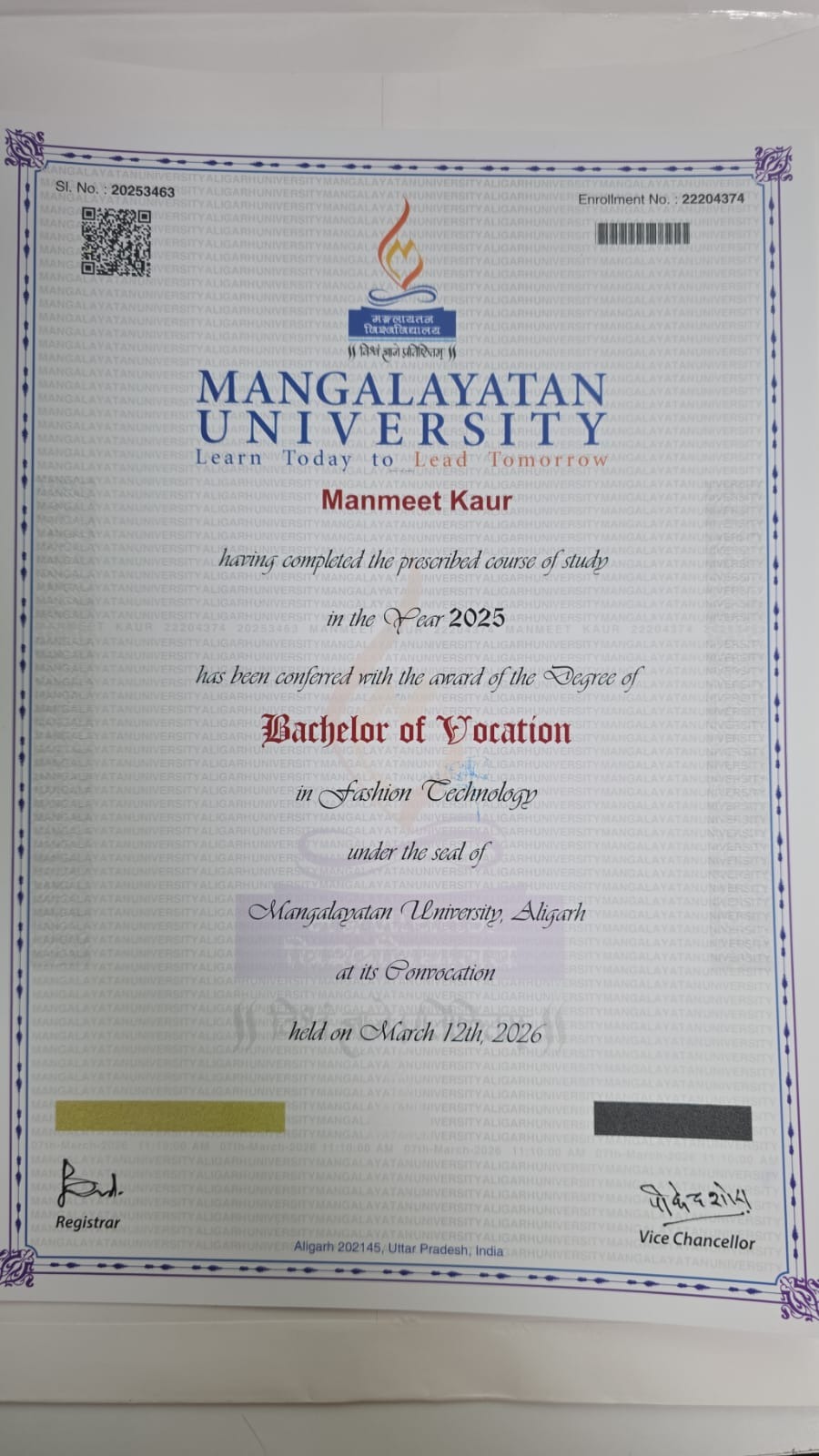
Sample Degree
Documents
Media Gallery
Frequently Asked Questions
Mangalayatan University is located at 33rd Milestone, Aligarh-Mathura Highway, Beswan, Aligarh, Uttar Pradesh, India. The campus is situated in close proximity to the Yamuna Expressway and the cities of Aligarh and Mathura.
Mangalayatan University was established in 2006 under the Mangalayatan University, Uttar Pradesh Act, 2006. The University states that it has the right to confer degrees under Sections 2(f) and 22(1) of the UGC Act.
Yes. Mangalayatan University states that it is recognized by the University Grants Commission (UGC) and was established through an Act of the Uttar Pradesh State Legislature. The University also lists NAAC A+ accreditation among its recognitions.
Yes. The University states that it is recognized by UGC-DEB for Open and Distance Learning (ODL) and is entitled by the UGC to offer online degree programmes. It also states that its online programmes are approved by AICTE.
Mangalayatan University offers programmes across multiple academic levels, including UG, PG, Diploma, PG Diploma and PhD. Its programme portfolio covers areas such as Engineering & Technology, Computer Applications, Management, Agriculture, Biotechnology, Pharmacy, Physiotherapy, Nursing, Journalism & Mass Communication and other disciplines.
Depending on the programme, applicants may be required to provide Class 10 and Class 12 certificates and marksheets, graduation/post-graduation marksheets where applicable, competitive examination rank card where applicable, migration/transfer certificate and recent passport-size photographs. Original documents may be required for verification.
Yes. The University states that students can apply for an education loan through banks, subject to the bank's eligibility criteria.
Mangalayatan University has a 70+ acre campus in Aligarh, Uttar Pradesh.
Mangalayatan University holds an A+ accreditation grade from the National Assessment and Accreditation Council (NAAC).
Yes. Mangalayatan University carries AICTE approval for its technical programmes.
The degree certificate is issued and signed directly by Mangalayatan University, rather than by EasyShiksha or another third-party platform.
The degree certificate is personalised with the student's name, programme, and completion date and carries the university's official signature and seal.
Yes. The university's campus hosts optional immersion sessions associated with select Executive and Hybrid-mode programmes.
Students can select a Mangalayatan University programme, submit their personal details and required documents, pay the application fee, and proceed through the university's application review process.
Yes. Applications submitted through EasyShiksha can be monitored through the dashboard, where applicants can view status updates such as Under Review and Accepted along with their reference ID.
The B.Voc in Fashion Design & Styling is a six-semester vocational undergraduate program at Mangalayatan University covering fashion design, illustration, textiles, pattern making, garment manufacturing, apparel management, marketing, styling, entrepreneurship and related professional practices. The curriculum carries 148 total credits.
The curriculum includes subjects such as Foundation Art and Sketching, Fashion Art and Drawing, Concept of Fashion Design, Draping and Pattern Making, Textiles - Fabric Study, Pattern Making, Garment Manufacturing, Indian Embroideries and Textiles, Apparel Production and Management, Fashion Marketing and Retailing, Sustainable Fashion Ethics, Quality Control, Global Marketing and Fashion Styling - Basics.
The syllabus includes project and industry-oriented components such as Design Project - I, Design Project - II, Design Project - Digital, Live Project - Industrial and Craft Documentation - Field Work. It also includes practical-oriented subjects involving pattern making, garment stitching, manufacturing, illustration and portfolio development. The provided curriculum does not list a separate internship or industrial training subject.
Students can develop skills in fashion illustration, garment design, pattern making, garment stitching and manufacturing, textile understanding, digital design, design communication, portfolio development, apparel production, quality control, fashion marketing, styling, research, sustainability and entrepreneurship.
Graduates can explore opportunities related to fashion design, fashion illustration, pattern making, garment production, quality control, fashion marketing, retailing, merchandising, fashion styling, portfolio development and entrepreneurship, depending on their specialization of skills and professional interests.