D.Voc in Hotel Management
Program Overview
The Diploma in Hotel Management is offered by the Institute of Vocational Studies, Mangalayatan University. The curriculum provides structured learning across the major operational areas of hospitality, including Food Production, Food and Beverage Service, Front Office Operations, Housekeeping Operations, Computer Fundamentals, Communication Skills, Accounting, Travel and Tourism Management, and Event Management. The official curriculum is organized into two semesters, with 26 credits in Semester I, 30 credits in Semester II, and 56 total program credits.
Semester I focuses on foundational hospitality operations. Students study Foundation in Food Production-I, Foundation in Food and Beverage Service-I, Foundation in Front Office Operations-I, Foundation in House Keeping Operations-I, Computer Fundamentals, and Communication Skills. Each of the four core hotel-operation areas is accompanied by a laboratory component, while Computer Fundamentals also includes a laboratory.
Semester II builds on these foundations through Fundamentals of Accounting, Food Production-II, Food and Beverage Services-II, Front Office Operations-II, Housekeeping Operations-II, Travel and Tourism Management, and Basics of Event Management. Practical laboratory components continue for Food Production, Food and Beverage Services, Front Office Operations and Housekeeping Operations.
The curriculum develops practical and professional capabilities relevant to hotel and hospitality operations. Areas covered include food preparation and kitchen safety, restaurant service, guest reception and reservations, housekeeping and laundry operations, accounting fundamentals, hospitality communication, computerized hotel operations, tourism, event planning and guest handling. The syllabus also introduces areas such as Property Management Systems (PMS), online travel agencies (OTAs), night audit concepts, sustainable housekeeping, eco-tourism, event sponsorship and crisis management.
Eligibility Criteria
The minimum eligibility for admission is 10+2 (in any stream) or equivalent or a two-year ITI Diploma after Class 10th or a three-year Polytechnic Diploma after Class 10th.
Approval Details
MHRD, Government of India and UGC
Curriculum
Semester I establishes the fundamentals of hotel and hospitality operations. Students are introduced to food production, food and beverage service, front office procedures, housekeeping, computer applications and professional communication. The semester contains both theory and laboratory components in several operational areas.
1. Foundation in Food Production-I
Course Code: DVOCHM-101
Credits: 3
This subject introduces the fundamentals of food production and kitchen operations in the hospitality industry. Students learn about kitchen organization, equipment, knife skills, food hygiene, cooking methods and basic stocks, soups and sauces.
Key Topics:
- Meaning and scope of food production in hospitality
- Organization and functions of the kitchen department
- Kitchen staff classification and responsibilities
- Kitchen layouts and professional kitchen planning
- Kitchen equipment, tools and utensils
- Knife handling, safety and basic knife cuts
- Food hygiene, contamination and food poisoning
- Kitchen sanitation, pest control and fire safety
- First aid and accident prevention
- Moist heat, dry heat and fat cooking methods
- Boiling, simmering, poaching, steaming, roasting, baking and grilling
- Shallow and deep frying
- Stocks, soups, sauces and thickening agents
2. Foundation in Food Production-I Laboratory
Course Code: DVOCHM-102
Credits: 2
This practical component accompanies Foundation in Food Production-I and provides laboratory-based exposure to foundational food production activities. The syllabus identifies the component as a practical laboratory but does not provide a separate detailed list of practical exercises in the uploaded document.
3. Foundation in Food and Beverage Service-I
Course Code: DVOCHM-103
Credits: 3
This subject introduces food and beverage service operations and the role of the F&B department within a hotel. Students learn restaurant organization, service equipment, service styles, table setting, service etiquette and beverage fundamentals.
Key Topics:
- Meaning and scope of food and beverage service
- Role of F&B service in hotel operations
- Types of food and beverage outlets
- Restaurant organization and service staff responsibilities
- Personal hygiene and grooming standards
- Restaurant equipment, furniture, linen, tableware, glassware and cutlery
- Types of food and beverage service
- English, French, Russian and American service
- Self-service, assisted service and single-point service
- Principles of table setting and table covers
- Formal and informal table settings
- Service etiquette and guest complaint handling
- Tea, coffee, soft drinks and juices
- Introduction to alcoholic beverages and responsible service
4. Foundation in Food and Beverage Service-I Laboratory
Course Code: DVOCHM-104
Credits: 2
This laboratory component provides practical learning associated with Foundation in Food and Beverage Service-I. The syllabus identifies it as a practical component but does not separately detail the laboratory exercises.
5. Foundation in Front Office Operations-I
Course Code: DVOCHM-105
Credits: 3
This subject introduces front office functions and the role of reception and guest services in hotel operations. Students learn reservations, registration, guest communication, basic guest accounting and front office procedures.
Key Topics:
- Meaning and importance of the front office department
- Role of front office in hotel operations
- Front office layout and terminology
- Organization structure and staff responsibilities
- Professional grooming and etiquette
- Front office communication
- Reservation types, sources and procedures
- Reservation records and charts
- Introduction to online reservation systems
- Reception area and equipment
- Guest arrival and registration procedures
- Handling special guests and VIPs
- Guest check-in procedures
- Guest requests and complaint handling
- Telephone, message and mail handling
- Wake-up call services
- Guest accounts and payment methods
- Introduction to billing procedures
- Role of the front office cashier
6. Foundation in Front Office Operations-I Laboratory
Course Code: DOVCHM-106
Credits: 2
This practical laboratory accompanies Foundation in Front Office Operations-I. The syllabus identifies the laboratory component but does not provide a separate detailed breakdown of its practical exercises.
7. Foundation in House Keeping Operations-I
Course Code: DVOCHM-107
Credits: 3
This subject introduces housekeeping operations and their importance in hotel management. Students learn about housekeeping organization, cleaning equipment, guest-room cleaning, linen and laundry management, and safety procedures.
Key Topics:
- Role and importance of housekeeping
- Housekeeping terminology and accommodation establishments
- Housekeeping organization and staff responsibilities
- Personal hygiene and grooming
- Interdepartmental coordination
- Manual and mechanical cleaning equipment
- Cleaning agents and chemicals
- Selection and use of cleaning agents
- Guest-room and bathroom cleaning
- Public-area cleaning
- Night service and turndown service
- Linen room organization and laundry operations
- Linen control, inventory, care and storage
- Chemical and equipment safety
- Fire prevention and accident prevention
- Guest and employee safety
8. Foundation in House Keeping Operations-I Laboratory
Course Code: DVOCHM-108
Credits: 2
This practical laboratory supports Foundation in House Keeping Operations-I. It is identified as a practical component in the official course structure, while a separate list of laboratory exercises is not provided in the uploaded syllabus.
9. Computer Fundamentals
Course Code: DVOCHM-109
Credits: 2
Computer Fundamentals introduces basic computer knowledge and its application in the hotel industry. Students learn hardware, software, operating systems, office tools, internet use and basic cybersecurity.
Key Topics:
- Computer definition, characteristics and evolution
- Types and applications of computers
- Applications of computers in the hotel industry
- Computer hardware and system components
- Input and output devices
- CPU and memory
- Storage devices
- System and application software
- Operating systems and utility software
- Introduction to hotel management software
- Windows operating system
- File and folder management
- Basic troubleshooting
- MS Word, MS Excel and MS PowerPoint
- Internet, networks, browsers and search engines
- Email concepts and etiquette
- Cybersecurity and safe internet practices
10. Computer Fundamentals Laboratory
Course Code: DVOCHM-110
Credits: 2
This practical laboratory accompanies Computer Fundamentals. The official syllabus identifies the component as practical but does not provide a separate detailed list of laboratory activities.
11. Communication Skills
Course Code: DVOCHM-111
Credits: 2
Communication Skills focuses on professional communication required in hospitality environments. Students develop verbal, non-verbal, listening, interpersonal and written communication abilities, with specific attention to guest handling and workplace communication.
Key Topics:
- Communication meaning, importance and process
- Verbal, non-verbal, written and visual communication
- Communication barriers and overcoming them
- Speaking, pronunciation and clarity
- Tone, pitch and voice modulation
- Public speaking and hospitality conversation skills
- Body language, gestures and facial expressions
- Eye contact, posture and professional appearance
- Cultural aspects of non-verbal communication
- Listening and interpersonal skills
- Active listening, empathy and emotional intelligence
- Formal and informal letter writing
- Email etiquette and report writing
- Notices, memos and messages
- Guest communication and telephone handling
- Complaint handling and communication with difficult guests
- Team communication, grooming and professional behavior
Download Syllabus
Semester II advances the foundational hotel-management subjects into more specialized operational and managerial areas. Students study accounting, advanced food production, food and beverage service, front office operations and housekeeping, along with travel and tourism and event management. Practical laboratory components continue across the major hotel-operation disciplines.
1. Fundamentals of Accounting
Course Code: DVOCHM-201
Credits: 4
This subject introduces accounting principles and processes relevant to business and hotel operations. Students learn journal entries, ledgers, cash books, final accounts and introductory cost accounting.
Key Topics:
- Meaning, nature and scope of accounting
- Objectives and importance of accounting
- Users of accounting information
- Basic accounting terminology
- Accounting principles and concepts
- Types of accounts
- Rules of debit and credit
- Journal and journal entries
- Ledger and posting
- Trial balance
- Cash books and petty cash
- Bank transactions and bank reconciliation
- Subsidiary books
- Purchase and sales books
- Purchase and sales returns
- Final accounts
- Trading account, profit and loss account and balance sheet
- Adjustments in final accounts
- Introduction to cost accounting
- Cost control and cost reduction
- Importance of cost accounting in hotels
2. Food Production-II
Course Code: DVOCHM-202
Credits: 3
Food Production-II builds on basic cooking knowledge and introduces advanced cooking methods, food groups, bakery fundamentals, menu planning and kitchen cost control.
Key Topics:
- Review of basic cooking methods
- Combination cooking methods
- Braising and stewing
- Poaching and blanching
- Introduction to microwave and sous-vide cooking
- Classification and cooking of cereals and pulses
- Rice varieties and rice cookery
- Vegetable classification, cuts and presentation
- Egg structure, selection, storage and cooking
- Milk and dairy products
- Meat classification, selection, storage and cooking
- Poultry preparation
- Fish classification and basic cookery
- Bakery ingredients and bread making
- Cakes, cookies and introduction to confectionery
- Menu planning principles
- Types of menus and standard recipes
- Portion control and basic food-cost control
3. Food Production-II Laboratory
Course Code: DVOCHM-203
Credits: 2
This laboratory component provides practical learning associated with Food Production-II. The syllabus identifies the subject as a practical laboratory, without separately listing the individual practical exercises.
4. Food and Beverage Services-II
Course Code: DVOCHM-204
Credits: 3
This subject develops food and beverage service knowledge through advanced restaurant service procedures, menu knowledge, beverages, bar operations and banquet and outdoor catering.
Key Topics:
- Advanced food and beverage service concepts
- F&B service and guest satisfaction
- Service planning and coordination
- Service sequence
- Order-taking methods
- Service of food courses and accompaniments
- Clearing and crumbing down
- Professional guest complaint handling
- Menu types, layout and terminology
- Factors influencing menu planning
- Menu engineering basics
- Classification of alcoholic beverages
- Wines, spirits, liqueurs, beer and cider
- Responsible service of alcohol
- Bar layout, equipment, tools and glassware
- Basic bartending terminology
- Cocktails and mocktails
- Bar hygiene and safety
- Banquet types, setup and service styles
- Outdoor catering operations
- Coordination between kitchen and service teams
5. Food and Beverage Services-II Laboratory
Course Code: DVOCHM-205
Credits: 2
This practical laboratory accompanies Food and Beverage Services-II. It is included as a laboratory component in the official course structure; the uploaded syllabus does not separately specify the individual practical exercises.
6. Front Office Operations-II
Course Code: DVOCHM-206
Credits: 3
Front Office Operations-II advances students' knowledge of hotel front office systems, guest-cycle management, technology, billing, concierge services and safety.
Key Topics:
- Advanced front office functions
- Front office role in revenue generation
- Coordination with housekeeping and F&B
- Front office performance standards
- Guest cycle and its stages
- Pre-arrival, arrival, occupancy and departure
- Post-departure activities
- Property Management System (PMS)
- Computerized front office operations
- Night audit concept
- Online Travel Agencies (OTAs)
- Technology in front office operations
- Advanced guest accounting and folios
- Settlement methods
- Credit policy
- Late check-outs and no-shows
- Concierge and guest relation services
- VIP and special guest handling
- Complaint handling and service recovery
- Front office safety and security
- Key control, emergencies and lost-and-found procedures
- Data privacy and guest confidentiality
7. Front Office Operations-II Laboratory
Course Code: DVOCHM-207
Credits: 2
This practical laboratory supports Front Office Operations-II. It is included in the official course structure as a practical component, while the syllabus does not provide a separate detailed exercise list.
8. Housekeeping Operations-II
Course Code: DVOCHM-208
Credits: 3
Housekeeping Operations-II develops more advanced knowledge of housekeeping management, guest-room management, inventory, laundry, interior aesthetics, safety and environmental practices.
Key Topics:
- Advanced housekeeping management
- Housekeeping planning and scheduling
- Coordination with front office and maintenance
- Housekeeping performance standards
- Types of guest rooms
- Room status and room reports
- Room inspection procedures
- Deep and special cleaning
- Turndown and special services
- Housekeeping inventory and par stock
- Storekeeping, purchasing and issue control
- Housekeeping record keeping
- Commercial laundry layout and equipment
- Laundry chemicals and linen exchange
- Laundry cost control
- Outsourced laundry services
- Interior decoration principles
- Colour, lighting and flower arrangement
- Soft furnishings and décor
- Seasonal and theme decoration
- Housekeeping safety and emergency procedures
- Waste management
- Sustainable and eco-friendly housekeeping
9. Housekeeping Operations-II Laboratory
Course Code: DVOCHM-209
Credits: 2
This practical laboratory accompanies Housekeeping Operations-II and is included as a practical component in the course structure. The uploaded syllabus does not provide a separate detailed list of laboratory exercises.
10. Travel and Tourism Management
Course Code: DVOCHM-210
Credits: 3
This subject introduces travel and tourism and examines tourism organizations, travel agencies, tour operations, transportation, accommodation, tourism products and sustainable tourism.
Key Topics:
- Meaning, nature and evolution of travel and tourism
- Domestic, international, inbound and outbound tourism
- Components of the tourism industry
- Tourism and economic development
- Government role in tourism development
- Ministry of Tourism, Government of India
- UNWTO, IATA and WTTC
- Tourism policies and planning
- Travel agencies and their functions
- Tour operators and their roles
- Tour packaging and basic costing
- Travel-business documentation
- Transportation in tourism
- Air, rail, road and water transport
- Introduction to travel formalities
- Accommodation types and hotel classification
- Resorts, heritage hotels and alternative accommodation
- Tourism products and destination development
- Emerging tourism trends
- Eco-tourism and responsible tourism
- Sustainable tourism practices
- Social and environmental impacts of tourism
- Career opportunities in travel and tourism
11. Basics of Event Management
Course Code: DVOCHM-211
Credits: 3
This subject introduces the principles and processes of event management, from event concept development and planning to logistics, marketing, execution and post-event evaluation.
Key Topics:
- Meaning and scope of event management
- Social, corporate, cultural and sports events
- Exhibitions and event-industry structure
- Role of an event manager
- Event life cycle
- Event objectives and theme selection
- Event concept development and creativity
- Target-audience analysis
- Event proposals and budgeting basics
- Timelines and checklists
- Venue selection and layout planning
- Vendor management
- Equipment and infrastructure
- Staffing and team coordination
- Permissions and legal requirements
- Event promotion and media planning
- Sponsorship planning and proposals
- Branding and publicity
- Client communication
- Pre-event briefing and on-event coordination
- Crowd management and guest protocol
- Crisis and risk management basics
- Event closure and feedback
- Financial settlement and event reporting
- Career opportunities in event management
Fee Structure
Admission Process
Students can apply for the DIPLOMA Hotel Management programme through EasyShiksha. The complete application process is designed to make admission simple and convenient for eligible students.
Step 1: Click on Apply Now
Click the Apply Now button on the DIPLOMA Hotel Management programme page and begin your application through EasyShiksha.
Step 2: Complete Personal Information
Fill in the required personal, contact and academic details accurately in the application form.
Step 3: Upload Required Documents
Upload the required documents for eligibility and admission verification as specified during the application process.
Step 4: Pay Application Fee
Pay the applicable application fee through the available online payment options to submit your application and initiate the admission process.
Step 5: Application Review
The EasyShiksha team reviews your application and submitted documents to verify your eligibility and ensure that the required information and documents have been provided.
Step 6: University Enrollment
Once the application is successfully reviewed and the student is found eligible, EasyShiksha facilitates the enrollment process with Mangalyatan University.
Step 7: LMS Access
After successful enrollment, the student is provided access to the Learning Management System (LMS) to begin their academic journey and access the available learning resources.
Start Your Application
Ready to begin your journey in Software Development? Click Apply Now to submit your application through EasyShiksha.
Career & Placements
The Diploma in Hotel Management covers the core operational departments of hospitality along with accounting, tourism, event management, computer applications and communication. Based on these curriculum areas, students can explore opportunities across hotel operations, food service, guest services, housekeeping, travel and tourism, and event-related work, depending on their skills and experience.
Food Production & Kitchen Operations
- Food Production Assistant – Support food preparation and kitchen operations using foundational cooking and food-safety knowledge.
- Kitchen Operations Assistant – Assist with kitchen equipment, preparation processes, sanitation and routine kitchen activities.
- Bakery and Confectionery Assistant – Work with basic bread, cake, cookie and confectionery preparation concepts covered in the curriculum.
- Food Preparation Support – Apply knowledge of cooking methods, food groups, portion control and standard recipes.
Food & Beverage Service
- Food and Beverage Service Assistant – Support restaurant service, table setting, order taking and guest service.
- Restaurant Service Staff – Apply knowledge of table service, service sequences, restaurant equipment and service etiquette.
- Banquet Service Assistant – Support banquet setup, service styles and event-related food and beverage operations.
- Bar Service Assistant – Work in areas involving beverage service, bar equipment, glassware and basic bartending concepts, subject to applicable workplace requirements.
Front Office & Guest Relations
- Front Office Assistant – Support reservations, reception, registration and routine front office activities.
- Guest Service Assistant – Assist with guest requests, communication, complaint handling and service-related activities.
- Reservation Assistant – Work with reservation procedures, reservation records and online reservation concepts.
- Concierge/Guest Relations Assistant – Support guest-relations activities, VIP handling and service recovery processes.
- Front Office Operations Assistant – Apply knowledge of guest cycles, PMS concepts, billing and computerized front office operations.
Housekeeping Operations
- Housekeeping Assistant – Support guest-room and public-area cleaning and housekeeping routines.
- Room Attendant – Apply knowledge of room cleaning, room status, turndown and special cleaning procedures.
- Laundry and Linen Assistant – Work with linen handling, laundry processes, inventory and linen exchange.
- Housekeeping Operations Assistant – Support housekeeping scheduling, inventory control, safety and coordination activities.
Travel & Tourism
- Travel Operations Assistant – Support basic travel-agency and tour-operation activities.
- Tourism Services Assistant – Work in tourism-related service environments using knowledge of tourism products and destinations.
- Tour Operations Support – Assist with tour packaging, basic costing and travel documentation.
- Tourism Service Executive – Explore customer-facing and operational roles within travel and tourism depending on skills and experience.
Event Management
- Event Management Assistant – Support event planning, logistics and event execution.
- Event Operations Assistant – Assist with venue setup, vendors, equipment, staffing and on-event coordination.
- Event Coordination Support – Work with timelines, checklists, guest handling and event communication.
- Event Marketing Support – Assist with event promotion, branding, publicity and sponsorship activities.
Hospitality Administration & Support
- Hospitality Operations Assistant – Apply knowledge across hotel departments and support day-to-day hospitality operations.
- Accounts/Hotel Accounting Assistant – Use foundational accounting knowledge for relevant accounting and cost-control support functions.
- Hotel Computer Operations Support – Apply computer, office-automation and hotel-management software knowledge in hospitality settings.
- Guest Communication Support – Use professional communication, telephone handling and complaint-management skills in customer-facing environments.
Mangalayatan University, Aligarh
Mangalayatan University is a UGC-recognized private university located in Aligarh, Uttar Pradesh, India. Known for its strong industry connections, cutting-edge curriculum, and commitment to technology-driven education, Mangalayatan University has established itself as one of central India's premier higher education institutions.
The university's vision is to foster academic excellence, industry readiness, and global competitiveness among its graduates — making it an ideal partner for EasyShiksha's mission of accessible, quality online education.
EasyShiksha has signed an MoU with Mangalayatan University to facilitate applications for various university programs and jointly offer B.Voc programs. All degrees and certifications under these programs will be awarded by Mangalayatan University. The EasyShiksha team will provide complete assistance and support throughout the admission and program process.
Mangalayatan University, Uttar Pradesh
Sample Certificate
Documents
Media Gallery
Frequently Asked Questions
Mangalayatan University is located at 33rd Milestone, Aligarh-Mathura Highway, Beswan, Aligarh, Uttar Pradesh, India. The campus is situated in close proximity to the Yamuna Expressway and the cities of Aligarh and Mathura.
Mangalayatan University was established in 2006 under the Mangalayatan University, Uttar Pradesh Act, 2006. The University states that it has the right to confer degrees under Sections 2(f) and 22(1) of the UGC Act.
Yes. Mangalayatan University states that it is recognized by the University Grants Commission (UGC) and was established through an Act of the Uttar Pradesh State Legislature. The University also lists NAAC A+ accreditation among its recognitions.
Yes. The University states that it is recognized by UGC-DEB for Open and Distance Learning (ODL) and is entitled by the UGC to offer online degree programmes. It also states that its online programmes are approved by AICTE.
Mangalayatan University offers programmes across multiple academic levels, including UG, PG, Diploma, PG Diploma and PhD. Its programme portfolio covers areas such as Engineering & Technology, Computer Applications, Management, Agriculture, Biotechnology, Pharmacy, Physiotherapy, Nursing, Journalism & Mass Communication and other disciplines.
Depending on the programme, applicants may be required to provide Class 10 and Class 12 certificates and marksheets, graduation/post-graduation marksheets where applicable, competitive examination rank card where applicable, migration/transfer certificate and recent passport-size photographs. Original documents may be required for verification.
Yes. The University states that students can apply for an education loan through banks, subject to the bank's eligibility criteria.
Mangalayatan University has a 70+ acre campus in Aligarh, Uttar Pradesh.
Mangalayatan University holds an A+ accreditation grade from the National Assessment and Accreditation Council (NAAC).
Yes. Mangalayatan University carries AICTE approval for its technical programmes.
The degree certificate is issued and signed directly by Mangalayatan University, rather than by EasyShiksha or another third-party platform.
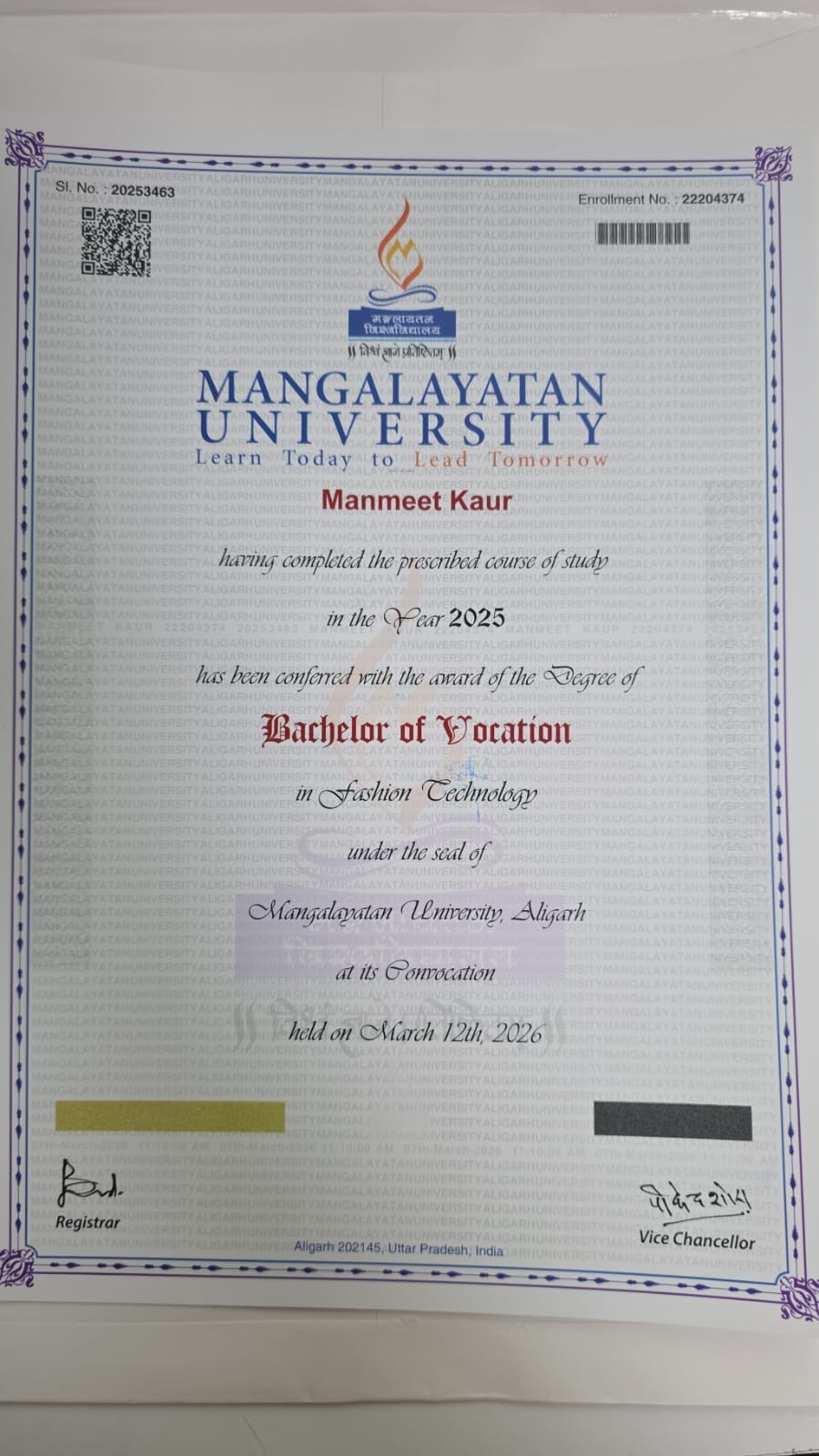
The degree certificate is personalised with the student's name, programme, and completion date and carries the university's official signature and seal.
Yes. The university's campus hosts optional immersion sessions associated with select Executive and Hybrid-mode programmes.
Students can select a Mangalayatan University programme, submit their personal details and required documents, pay the application fee, and proceed through the university's application review process.
Yes. Applications submitted through EasyShiksha can be monitored through the dashboard, where applicants can view status updates such as Under Review and Accepted along with their reference ID.
The Diploma in Hotel Management at Mangalayatan University is a diploma program covering major hospitality functions such as food production, food and beverage service, front office operations, housekeeping, accounting, travel and tourism, and event management. The curriculum is structured across two semesters with a total of 56 credits.
The program covers Foundation in Food Production-I and II, Foundation in Food and Beverage Service-I, Food and Beverage Services-II, Foundation in Front Office Operations-I, Front Office Operations-II, Foundation in House Keeping Operations-I, Housekeeping Operations-II, Computer Fundamentals, Communication Skills, Fundamentals of Accounting, Travel and Tourism Management, and Basics of Event Management, along with several laboratory components.
Yes. The official course structure includes practical laboratory components for Food Production, Food and Beverage Service, Front Office Operations, Housekeeping Operations and Computer Fundamentals. These are incorporated into the semester-wise curriculum. The uploaded syllabus does not specify a separate internship or industrial training component.
Students can develop skills related to food preparation and kitchen safety, restaurant and beverage service, front office procedures, reservations and guest handling, housekeeping operations, computer applications, communication, basic accounting, travel and tourism operations, and event planning. The curriculum also introduces PMS, OTAs, sustainable housekeeping, tourism practices and event risk management.
Depending on their skills and experience, students can explore roles in hotel operations, food production, food and beverage service, front office, guest relations, housekeeping, travel and tourism, and event management. Potential roles include food production assistant, restaurant service staff, front office assistant, guest service assistant, housekeeping assistant, travel operations assistant and event management assistant. The syllabus does not guarantee employment or a particular job position.