
















Semiconductors & its Application in Analog Electronics
Master semiconductors from basics to p-n junctions, building the foundation for advanced electronics and VLSI career pathways.
#1 Most Popular Online Course & Internship in Electronics You can enroll today & get certified from EasyShiksha & HawksCode.
 Build real-world projects
Internship with certificate
Resume-ready experience
Beginner to advanced
Lifetime access
Interview prep included
Build real-world projects
Internship with certificate
Resume-ready experience
Beginner to advanced
Lifetime access
Interview prep included
 Updated September 28, 2026
Join 5,00,000+ students already enrolled worldwide
No risk — 30-day full refund guarantee
Start instantly after payment — access in seconds
Certificate + Internship Joining Letter included
Updated September 28, 2026
Join 5,00,000+ students already enrolled worldwide
No risk — 30-day full refund guarantee
Start instantly after payment — access in seconds
Certificate + Internship Joining Letter included
 Free Preview
 51 On-demand Videos
 Internship Joining Letter
 2 Certificates (Course + Internship)
 Lifetime Access
 1 Quiz + Assignments
 Mobile & Desktop Access



Why This Course and Internship Stands Out
See exactly what separates EasyShiksha students from everyone else
 Watching scattered YouTube
videos with no structure
No certificate — nothing to show
employers
No internship experience on
resume
Wasting months without clear
direction
Struggling to stand out in job
applications
No proof of practical skills
Structured, beginner-to-advanced
learning path
Verified certificate — shareable
on LinkedIn
Real internship offer letter for
your resume
Go from zero to job-ready in one
programme
Resume-ready experience before
graduation
Practical projects you can show
any recruiter
Watching scattered YouTube
videos with no structure
No certificate — nothing to show
employers
No internship experience on
resume
Wasting months without clear
direction
Struggling to stand out in job
applications
No proof of practical skills
Structured, beginner-to-advanced
learning path
Verified certificate — shareable
on LinkedIn
Real internship offer letter for
your resume
Go from zero to job-ready in one
programme
Resume-ready experience before
graduation
Practical projects you can show
any recruiter
Internship Opportunity Included With This Course
"This is not just a course — it's real career experience. Walk away with documents that prove your skills to any employer."



This Course is Perfect For
Whether you're starting from scratch or switching careers — this course is designed with your success in mind.







Before enrolling in the course I expect that you must be having a good idea about current electricity, chemistry and some knowledge about conductors. If you don't have any idea about it then you can enroll in rest of my courses which deals with all these concepts in depth.
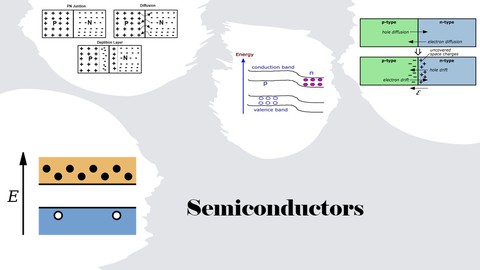
In this course, you will learn all the things about semiconductors from scratch. Below I had listed certain topics this would be our roadmap. There would also be certain topics that I'm not giving in this particular roadmap but its concept would be required to proceed further. So I had also explained that part.
@ Roadmap:-
-
Introduction to semiconductors
-
Difference between conductors, semiconductors, and an insulators
-
Energy band diagram for sodium and silicon atoms
-
Valence band and Conduction band diagram for sodium and silicon atoms
-
Forbidden Energy Gap
-
Intrinsic and Extrinsic Semiconductors
-
Internal structure or internal working of the p-n junction diode (Application part)
So this was all about the course.
@ Outcome of the course:-
-
As you all know that I'm making series on electronics, this is a course-2 and this course is a prerequisite to the next course where we will be dealing with diode circuits, Bjt and Fet's circuits, etc. So to understand the core electronics part or how any electronic device behaves, you should be very much well acquainted with the part of the semiconductor.
-
For those who want to perceive their future in the VLSI domain, this course is purely meant for them.
-
And there are many more advantages which I'm not revealing here, you yourself will get to know what knowledge you have acquired after completing this course.
 Unlock 49 More Lessons + Internship Access



This course provides a clear and practical understanding of semiconductor fundamentals and their applications in analog electronics. The concepts are explained in a structured manner, making it easy to understand topics such as diodes, transistors, amplifiers, and electronic circuits. The content is well-organized and suitable for both beginners and learners looking to strengthen their electronics knowledge. Overall, it is an informative and valuable course that effectively bridges theoretical concepts with real-world applications

The course starts with the basics of semiconductor physics — explaining the difference between conductors, insulators, and semiconductors, followed by how doping creates P-type and N-type materials. From there, it moves into the working principles of diodes, BJTs (Bipolar Junction Transistors), and FETs (Field Effect Transistors), and how these are used in various analog circuits.
I joined this course to strengthen my knowledge of semiconductors and their role in analog electronics, and it turned out to be an insightful and well-structured learning experience.
I really liked how the instructor connected theory with real-world applications. Each topic included practical examples — like using diodes for rectifiers and voltage regulation, or transistors in amplifiers and switching circuits. This helped me understand how these components are actually used in everyday electronics like power supplies, amplifiers, and signal processing circuits.
Missing this = losing the internship credential Missing this = losing your early-access advantage Missing this = falling behind candidates who did enroll

.svg?v1)
 Chat with us first →
 UPI
UPI
 Wallets
 Debit/ Credit card
 NetBanking
 EMIs
51 On-demand Videos Course Completion Certificate
Internship Certificate
Internship Joining/Offer Letter
Letter of Appreciation (LOA)
Internship Attendance Report
Internship Evaluation Report
Internship Certificate Hard Copy
Project Report Assitance
Internship Project Assitance
1:1 Live Mentor Call
Course Certificate in Elegant Wooden Frame
2 Certificates (Course + Internship) Lifetime Access Projects & Assignments 1 Quiz + Assignments
EMIs
51 On-demand Videos Course Completion Certificate
Internship Certificate
Internship Joining/Offer Letter
Letter of Appreciation (LOA)
Internship Attendance Report
Internship Evaluation Report
Internship Certificate Hard Copy
Project Report Assitance
Internship Project Assitance
1:1 Live Mentor Call
Course Certificate in Elegant Wooden Frame
2 Certificates (Course + Internship) Lifetime Access Projects & Assignments 1 Quiz + Assignments
Why Start Now?
The Opportunity Won’t Wait.
Every day you delay is a missed opportunity to grow your skills. Learners who start today gain the advantage — whether it's building skills, improving careers, or unlocking new opportunities.
Still Thinking?
Here's everything that makes this a no-brainer:
No prior experience needed — start from absolute zero Beginner friendly — explained step by step Risk-free — 30-day full refund guarantee One-time payment — access forever Student-friendly pricing — see details at checkout Real internship certificate includedWhat Happens After You Enroll?
From payment to certificate — here's exactly what to expect
 Secure Payment
 Instant Access
30-Day Refund
2 Certificates
Instant Access
30-Day Refund
2 Certificates
Imagine After Completing This Course
Picture yourself 30 days from now — with skills, experience, and credentials that open real doors.




 Includes Internship


















Veerasubash S
-
01 Jun 2026This course provides a clear and practical understanding of semiconductor fundamentals and their applications in analog electronics. The concepts are explained in a structured manner, making it easy to understand topics such as diodes, transistors, amplifiers, and electronic circuits. The content is well-organized and suitable for both beginners and learners looking to strengthen their electronics knowledge. Overall, it is an informative and valuable course that effectively bridges theoretical concepts with real-world applications
Arpita Banerjee
-
05 Nov 2025The course starts with the basics of semiconductor physics — explaining the difference between conductors, insulators, and semiconductors, followed by how doping creates P-type and N-type materials. From there, it moves into the working principles of diodes, BJTs (Bipolar Junction Transistors), and FETs (Field Effect Transistors), and how these are used in various analog circuits.
Vedant Kumar
-
04 Nov 2025I joined this course to strengthen my knowledge of semiconductors and their role in analog electronics, and it turned out to be an insightful and well-structured learning experience.
Ritu Das
-
02 Nov 2025I really liked how the instructor connected theory with real-world applications. Each topic included practical examples — like using diodes for rectifiers and voltage regulation, or transistors in amplifiers and switching circuits. This helped me understand how these components are actually used in everyday electronics like power supplies, amplifiers, and signal processing circuits.
Mianshoaib Mianshoaib
-
28 Dec 2024Very good mix of physics and practical electronics. After taking this course, I feel confident designing analog circuits using transistors and op‑amps
Abdul Quaim khan
-
06 Oct 2024Very well-organized course. I learned how diodes, transistors, and other semiconductor devices are applied in analog circuits
Sai fsali
-
13 Aug 2024This course provides a solid understanding of semiconductors and their applications in analog electronics. The explanations are clear, and the examples help demonstrate how semiconductors are used in real-world circuit designs
SHAIK ARIF
-
11 Aug 2024A great course for anyone interested in learning about semiconductors. The instructor covers the essential concepts and applications in analog electronics, making complex topics like diodes and transistors easy to understand