For many students, completing an online course feels like reaching an important destination. They watch the final video, finish the remaining lessons, download their certificate, and feel a sense of achievement. After spending days or weeks learning new concepts, completing assignments, and understanding unfamiliar topics, finishing the course can feel like the final step in the learning process. However, the last video is not actually the end of education. It is the point where learning must begin to move beyond the screen and become practical knowledge, useful skills, personal confidence, and career preparation.
In today’s digital education environment, students have access to more learning opportunities than ever before. Online courses, professional certificates, degree programmes, quizzes, internships, career counselling, educational games, and university discovery platforms have created new ways to learn and explore opportunities. Yet access to learning does not automatically guarantee progress. A student may complete several courses without knowing how to apply the knowledge, demonstrate practical abilities, or decide what to learn next. The real value of a course becomes visible when students use what they have learned to solve problems, practise skills, build projects, and take meaningful steps towards their future goals.
Consider the experience of a student named Kavya, who completed an introductory course in digital marketing. She watched every video, submitted the assignments, and received her certificate. Initially, she felt prepared to apply for an internship. However, when she reviewed internship descriptions, she noticed that employers were looking for skills such as content planning, search engine optimisation, social media analytics, keyword research, and campaign reporting. Kavya had heard about these concepts during her course, but she had not practised them in a realistic situation. She understood that completing the course was an achievement, but it was not yet evidence that she could perform professional tasks.
Kavya’s experience reflects a common challenge in online learning. Students often focus on course completion because it provides a clear and measurable outcome. Watching all the videos and receiving a certificate can create a feeling of progress, but long-term development requires a continuous learning cycle. Students must ask what they can do with the knowledge, how they can test their understanding, where they can practise, and which opportunities can help them gain experience. This is where a connected education platform such as EasyShiksha can support students by bringing together courses, online degrees, quizzes, internships, career counselling, educational games, and academic discovery tools.
Completing a Course Is the Beginning of Application
The completion of a course confirms that a student has reached the end of a planned learning module. It may indicate that the learner has watched the lessons, completed the required activities, or met the course requirements. However, completion alone does not always demonstrate deep understanding or practical ability. A student may remember definitions without being able to use them, recognise concepts without explaining them clearly, or follow an instructor’s example without independently repeating the process.
Learning becomes more meaningful when students begin applying concepts outside the original course environment. A student who completes a web development course, for example, should gradually move from watching coding demonstrations to writing and testing their own code. A learner who completes a finance course can practise preparing budgets, analysing financial statements, or working with spreadsheets. Someone who studies graphic design can create original designs instead of only observing how an instructor uses a design tool. In each case, the course provides the foundation, while practice helps transform that foundation into capability.
The next step after course completion should therefore be connected to the subject that the student has studied. Students do not need to immediately begin another unrelated course simply because they have finished one. They should first consider whether they understand the central concepts, whether they can explain them in their own words, and whether they can perform basic tasks without depending entirely on the instructor’s guidance. This reflection helps students identify the difference between completing content and developing usable knowledge.
EasyShiksha’s connected learning approach can encourage students to think of education as a journey rather than a collection of completed videos. Courses can introduce concepts, quizzes can help learners test their understanding, and internships or practical activities can create opportunities to apply knowledge. When these experiences are viewed as connected stages, students can move from passive consumption towards active participation in their own learning.
Why Students Should Review What They Have Learned
After completing a course, students often feel eager to move forward immediately. They may search for another certificate or enrol in a more advanced programme without reviewing the previous material. Although continuous learning is valuable, moving too quickly can create gaps in understanding. A short review period helps learners identify what they genuinely understand and which concepts require additional practice.
Reviewing a completed course does not mean watching every video again from the beginning. Instead, students can revisit important concepts, course assignments, examples, and areas that initially felt difficult. They can attempt to explain the subject without referring to their notes. They can also ask themselves how the concepts relate to real situations. This process helps convert short-term familiarity into stronger understanding.
Quizzes are particularly useful during this stage because they encourage students to retrieve information rather than simply recognise it. When a student answers a question without looking at the lesson, the learner is actively recalling knowledge. If the answer is incorrect, the student receives an opportunity to identify the gap and revisit the relevant concept. This makes assessment part of the learning process rather than something used only at the end of a course.
For example, a student who has completed a cybersecurity course may remember that strong passwords are important. However, a quiz or practical question could ask the student to identify a secure password practice, recognise a phishing attempt, or explain why multi-factor authentication matters. Such activities encourage the student to use knowledge in a specific context. EasyShiksha’s quiz-based learning opportunities can support this transition by helping students test their understanding after completing lessons.
Review also gives students a clearer sense of readiness. A learner does not need to know everything before starting a practical task, but they should understand the fundamentals well enough to begin. When students use quizzes and self-testing to identify their strengths and weaknesses, they can make better decisions about whether to practise more, pursue an advanced course, or explore an internship.
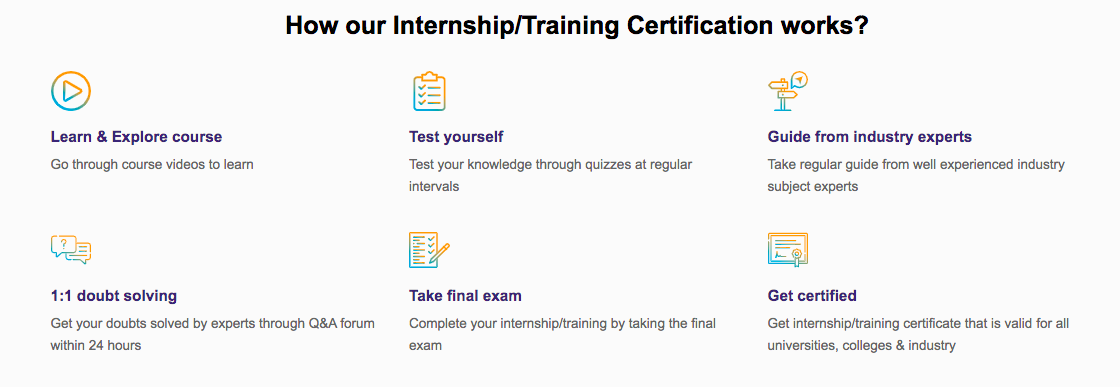
How EasyShiksha Internship/Training Program Works
Turning Course Knowledge Into Practical Skills
The most important step after completing a course is to apply the knowledge through practical work. Practical application gives students the opportunity to discover whether they can use concepts independently. It also helps them understand the challenges that are not always visible in instructional videos.
A course may demonstrate how to complete a task under ideal conditions. Real situations, however, often involve incomplete information, technical problems, time limitations, and unexpected decisions. A student who has learned data analysis may understand how to create charts but struggle when a dataset contains missing values. A learner who has studied content writing may know the structure of an article but find it difficult to write for a specific audience. Someone who has completed a programming course may understand syntax but face errors when building an independent application.
These difficulties are not signs that the course was unsuccessful. They are a natural part of moving from guided learning to independent practice. Students develop stronger skills when they attempt a task, encounter a problem, investigate possible solutions, and improve their work. This process builds confidence because the learner gradually learns how to respond when the answer is not immediately available.
Students can begin with small practical activities related to their completed course. A beginner in digital marketing might create a sample content calendar or conduct basic keyword research for an imaginary business. A student of graphic design could develop a social media poster series. A learner studying Python could build a simple calculator, expense tracker, or data visualisation project. A student interested in human resources might prepare a sample interview questionnaire or employee onboarding document.
The purpose of these activities is not to create perfect professional work immediately. The purpose is to practise decision-making, identify mistakes, and develop the ability to complete a task without following every instruction from a teacher. Over time, small activities can develop into more structured projects that demonstrate a student’s growing competence.
Building a Project That Demonstrates Understanding
A certificate can show that a student completed a learning programme, but a project can demonstrate how the student used the knowledge. This is why project-based learning is an important next step after completing an online course. A project creates an opportunity to connect concepts, make decisions, solve problems, and produce an outcome that can be reviewed.
The project should be appropriate to the student’s level. Beginners do not need to build complex systems or develop highly advanced solutions. A simple, well-executed project can be more valuable for learning than an ambitious project that is copied from an online tutorial and not fully understood. Students should choose a problem that they can investigate and attempt to solve using the concepts introduced in their course.
For instance, after completing a basic data science course, a student could analyse a small dataset related to student attendance, household expenses, or public information. The learner could clean the data, identify patterns, create visualisations, and explain the findings. After completing a web design course, a student could create a responsive website for a fictional local business or educational initiative. After studying communication, a learner could prepare a professional presentation and record a short explanation of the topic.
The project development process is as important as the final output. Students should identify the objective, decide which tools they will use, plan the work, document their progress, and review the result. If they face difficulties, they should record the problem and explain how they attempted to solve it. This documentation can help students reflect on their learning and later describe their work during interviews or internship applications.
EasyShiksha can become part of this process by helping learners discover courses and practical learning opportunities that align with their interests. Students can use a completed course as the starting point for selecting a project, exploring an internship, or identifying the next skill they want to develop. The objective is to create a clear connection between learning content and practical evidence.
Why Students Should Not Collect Certificates Without Building Evidence
Certificates can play a useful role in a student’s learning journey. They may confirm participation or completion and can help learners organise their educational achievements. However, certificates become more meaningful when they are supported by evidence of understanding and application. Collecting certificates without practising the associated skills may leave students unprepared for practical situations.
A student might list several courses on a résumé, but an interviewer may ask what the learner actually did with the knowledge. The student may be asked to explain a project, solve a basic problem, demonstrate a tool, or describe a challenge faced during practice. If the learner has only watched videos, answering these questions can be difficult.
Evidence does not always require professional employment. Students can demonstrate learning through academic projects, personal experiments, practice assignments, internships, volunteer activities, case studies, or portfolios. The type of evidence depends on the subject. A coding student may share a working application, while a marketing student may present a campaign plan. A student studying finance may show a financial analysis project, and a learner interested in design may create a portfolio of original work.
This approach encourages students to ask a more useful question after completing a course. Instead of asking only, “Which certificate should I earn next?” they can ask, “What can I create, explain, demonstrate, or improve because of this course?” The second question shifts attention from collection to development.
EasyShiksha’s focus on courses, certificates, quizzes, internships, and career-oriented learning reflects the importance of connecting educational achievement with practical growth. Students can use certificates as part of their academic or professional profile while also working towards projects and experiences that demonstrate their capabilities.
Using Quizzes to Identify Learning Gaps
Quizzes should not be treated only as a formal test that appears at the end of a course. They can become a regular tool for reviewing knowledge, identifying weaknesses, and preparing for practical application. After finishing a course, students can use quizzes to check whether they remember important concepts and can apply them to simple situations.
A learner may feel confident after watching a lesson because the explanation appears clear. However, confidence during observation does not always mean that the learner can recall the information independently. A quiz introduces a small challenge that requires the student to retrieve and use knowledge. This process can reveal areas where the student needs more revision.
For example, a student who has completed a course in computer fundamentals may understand the difference between hardware and software while watching the lessons. A quiz could ask the student to identify the role of an operating system or select the correct example of input hardware. A student studying search engine optimisation could be asked to distinguish between on-page and off-page optimisation or identify the purpose of a meta description. Such questions help learners examine whether their understanding is clear and usable.
Quizzes can also support better learning decisions. If a student performs well in basic questions but struggles with application-based questions, the learner may need more practical examples. If the student repeatedly makes mistakes in one topic, revisiting that section before progressing may be helpful. If the student demonstrates strong understanding, they may be ready for a more advanced course or project.
Through learning platforms that combine courses and quizzes, students can make self-assessment a regular part of their education. EasyShiksha can support this type of connected learning by helping students move between learning content and knowledge testing instead of treating them as separate activities.
Moving From Practice to Internship Experience
Once students have reviewed their knowledge and completed a few practical activities, they can begin exploring internships. An internship provides an opportunity to understand how skills are used in a professional environment. It may involve teamwork, communication, deadlines, feedback, task management, and real-world expectations that are difficult to reproduce through individual learning alone.
Students should not assume that they must be experts before applying for an internship. Many beginner-friendly internships are designed to help learners gain experience while developing their abilities. However, students should understand the requirements of each opportunity and apply to roles that match their current knowledge and interests. A completed course can provide a foundation, while a small project can help demonstrate motivation and basic capability.
For Kavya, the digital marketing student, the next step after her course was not immediately enrolling in another programme. She began by creating a sample campaign plan for a fictional educational website. She researched keywords, wrote sample social media captions, and prepared a basic performance report using hypothetical data. This project helped her understand the relationship between content, audience, and measurement. When she later explored internship opportunities, she had something practical to discuss.
Internships can also help students discover whether a particular career path suits their interests. A learner may enjoy studying a subject but find that professional tasks require a different combination of skills. For example, someone interested in graphic design may discover that client communication and revisions are as important as creative ability. A student interested in software development may learn that collaboration, documentation, and debugging are central parts of the work.
EasyShiksha’s internship-oriented learning opportunities can help students connect education with experience. The ideal journey is not simply course completion followed by an unrelated internship. It is a gradual process in which students use courses to build foundations, quizzes to check understanding, projects to practise, and internships to gain exposure to professional tasks.
Choosing the Next Course With a Clear Purpose
After completing a course, students often search for another course because they believe continuous enrolment automatically means continuous progress. However, the next course should be selected with a clear purpose. Students should understand what new ability they want to develop and how the course connects to their broader learning journey.
A learner who has completed an introductory Excel course might choose an advanced data analysis course if they want to work with dashboards and reporting. A student who has studied basic programming may explore a course focused on web development, data structures, or application building, depending on their interests. A beginner in digital marketing may decide to study analytics, search engine optimisation, content strategy, or advertising after practising the fundamentals.
The decision should be based on the student’s current level, interests, career exploration, and practical goals. Students can ask whether the next course will deepen existing knowledge, introduce a related skill, prepare them for an internship, or support a project they want to complete. They should also consider whether they have practised enough of the previous subject to benefit from advanced content.
Career counselling can be useful when students are uncertain about their next direction. Career choices are influenced by interests, abilities, educational background, opportunities, and changing industry requirements. A counsellor or structured career guidance resource can help students organise their questions and explore possible pathways without assuming that one decision must determine their entire future.
EasyShiksha’s broader education ecosystem, which includes courses, online degrees, career counselling, quizzes, internships, and educational discovery tools, can help learners explore the next step according to their individual goals. The focus should be on informed exploration rather than enrolling in courses without a learning objective.
Short online courses can introduce students to new subjects and practical skills, while online degree programmes can provide more structured and comprehensive academic learning. These two forms of education do not necessarily compete with one another. They can support different needs within the same learning journey.
A student may use a short course to explore a subject before deciding whether to pursue it at a deeper academic level. For example, a learner interested in business may complete introductory courses in finance, marketing, entrepreneurship, or management before exploring a relevant degree programme. Another student may pursue a degree while using short online courses to develop additional technical or professional skills.
The key is to understand the role of each learning experience. A degree may provide structured academic knowledge, assessment, and a broader subject foundation. A short course may help students gain focused knowledge or practise a specific tool. An internship may provide workplace exposure, while quizzes and projects can support revision and application. When students understand these differences, they can combine learning opportunities more purposefully.
EasyShiksha’s availability of online education and degree-related discovery can help students consider different learning formats according to their circumstances. Learners who are exploring higher education can research universities and programmes, while those seeking targeted skill development can explore relevant courses and practical learning opportunities. This creates a more flexible approach in which students do not view education as a single event that ends with graduation or course completion.
Creating a Personal Learning Record
Students should maintain a record of their learning activities so that they can understand their progress over time. A learning record may include completed courses, quiz results, projects, internship experiences, certificates, skills practised, and reflections on challenges. The purpose is not simply to create a long list of achievements. It is to develop a clear picture of what the student has learned and how that learning has been applied.
A personal learning record can help students identify patterns. They may discover that they repeatedly choose courses related to technology, communication, business, or creative work. They may notice that they enjoy practical assignments more than theoretical lessons or that they need additional support in a particular area. Such observations can help students make more informed decisions about future education.
The record can also become useful during internship and job applications. Instead of remembering achievements at the last moment, students can review their projects and explain what they learned from each experience. They can describe the tools they used, the tasks they completed, and the problems they attempted to solve. This creates a more detailed professional narrative than a list of certificates alone.
A digital education profile can make this process easier by bringing learning achievements and experiences into one connected space. As students move from school or college discovery to courses, quizzes, degrees, projects, and internships, their educational journey can become easier to review. EasyShiksha’s connected platform concept aligns with this need for a more organised and continuous learning identity.
Learning Through Educational Games and Challenges
Learning after course completion does not always have to follow a formal classroom structure. Educational games and challenges can provide additional ways to practise concepts, improve problem-solving, and maintain motivation. When designed around meaningful learning objectives, games can encourage students to experiment, make decisions, and learn from mistakes.
For example, a programming challenge may ask students to identify an error in a simple code sample. A vocabulary game can help language learners practise new words. A business simulation may require learners to make decisions about pricing, budgeting, or customer needs. A cybersecurity challenge may present a fictional scenario in which the student must identify suspicious activity.
The value of these activities lies in the opportunity to use knowledge in a different format. Students may approach a challenge with greater curiosity because it feels interactive rather than repetitive. Games can also encourage learners to continue practising after a course has ended, especially when activities are organised into levels or achievable milestones.
However, games should support learning rather than replace deeper practice. Students should connect game-based activities with real tasks, revision, and projects. An educational game can introduce a concept or strengthen recall, but learners may still need to complete a practical assignment to demonstrate independent ability.
EasyShiksha’s inclusion of games alongside courses, quizzes, internships, and other education services reflects the possibility of creating a learning environment that is both engaging and purposeful. Students can use different learning formats depending on their goals, attention, and stage of development.
Preparing for Career Conversations
One of the most useful things students can do after completing a course is practise explaining what they have learned. Career conversations often require learners to describe their interests, skills, projects, and future goals. Students who have studied a subject but never reflected on their learning may find it difficult to communicate their progress clearly.
A student should be able to explain why they chose a course, what concepts they learned, which tools they practised, and how they applied the knowledge. They should also be comfortable discussing mistakes and describing what they would improve. These conversations are not limited to job interviews. They can take place during internship applications, academic counselling sessions, networking opportunities, and discussions with mentors.
For example, instead of saying, “I completed a digital marketing course,” Kavya could explain that she studied basic keyword research, content planning, and campaign measurement. She could describe the sample campaign she developed, mention the challenges she faced, and explain which advanced skills she wants to practise next. This type of explanation demonstrates reflection and direction.
Career counselling can help students prepare for these conversations by encouraging them to understand their interests, strengths, and possible learning pathways. EasyShiksha’s career guidance features can support students as they consider how their education connects with future opportunities. The goal is not to force students into a fixed career decision but to help them develop better questions and make informed choices.
Measuring Progress Beyond Course Completion
Students need meaningful ways to measure progress after the final video. Course completion is one indicator, but it should be combined with other signs of development. A learner can consider whether they can explain the subject clearly, solve basic problems, complete a project, use relevant tools, respond to feedback, and work more independently than before.
Progress may also be visible in the quality of questions a student asks. A beginner might ask what a particular tool does, while a more experienced learner may ask which method is appropriate for a specific situation and why. Developing the ability to ask better questions indicates that the student is beginning to understand the subject more deeply.
Another measure is the ability to learn independently. Students will not always have an instructor available to guide every task. They need to know how to search for reliable information, compare possible solutions, practise unfamiliar skills, and request help when necessary. Online learning can support this independence, but students must actively participate in the process rather than depend entirely on video instruction.
Students should also measure progress through consistency. One completed course may create initial motivation, but long-term growth requires regular practice and reflection. Even short periods of revision, project work, or quiz-based testing can contribute to development when they are maintained over time.
The Role of EasyShiksha in the Next Stage of Learning
The idea that education ends with the last video is based on a limited view of learning. In reality, students need opportunities to revise, practise, test, explore, and apply knowledge. A connected digital platform can support this process by bringing different educational services into a broader learning journey.
EasyShiksha provides access to online courses, online degrees, certificates, quizzes, internships, career counselling, educational games, and tools for discovering schools, colleges, and universities. These features can be viewed as connected opportunities rather than separate services. A student may begin with a quiz to identify an interest, explore a course to develop foundational knowledge, complete practical activities to strengthen skills, and search for an internship to gain experience. Another learner may use career counselling and university discovery tools while considering an online degree or a new academic direction.
This connected approach is valuable because students often face fragmented learning experiences. They may use one platform for courses, another for quizzes, a different website for internships, and separate resources for college research. When learning activities are disconnected, students may struggle to understand how one achievement relates to the next step. A platform that brings different education-related opportunities together can help learners organise their journey more clearly.
EasyShiksha can support the transition from learning content to learning action by encouraging students to think beyond completion. The certificate can be one part of the experience, while quizzes, projects, internships, career guidance, and continued education help students build on what they have learned. The purpose is to make online education more connected to practical development and future opportunities.
Frequently Asked Questions
Q. How can I apply for an internship with EasyShiksha?
You can apply by visiting our website, browsing available internships, and following the application instructions provided.
Q. What types of internships are available through EasyShiksha?
EasyShiksha offers a wide range of internships across technology, business, marketing, healthcare, and more.
Q. Will I receive a certificate upon completing an internship?
Yes, upon successful completion, you will receive a certificate recognizing your participation and achievements.
Q. Are EasyShiksha's certificates recognized?
Yes, the certificates are recognized by universities, colleges, and employers worldwide.
Q. When can I start the course?
You can choose any course and start immediately without delay.
Q. What are the course and session timings?
These are fully online courses. You can learn at any time and pace that fits your schedule.
Q. What will happen when my course is over?
After completion, you will have lifetime access to the course for future reference.
Q. Can I download the notes and study material?
Yes, you can access and download course materials and have lifetime access for future reference.
Q. What software/tools would be needed?
All necessary software/tools will be shared during the training as needed.
Q. I’m unable to make a payment. What should I do?
Try using a different card. If the problem persists, email us at info@easyshiksha.com.
Q. Do I get the certificate in hard copy?
No, only a soft copy is provided, which can be downloaded and printed if required.
Q. The payment got deducted but shows “failed”?
The deducted amount will be returned to your account in 7-10 working days automatically.
Q. Payment successful but dashboard shows ‘Buy Now’?
Reflection may take 30 mins. If longer, email info@easyshiksha.com with your screenshot.
Q. What is the refund policy?
Refunds are available for technical issues. No refunds once a certificate is generated.
Q. Can I enroll in a single course?
Yes, select any course, complete the details, and start learning immediately.
Q. Need further help?
Contact us at info@easyshiksha.com for any other questions.
A Continuous Learning Mindset for Students
The most important change students can make after completing a course is to develop a continuous learning mindset. This does not mean that they must study every hour or enrol in new courses without a break. It means they should understand that learning develops through repeated cycles of knowledge, practice, feedback, reflection, and improvement.
Students should give themselves time to apply what they have learned before deciding what comes next. They should be willing to make mistakes and treat challenges as opportunities to improve. They should also recognise that different stages of education require different activities. Sometimes the next step is a quiz. Sometimes it is a project, internship, advanced course, degree programme, counselling session, or simple period of reflection.
Kavya eventually understood that receiving her digital marketing certificate was not the final achievement she needed. It was the foundation for her next stage. She reviewed her course, tested her understanding through quizzes, created a sample campaign, improved her work after feedback, and began exploring internships. Each step helped her develop a clearer understanding of her interests and abilities. She did not become professionally ready through one video or one certificate. She progressed through a connected process of learning and application.
The same principle applies across subjects and educational levels. A student studying technology, business, healthcare, design, communication, finance, or any other field can benefit from moving beyond passive course completion. The learner’s progress becomes more meaningful when knowledge is used, tested, discussed, improved, and connected to real goals.
Conclusion: The Last Video Is a New Starting Point
The end of an online course should not be treated as the end of a student’s learning journey. It should be viewed as a transition from guided instruction to independent application. After completing a course, students can review what they have learned, test their understanding through quizzes, practise relevant skills, build projects, explore internships, seek career guidance, and choose future learning opportunities with greater clarity.
Certificates can document achievement, but practical evidence helps demonstrate what students can actually do. Courses can introduce knowledge, but projects and internships help learners apply it. Quizzes can test understanding, while career counselling can help students reflect on possible directions. Online degrees and university discovery tools can support broader educational decisions, while games and interactive challenges can make practice more engaging.
A platform such as EasyShiksha can support this connected journey by bringing courses, online degrees, quizzes, internships, certificates, career counselling, games, and educational discovery into one digital ecosystem. Students can use these opportunities to move from learning content to practical experience and from uncertainty to informed exploration.
The final video is only the closing moment of a lesson. The real value of the course begins when students ask what they can do next, how they can use their knowledge, and which experience will help them grow. Education becomes more powerful when completion leads to action, action leads to experience, and experience leads to continuous learning.
Anshika Jain is an Engineer, Developer, and Educational Content Author known for her dedication to technology and knowledge sharing. With a strong analytical mindset and a passion for innovation, she has consistently contributed to creating meaningful digital solutions and insightful educational articles.
Her ability to simplify complex technical concepts into engaging and easy-to-understand content makes her work valuable for students and learners across various platforms. Along with her technical expertise, Anshika is admired for her creativity, professionalism, and commitment to continuous learning.
She represents a perfect blend of technical excellence and impactful communication, inspiring others through both her development work and educational contributions.