Digital education has changed how people acquire knowledge, develop professional capabilities and demonstrate their readiness for employment. Students can now learn through online courses, complete practical projects, participate in internships and earn certificates without following a traditional classroom-based pathway. These opportunities make education more flexible and accessible, particularly for learners who want to develop skills alongside their studies or employment. However, the expansion of digital learning creates a fundamental challenge: how much evidence should an educational platform require before declaring that a student has acquired a particular skill?
A learner may complete an online course, score well on a quiz or submit a successful project. Each achievement provides useful information, but none automatically proves every aspect of the competency being claimed. A quiz may demonstrate conceptual understanding without establishing practical ability. A project may show successful application under specific conditions without proving that the learner can repeat the performance independently. An internship may provide workplace exposure, but the quality of the experience and the relevance of the assigned tasks can vary significantly.
This challenge can be described as the Evidence Sufficiency Problem. It concerns the amount, quality, diversity and reliability of evidence required before a platform can responsibly certify that a learner has demonstrated a particular skill. The problem is not simply about collecting more data. It is about determining whether the available evidence is strong enough to support the claim made by the certificate.
For EasyShiksha, which connects online courses, quizzes, internships, certificates, university programmes and career guidance, this concept has important implications. A credible certification system should recognise student progress without making claims that exceed what the assessment actually proves. It should distinguish course participation from demonstrated knowledge, practical performance from independent competence and introductory capability from professional readiness.
The central question is therefore not whether students deserve certificates after completing their learning activities. It is what each certificate should represent, what evidence supports that representation and how a platform can make its decisions transparent, fair and meaningful.
What Is the Evidence Sufficiency Problem?
The Evidence Sufficiency Problem arises when an educational platform must decide whether the evidence collected from a learner is adequate to support a particular competency claim. The platform needs to establish a reasonable relationship between what the student has demonstrated and what the certificate communicates to students, educators and employers.
Consider a learner who completes an introductory web development course. The learner watches lessons, completes the final quiz and receives a certificate. The certificate may accurately confirm that the learner completed the course and passed its assessment. However, if the certificate implies that the student can independently build and maintain production-ready websites, the claim may exceed the evidence available.
The problem is not necessarily that the certificate is invalid. It may be the wording of the claim that is too broad for the assessment. Evidence sufficiency depends on the relationship between the strength of the evidence and the scope of the competency being certified.
A platform must therefore define the claim before deciding what evidence is required. Certifying that a learner understands introductory HTML concepts requires a different standard from certifying that the learner can develop an accessible, responsive website, diagnose common frontend problems and explain the implementation decisions.
The Evidence Sufficiency Problem also concerns the possibility of insufficiently diverse evidence. A learner may perform well on several nearly identical questions, but those questions may repeatedly test the same narrow aspect of knowledge. The number of observations may appear high while the actual range of demonstrated capability remains limited.
A responsible certification framework must consequently examine not only how much evidence exists, but also what that evidence demonstrates, how it was collected, which conditions influenced the performance and whether alternative explanations remain plausible.
Why More Evidence Does Not Always Mean Better Evidence
It may appear that certification decisions become more reliable when platforms collect as many assessments, scores and learning records as possible. However, evidence quantity alone does not guarantee quality. Ten repetitive quizzes may provide less meaningful information about practical competence than a well-designed project accompanied by a clear explanation of the learner's decisions.
The value of evidence depends on its relevance to the skill being assessed. If a platform wants to certify analytical reasoning, repeated questions that test memorised definitions may provide limited support. If the claim concerns practical programming ability, a theoretical examination may establish foundational understanding but fail to demonstrate implementation and debugging skills.
Evidence can also be redundant. Several assessments may use the same questions, the same underlying examples or the same scoring method. Although each assessment generates a separate result, they may all share the same weakness. If a student memorises a familiar question format, repeating that format does not necessarily establish broader competence.
The independence of evidence matters as well. A learner who completes three tasks using the same template and step-by-step guidance may not have demonstrated three independent instances of skill. The tasks may all depend on the same support structure, making it difficult to determine whether the student can apply the competency in a different situation.
For EasyShiksha, this distinction suggests that certification quality should not be measured by the number of quizzes, assignments or learning activities completed. Instead, the platform could examine whether the evidence collectively addresses the learning objectives and provides a sufficiently broad view of the claimed competency.
A smaller set of carefully designed assessments may therefore support a more credible certification decision than a large collection of repetitive activities.
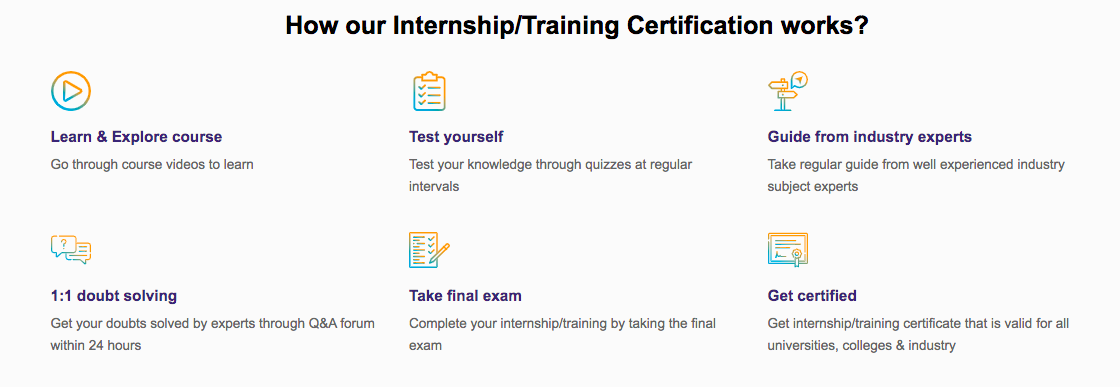
How EasyShiksha Internship/Training Program Works
Defining the Skill Before Defining the Evidence
The first step towards solving the Evidence Sufficiency Problem is to define the skill precisely. Broad labels such as digital marketing, programming, data analytics or communication can represent many different capabilities. Without a clear definition, a platform cannot determine what evidence should be sufficient.
For example, the term data analytics may refer to understanding basic statistical concepts, cleaning datasets, writing database queries, creating visualisations, interpreting trends or communicating findings to stakeholders. A learner may demonstrate one of these capabilities without possessing all the others.
A certificate that claims general proficiency in data analytics should therefore require broader evidence than a certificate confirming introductory knowledge of data analytics concepts. The certification standard must reflect the level and scope of the claim.
A practical competency definition should describe the task the learner can perform, the conditions under which the task is expected to be completed and the quality standards that determine acceptable performance. It should also identify relevant limitations. An introductory certificate might establish that the learner can perform a basic operation using guided instructions, while an advanced credential might require independent execution under less familiar conditions.
This clarity benefits both students and employers. Students understand what they need to demonstrate, while employers can interpret the certificate without assuming that it guarantees capabilities that were never assessed.
For EasyShiksha, competency definitions could form the foundation of a structured certification framework. Course learning outcomes, quizzes, practical projects and internship activities could be connected to clearly defined skills. Evidence would then be evaluated against those skills rather than against vague expectations associated with a course title.
The Different Types of Evidence Used in Skill Certification
Skill certification can draw on several types of evidence, each revealing a different aspect of learning. Conceptual evidence demonstrates whether the learner understands relevant principles and relationships. This evidence may come from quizzes, written explanations, oral responses or questions requiring students to interpret scenarios. It is particularly useful when the skill depends on foundational knowledge or theoretical understanding.
Practical evidence demonstrates whether the learner can apply knowledge to produce an outcome. Projects, coding exercises, simulations, design tasks and analytical assignments can reveal whether the student can perform the relevant activity. Practical evidence is often essential when the certificate makes claims about execution rather than knowledge alone.
Process evidence provides information about how the learner reached a result. This may include explanations of decisions, debugging steps, design reasoning, revisions or the ability to identify limitations in a solution. Process evidence can help distinguish a well-understood solution from an output produced through a procedure the learner cannot explain.
Repeated-performance evidence shows whether the student can demonstrate the competency across more than one independent task. This is important when the certification claim implies dependable performance rather than success on one occasion. Related tasks can vary in their examples, constraints or context while preserving the same core learning objective.
Finally, contextual evidence may come from supervised projects, internships or workplace simulations. Such evidence can demonstrate how a learner applies knowledge under practical conditions. However, it must be interpreted carefully because the quality of supervision, task difficulty, available resources and opportunities for independent work can influence the result.
No single evidence type is universally sufficient. The appropriate combination depends on the competency, the level of certification and the consequences of making an incorrect certification decision.
Establishing Evidence Thresholds for Different Skill Levels
One of the most important design decisions is determining whether every skill should require the same amount of evidence. A uniform standard may appear fair, but it can be inefficient and inappropriate because different competencies vary in complexity, risk and scope.
An introductory digital literacy certificate may require a short assessment demonstrating that the learner can perform a limited set of clearly defined tasks. A credential in advanced cybersecurity, financial analysis or another high-consequence area may require more extensive practical evidence because incorrect performance can have significant consequences.
A useful certification framework could establish progressive evidence thresholds. At the introductory level, the evidence may demonstrate basic understanding and guided application. At an intermediate level, it may need to establish independent performance across several related tasks. At an advanced level, it may also require problem diagnosis, adaptation to unfamiliar conditions and the ability to justify decisions.
These levels should not be interpreted as rigid universal rules. A complex introductory competency may require substantial assessment, while a narrowly defined advanced technique may be demonstrated through a focused practical task. The key principle is proportionality: the evidence standard should match the scope and consequences of the claim.
EasyShiksha could use this approach to distinguish between certificates that document course completion, credentials that recognise demonstrated knowledge and assessments that verify practical competency. These distinctions would help prevent a short introductory assessment from being interpreted as proof of broad professional expertise.
The certification framework should also communicate the evidence threshold clearly. Students should know what they need to demonstrate, how their performance will be evaluated and whether the certificate recognises participation, knowledge, practical application or a more comprehensive level of competence.
The Relationship Between Assessment Difficulty and Evidence Sufficiency
Assessment difficulty can influence how much evidence is required, but difficulty alone does not determine whether evidence is sufficient. A very difficult test may be poorly aligned with the target skill, while a relatively straightforward practical task may provide strong evidence if it directly reflects the competency being certified.
The more important consideration is whether the assessment allows the learner to demonstrate the intended capability under appropriate conditions. If a certificate claims that a student can build a responsive webpage, the assessment should require relevant implementation skills. Making the task unnecessarily complicated through unrelated technical requirements may reduce the validity of the result.
At the same time, an assessment that is too easy may fail to distinguish between basic familiarity and actual competence. If a learner can pass simply by memorising a definition or following an obvious sequence, the evidence may not support a broader practical claim.
A strong assessment balances relevance, challenge and fairness. It should be sufficiently demanding to reveal the target capability without introducing obstacles that are unrelated to the learning objective. The difficulty should also be appropriate to the certificate's level.
For EasyShiksha, this means that certification design should begin with the question of what a successful learner should be able to do. The assessment can then be designed to elicit evidence of that ability, rather than increasing the difficulty merely to make the certificate appear more prestigious.
How Multiple Independent Tasks Strengthen Certification
A single task can be affected by luck, familiarity, unexpected assistance or the particular structure of the problem. Multiple independent tasks can reduce the influence of these factors by providing additional opportunities to demonstrate the same competency.
Suppose a learner is seeking certification in spreadsheet analysis. One task may ask the student to calculate totals and create a chart from a sales dataset. A second may require identifying inconsistencies in financial records, while a third may ask the learner to interpret trends in a new dataset. If all tasks target clearly defined spreadsheet and analytical capabilities, the results can reveal whether the learner's performance extends beyond one familiar example.
The tasks should be related but not identical. If they are too similar, the student may succeed by memorising a procedure. If they are too different, they may measure separate skills and become difficult to compare. The design challenge is to introduce enough variation to test application while preserving a consistent assessment objective.
Multiple tasks also help educators interpret inconsistent performance. A learner who performs well on two tasks and poorly on a third may need additional support with a particular aspect of the competency. The platform should investigate the pattern rather than automatically treating one unsuccessful attempt as proof that the student lacks the skill.
This approach aligns with the idea of skill reproducibility. Certification becomes more credible when the evidence demonstrates that the learner can apply the same underlying capability across independent opportunities, rather than simply producing one successful result.
Understanding False Positives and False Negatives in Certification
Certification systems can make two broad types of mistakes. A false positive occurs when a platform certifies a learner even though the available evidence does not adequately support the claimed competency. A false negative occurs when a learner who possesses the required skill fails to receive certification because the assessment does not capture the capability accurately.
False positives can weaken trust in digital credentials. If certificates consistently overstate what students can do, employers may become reluctant to recognise them. Students may also enter advanced programmes or internships without the preparation they need.
False negatives create a different problem. A capable learner may fail because the assessment uses an unfamiliar interface, imposes unnecessary time pressure or depends heavily on language skills that are not part of the target competency. Technical failures or poorly written questions can also produce inaccurate results.
The appropriate balance depends on the purpose of the certificate. A narrowly defined introductory credential may accept a different level of evidence than a credential used to support high-stakes professional decisions. However, both should use assessments that are relevant, transparent and reasonably reliable.
Platforms should also provide a fair process for reassessment or review when results are disputed or technical problems occur. A student should not be permanently denied recognition because of a single unreliable assessment.
For EasyShiksha, the objective should be to reduce both kinds of errors. Certification standards should be strong enough to support meaningful claims while allowing genuine learners a fair opportunity to demonstrate their abilities.
Using AI to Evaluate Evidence Sufficiency
Artificial intelligence could help educational platforms manage the complexity of evidence-based certification. AI systems may assist in generating task variations, mapping assessment items to learning objectives, identifying recurring errors and organising evidence from quizzes and practical assignments.
For example, a platform could use AI to identify whether a learner's assessment record contains evidence of the main competencies covered by a course. It might highlight that the student has demonstrated conceptual understanding but has not yet completed a practical task. The system could then recommend an appropriate assessment instead of treating the missing evidence as proof of failure.
AI could also help identify inconsistencies in scoring. If similar responses receive substantially different evaluations, the system could flag the cases for human review. When a student completes several projects, AI may help organise evidence of the competencies demonstrated, provided the underlying evaluation criteria are clear and the results are checked appropriately.
However, AI should not independently decide that a student has mastered a complex skill merely because a collection of scores appears sufficient. Automated systems may misinterpret explanations, overlook valid alternative solutions or reproduce biases present in training data and evaluation methods.
Evidence sufficiency is ultimately a question of whether the certification claim is justified. AI can support the analysis, but the framework must still define the skill, establish the required evidence and provide a way to review uncertain decisions.
EasyShiksha could use AI as a decision-support layer that helps educators identify gaps and recommend assessments. High-stakes certification decisions should include appropriate validation, transparency and human oversight, especially when results may influence educational progression or employment opportunities.
Connecting Evidence Sufficiency With EasyShiksha Courses and Quizzes
Online courses and quizzes provide a natural starting point for an evidence-based certification framework. Courses introduce knowledge and develop understanding, while quizzes can check whether students have grasped the concepts. However, the relationship between learning content and certification criteria should be explicit.
Each course should identify the competencies that the student is expected to develop. Assessment questions can then be mapped to those competencies so that educators can see which learning objectives have been evaluated and which remain untested.
A course on introductory programming, for example, might teach variables, conditions, loops and functions. A quiz can evaluate conceptual understanding, but practical tasks may be needed to establish whether the student can combine these concepts to solve a problem. If the certificate claims only that the student completed the course and passed its assessment, the quiz may be adequate. If it claims that the learner can independently implement basic programming solutions, practical evidence is likely to be necessary.
EasyShiksha could use this distinction to make certification outcomes clearer. Course completion, knowledge assessment and demonstrated practical skill could be represented as different achievements rather than being treated as equivalent.
The approach would also support more useful feedback. A learner who understands the concepts but struggles with implementation could receive targeted practice. A student who completes practical tasks but cannot explain key decisions might need to strengthen conceptual understanding. Certification decisions could then reflect the actual evidence collected rather than relying on a single overall score.
Extending Certification Evidence to Projects and Internships
Projects provide opportunities to assess whether students can combine multiple skills to produce a meaningful result. They are particularly valuable when a certificate claims practical competence because they require learners to interpret requirements, make decisions and apply knowledge.
However, project evidence must be evaluated in context. A polished project may have been created with extensive assistance, while a simpler project may demonstrate substantial independent reasoning. The final output alone may not reveal the learner's contribution or level of understanding.
A stronger project assessment can include an explanation of the student's decisions, a short modification task or a review of how the learner responded to a changed requirement. These additional observations can help establish whether the student understands the work and can adapt it beyond the original conditions.
Internships can provide another layer of evidence by exposing learners to practical tasks, deadlines and workplace expectations. Yet internship participation alone should not automatically establish professional competence. The relevance of the assigned work, the quality of supervision and the degree of independent responsibility all influence what can reasonably be inferred.
For EasyShiksha, projects and internships could complement course-based assessments when a certificate makes broader claims about applied skills. A learner might first demonstrate foundational knowledge, then complete an independent project and subsequently gain supervised practical experience. Each stage would contribute distinct evidence, allowing the platform to communicate progress without overstating the meaning of any single achievement.
Creating Transparent and Verifiable Certification Records
Evidence becomes more useful when the certification record explains what was assessed and how the decision was reached. A certificate that contains only a course title and a learner's name may confirm an achievement, but it provides limited information about the competency demonstrated.
A more informative digital record could describe the specific learning outcomes, the assessment methods used, the conditions under which the learner performed and the level of competency the evidence supports. It could also indicate whether the credential recognises course completion, conceptual knowledge, practical application or a broader set of demonstrated capabilities.
Such records should remain understandable. Employers and students should not need to interpret complicated technical metrics to determine what a certificate means. Clear descriptions of competencies and assessment conditions can be more valuable than an unexplained score.
Verifiability is also important. Digital credentials may use secure identifiers or digital signatures to help confirm that a certificate was issued by the relevant platform and has not been altered. However, verifying that a certificate is authentic is different from verifying that the underlying competency claim is justified. Both dimensions matter, and one should not be mistaken for the other.
EasyShiksha could strengthen the value of its credentials by connecting certificates with clearly defined learning outcomes and appropriate supporting evidence. Students would be better able to communicate their capabilities, while employers could evaluate the claims without assuming that every certificate represents the same depth of assessment.
Privacy, Consent and Responsible Use of Learning Evidence
An evidence-based certification system may collect quiz results, project submissions, assessment records and internship feedback. These records can support more accurate decisions, but they also create responsibilities around privacy, access and data retention.
Students should understand what information is collected, how it contributes to certification and who may access it. The platform should avoid collecting additional information simply because it is technically possible. Evidence should be relevant to the competency and proportionate to the purpose of the assessment.
Sharing detailed learning records with employers or external institutions should require appropriate safeguards and, where applicable, the learner's consent. A student should not lose control over unrelated personal information simply because they want to verify a certificate.
Platforms must also avoid treating incomplete records as evidence of poor ability. A student may have demonstrated a skill through an experience that the platform has not recorded. Certification systems should communicate the limits of their evidence rather than imply that the absence of a record proves the absence of competence.
Responsible evidence management is therefore part of certification quality. A trustworthy system should not only make accurate decisions but also protect the learners whose performance it evaluates.
Empower your team. Lead the industry
Get a subscription to a library of online courses and digital learning tools for your organization with
EasyShiksha
Building a Practical Evidence Sufficiency Framework
A practical framework begins by defining the certification claim in precise terms. The platform identifies the competency, its expected level and the conditions under which the learner should be able to perform. It then determines which forms of evidence can directly demonstrate that capability.
The next stage is assessment design. Tasks should be aligned with the competency, sufficiently varied to avoid excessive dependence on memorised examples and appropriate to the learner's level. Scoring criteria should be clear, and valid alternative approaches should be recognised where relevant.
The platform then evaluates the quality and coverage of the evidence. It considers whether the learner has demonstrated the required knowledge and performance, whether important parts of the competency remain untested and whether the evidence comes from sufficiently independent observations. A missing component should trigger an appropriate follow-up assessment rather than an automatic assumption that the learner lacks ability.
Finally, the certification decision should be communicated transparently. If the evidence supports the claim, the platform can issue the credential with a clear description of what has been demonstrated. If the evidence is incomplete, the student should receive specific guidance about what remains to be assessed and how to prepare.
This framework should be reviewed over time. Platforms can compare assessment outcomes with subsequent project performance, internship feedback or other relevant evidence to determine whether their certification standards are producing meaningful results. If a credential repeatedly overestimates or underestimates competence, its assessment design may need revision.
For EasyShiksha, this would turn certification from a simple final step into a structured process that connects learning outcomes, assessment evidence and practical capability.
Conclusion: Certifying Skills With Evidence, Not Assumptions
The Evidence Sufficiency Problem highlights a fundamental challenge in digital education: deciding how much proof is enough to justify a skill certificate. The answer cannot be determined by the number of completed lessons, the volume of assessment data or a universal requirement that every learner complete the same number of tasks. It depends on the skill being certified, the breadth of the claim, the quality of the evidence and the consequences of an inaccurate decision.
A credible certification system defines its claims precisely, uses assessments that genuinely measure the intended competency and gathers evidence that is sufficiently relevant and reliable. Quizzes can demonstrate conceptual understanding, practical tasks can show application, repeated independent assessments can establish consistency and internships can provide contextual evidence of workplace performance. These sources should be combined according to the needs of the skill rather than treated as interchangeable.
For EasyShiksha, the Evidence Sufficiency Problem offers an opportunity to connect online courses, quizzes, projects, internships, certificates and career guidance through a transparent, evidence-based model. Students could receive recognition that accurately reflects what they have demonstrated, while educators and employers could better understand the meaning and limitations of each credential.
Ultimately, the goal is not to make certification unnecessarily difficult or to demand endless proof from learners. It is to require enough appropriate evidence to make a defensible claim. When a platform certifies a skill, it should be able to explain what the learner demonstrated, how the evidence supports the decision and what the certificate does not claim to prove. That clarity is essential for building trust in digital education and ensuring that certificates represent meaningful achievements rather than assumptions about competence.
Anshika Jain is an Engineer, Developer, and Educational Content Author known for her dedication to technology and knowledge sharing. With a strong analytical mindset and a passion for innovation, she has consistently contributed to creating meaningful digital solutions and insightful educational articles.
Her ability to simplify complex technical concepts into engaging and easy-to-understand content makes her work valuable for students and learners across various platforms. Along with her technical expertise, Anshika is admired for her creativity, professionalism, and commitment to continuous learning.
She represents a perfect blend of technical excellence and impactful communication, inspiring others through both her development work and educational contributions.